Monthly Archives: May 2026

The Operational Decision Platform: Palantir, Databricks, Snowflake, and Microsoft Fabric

Closing the Gap Between Data, Insight, and Action. Palantir, Databricks, Snowflake, and now Microsoft Fabric are often compared as if they solve the same problem. They don’t. Most organisations already have the first three layers of the modern data stack in place. And yet, despite significant investment, decision execution remains slow, manual, and inconsistent. Snowflake excels in scalable analytics and data warehousing, Databricks focuses on data engineering and AI model development, while Palantir enables operational decision execution through integrated workflows. Understanding their distinctions and how they complement each other is key to designing effective, modern data architectures.

Continue reading

The Gap Between Reality and Reporting: A Model of True Cyber Exposure in the UK

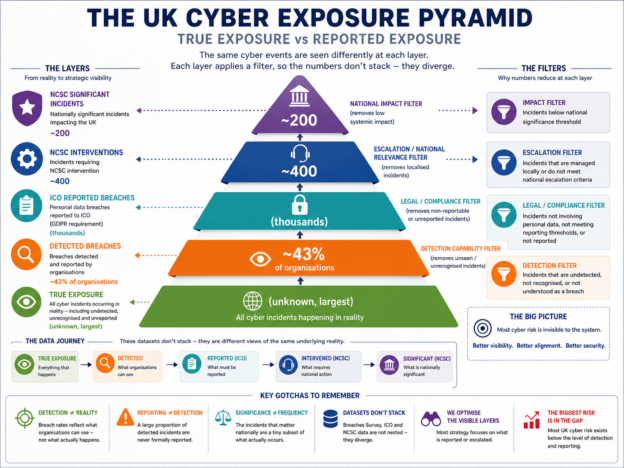
The UK’s cyber security data does not describe a single reality; it describes three filtered views of it. By overlaying Breaches Survey, ICO, and NCSC data, a clearer model emerges: one of layered visibility, not layered severity. This article introduces a “true exposure vs reported exposure” framework, showing that most cyber risk sits below what is detected, reported, or acted on, and that the current strategy is focused on the wrong layer.

Continue reading

A Decade of the UK Cyber Security Breaches Survey: Trends, Plateaus, and What Actually Changed

The UK Cyber Security Breaches Survey, viewed over time, reveals not progress but stabilisation. Breach rates remain persistently high, attack methods largely unchanged, and improvements in governance lag behind rising exposure. The data shows a system that has normalised insecurity, where awareness has increased, but action has not kept pace, resulting in a steady-state of widespread, structurally embedded cyber risk.

Continue reading

The UK Cyber Security Breaches Survey 2025/26: Stagnation, Scale, and the Illusion of Progress

The UK Cyber Security Breaches Survey 2025/26 suggests stability, but closer analysis reveals a system stuck in place rather than improving. Breaches remain widespread, detection uneven, and incentives misaligned. What looks like progress is often an artefact of measurement. This article argues the UK has reached a cybersecurity plateau, where risk is normalised, resilience is incomplete, and meaningful change will require structural, not incremental, intervention.

Continue reading

When Autism Doesn’t Work: The Human Cost of the Question of Usefulness

Part 6 of a seven-part series exploring how neurodivergent minds are understood through the lens of usefulness. The previous articles examined this question from historical, economic, diagnostic, and structural perspectives. This article takes a different approach. It describes what that dynamic feels like from the inside when it does not work.

Continue reading

The Age-Gated Internet Revisited: Identity, Trust and the Architecture of Control

This article responds to thirty-two questions posed in response to my earlier piece, “The Age-Gated Internet: Child Safety, Identity Infrastructure, and the Not So Quiet Re-Architecting of the Web”, where I explored how age verification and identity systems are beginning to reshape the internet. It examines the assumptions behind these developments and situates them within a broader architectural shift.

Continue reading

CYBERUK 2026: From Policy to Practice and the System Inbetween

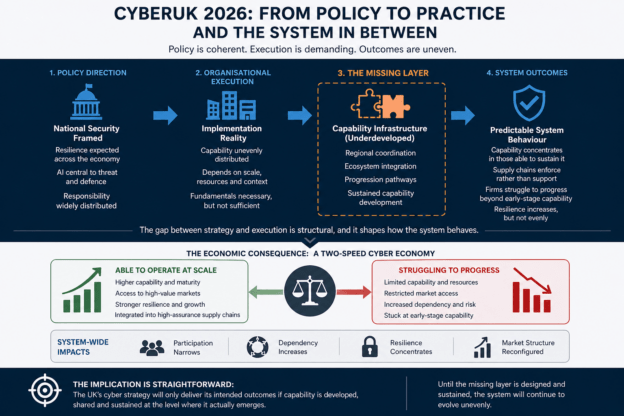
CYBERUK 2026 signals a shift from building a cyber ecosystem to operating a national cyber system. Across a series of analyses, a consistent pattern emerges: policy is coherent, execution is demanding, and outcomes are uneven. This article draws those strands together to show that the gap between strategy and delivery is not incidental; it is structural, and it defines how the system behaves.

Continue reading

CYBERUK 2026: The Missing Layer Between Strategy and Execution is Regional Capability Infrastructure

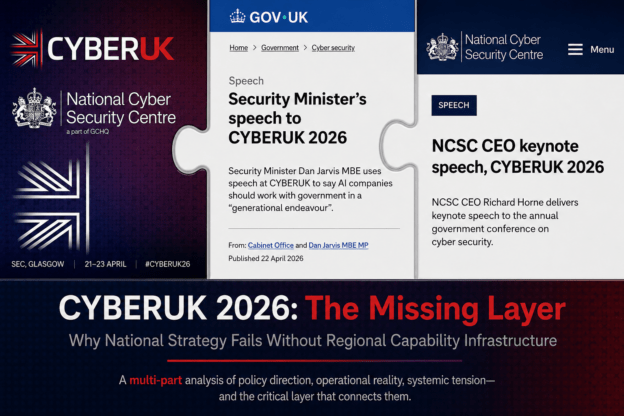
CYBERUK 2026 defines a clear national cyber strategy, but leaves a critical gap between ambition and execution. This article identifies the “missing layer”: the regional capability infrastructure required to translate policy into scalable organisational resilience. Without it, capability remains uneven, SMEs struggle to progress, and the system evolves by default rather than design, undermining the goal of distributed national resilience.

Continue reading