Monthly Archives: February 2026

Advances in Nature‑Inspired Cyber Security and Resilience Reviewed: Ambitious But Largely Speculative

The book Advances in Nature-Inspired Cyber Security and Resilience is an ambitious but largely speculative collection of academic experiments trying to borrow concepts from biology for cybersecurity. While the underlying resilience principles (adaptivity, diversity, redundancy) are sound, the research remains mostly theoretical and poorly translated to operational use. The algorithms look good in simulation but fail in real environments with real constraints. It’s more a showcase of potential than a set of deployable solutions. Insightful, yes, but still speculative: interesting to read, not ready to run.

Continue reading

Remembering Kim Cameron: The Man Who Changed Identity

Kim Cameron reshaped how we think about digital identity, placing the individual, not the platform, at the centre of control, consent, and privacy. From the Seven Laws of Identity to user-centric architectures like CardSpace, his influence continues to shape modern debates on decentralised identity, data ownership, and autonomy. This article reflects on his legacy, his humanity, and why his vision matters more than ever.

Continue reading

Nature-Inspired Cyber Security and Resiliency Reviewed: Fundamentals, Techniques and Applications

A grounded, unromantic review of Nature-Inspired Cyber Security and Resiliency (IET, 2020). The book argues that we can borrow defence principles from biology (immune systems, swarms, self-healing) to build adaptive digital security. The idea is clever but mostly speculative. The theory works on paper; the engineering doesn’t. Nature may be elegant, but enterprise networks aren’t petri dishes. Useful metaphors, immature mechanisms: an interesting academic exercise, not an operational blueprint.

Continue reading

Cyberbiosecurity in the New Normal Reviewed: Governance First, Apocalypse Later

Fouad’s “Cyberbiosecurity in the New Normal” attempts to elevate the digitisation of biology into a matter of international security. She is right that biology is now deeply digital and that this creates new attack surfaces. Where the article overreaches is in treating these risks as exceptional, geopolitically novel, or strategically transformative in themselves. Most cyberbio risks today are not exotic or unprecedented; they are familiar engineering and governance failures appearing in a new domain. The danger is less hacked DNA than over-securitised data.

Continue reading

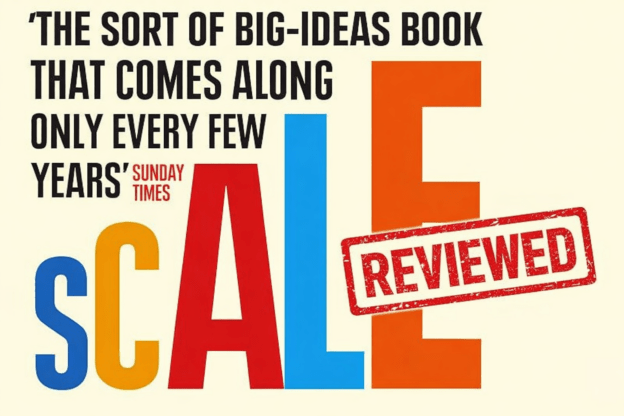
Scale by Geoffrey West Reviewed: Where Physics Meets Hubris

Geoffrey West’s Scale seeks universal mathematical laws of growth across biology, cities, and corporations. It’s bold, partly right, and mostly over-extended. The biological physics hold up; the social analogies don’t. Useful for thinking about efficiency, fragility, and systemic limits; but best treated as heuristic, not law.

Continue reading

The Death of the Commons and the Piss-Taking Wannabee Founders

A wave of performative, over-leveraged start-ups is degrading the shared trust that underpins venture capital. By making absurd nine-figure asks on the back of debt and bravado, showboating founders extract attention while imposing costs on everyone else. The result is harsher funding conditions, deeper scepticism, and the steady erosion of the start-up ecosystem as a commons.

Continue reading

CRTFs Move From Concept to Reality… But the Hard Questions Begin Now

Cyber Resilience Test Facilities (CRTFs) have now moved from concept into operational reality, with the first product assessments completed and reports issued. This milestone confirms CRTFs as a risk-based assurance mechanism rather than a pass/fail certification scheme. Yet major challenges remain: governance, market interpretation, high-assurance integration with UK Telecoms Lab (UKTL), and international alignment. CRTFs are real, but adoption must stay meaningful.

Continue reading

When Adoption Becomes The Goal, Risk Becomes Invisible By Design

This article examines how AI risk is obscured when organisations prioritise adoption over governance. Drawing on real-world examples, it argues that widespread AI usage is already endemic; but largely shallow, uncontrolled, and poorly understood. In regulated environments, optimising for uptake before addressing data lifecycle, verification, leakage, and accountability is not innovation, but a dangerous substitution of metrics for responsibility.

Continue reading

Unable To Load Conversation: Why ChatGPT Is Not Infrastructure

A case study in how “AI support” fails the moment it actually matters. This article documents the loss of a critical ChatGPT workspace conversation through backend failure, followed by a support process that denied reality, looped incompetently, and ultimately could not accept its own diagnostic evidence. It exposes systemic fragility, misplaced corporate faith in “Copilot”, and why treating LLMs as reliable infrastructure, especially in regulated environments, is reckless.

Continue reading

What Does It Take to Deliver? A Terrible Will

“Rise” by Public Image Ltd is not a song about hope or release. It is a manual for forward motion under pressure. Angular, repetitive, and unrelenting, it treats anger as usable energy rather than emotion. This track pairs with work done without validation, when opposition provides structure and refusal becomes propulsion.

Continue reading