Tag Archives: engineering

Advances in Nature‑Inspired Cyber Security and Resilience Reviewed: Ambitious But Largely Speculative

The book Advances in Nature-Inspired Cyber Security and Resilience is an ambitious but largely speculative collection of academic experiments trying to borrow concepts from biology for cybersecurity. While the underlying resilience principles (adaptivity, diversity, redundancy) are sound, the research remains mostly theoretical and poorly translated to operational use. The algorithms look good in simulation but fail in real environments with real constraints. It’s more a showcase of potential than a set of deployable solutions. Insightful, yes, but still speculative: interesting to read, not ready to run.

Continue reading

Nature-Inspired Cyber Security and Resiliency Reviewed: Fundamentals, Techniques and Applications

A grounded, unromantic review of Nature-Inspired Cyber Security and Resiliency (IET, 2020). The book argues that we can borrow defence principles from biology (immune systems, swarms, self-healing) to build adaptive digital security. The idea is clever but mostly speculative. The theory works on paper; the engineering doesn’t. Nature may be elegant, but enterprise networks aren’t petri dishes. Useful metaphors, immature mechanisms: an interesting academic exercise, not an operational blueprint.

Continue reading

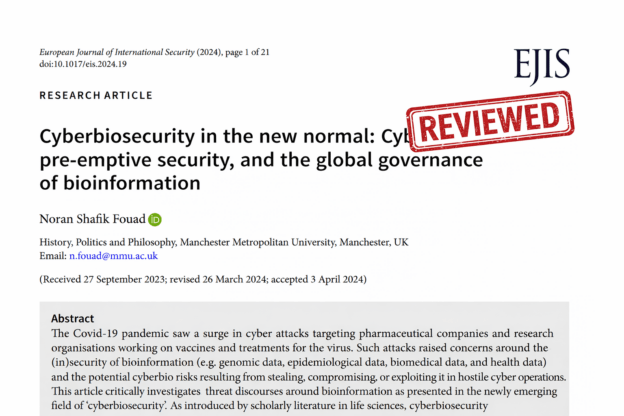
Cyberbiosecurity in the New Normal Reviewed: Governance First, Apocalypse Later

Fouad’s “Cyberbiosecurity in the New Normal” attempts to elevate the digitisation of biology into a matter of international security. She is right that biology is now deeply digital and that this creates new attack surfaces. Where the article overreaches is in treating these risks as exceptional, geopolitically novel, or strategically transformative in themselves. Most cyberbio risks today are not exotic or unprecedented; they are familiar engineering and governance failures appearing in a new domain. The danger is less hacked DNA than over-securitised data.

Continue reading

The Industrial Revolution: Quantification Meets Engineering

The Industrial Revolution, spanning the late 18th and 19th centuries, marked a seismic shift in human history. This period of rapid technological advancement, urbanization, and industrialization brought with it both opportunities and unprecedented challenges. As societies grappled with the complexity of large-scale infrastructure projects, mechanized production, and financial markets, the quantification of risk became an essential tool for decision-making. This essay explores how the Industrial Revolution catalyzed the integration of probability, statistics, and engineering into risk assessment, laying the groundwork for modern practices in safety, reliability, and financial risk management.

Continue reading

DBERR’s views on the future growth of the UK economy ‘New Industry, New Jobs’

Are you concerned about the state of the UK economy in the future, because I know I am, so I’ll be exploring some of the issues being faced by the UK economy, especially when it comes to science, technology, engineering and industry contributions to the UK’s GDP in my next few articles. …..

Links for this article:

]]>