Tag Archives: Cyber Governance

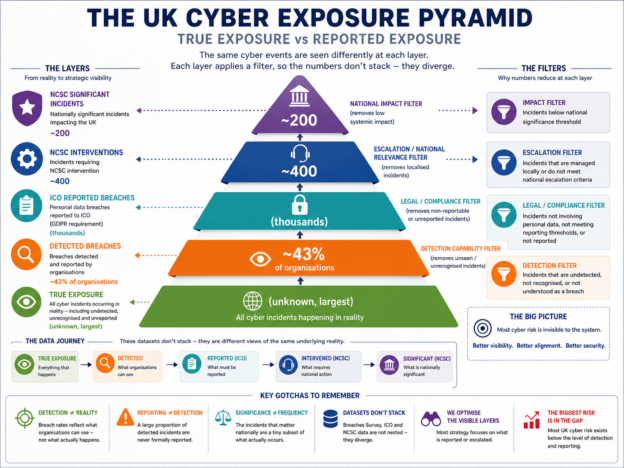
The Gap Between Reality and Reporting: A Model of True Cyber Exposure in the UK

The UK’s cyber security data does not describe a single reality; it describes three filtered views of it. By overlaying Breaches Survey, ICO, and NCSC data, a clearer model emerges: one of layered visibility, not layered severity. This article introduces a “true exposure vs reported exposure” framework, showing that most cyber risk sits below what is detected, reported, or acted on, and that the current strategy is focused on the wrong layer.

Continue reading

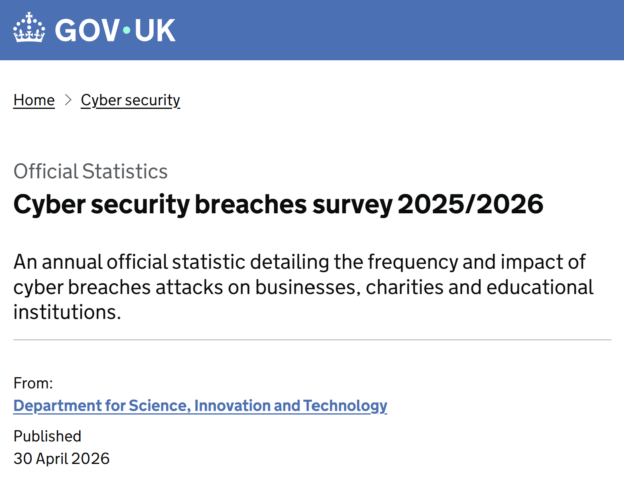
The UK Cyber Security Breaches Survey 2025/26: Stagnation, Scale, and the Illusion of Progress

The UK Cyber Security Breaches Survey 2025/26 suggests stability, but closer analysis reveals a system stuck in place rather than improving. Breaches remain widespread, detection uneven, and incentives misaligned. What looks like progress is often an artefact of measurement. This article argues the UK has reached a cybersecurity plateau, where risk is normalised, resilience is incomplete, and meaningful change will require structural, not incremental, intervention.

Continue reading

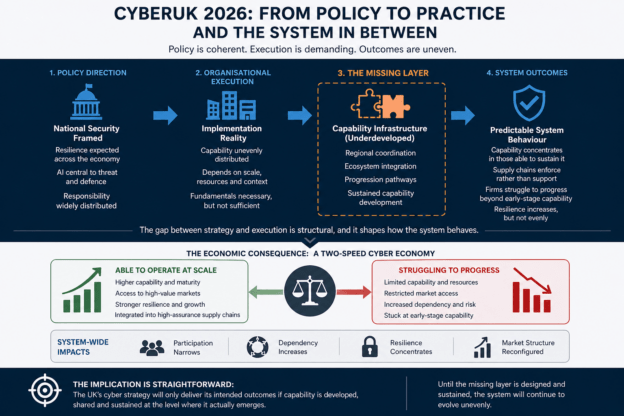
CYBERUK 2026: From Policy to Practice and the System Inbetween

CYBERUK 2026 signals a shift from building a cyber ecosystem to operating a national cyber system. Across a series of analyses, a consistent pattern emerges: policy is coherent, execution is demanding, and outcomes are uneven. This article draws those strands together to show that the gap between strategy and delivery is not incidental; it is structural, and it defines how the system behaves.

Continue reading

CYBERUK 2026: The Missing Layer Between Strategy and Execution is Regional Capability Infrastructure

CYBERUK 2026 defines a clear national cyber strategy, but leaves a critical gap between ambition and execution. This article identifies the “missing layer”: the regional capability infrastructure required to translate policy into scalable organisational resilience. Without it, capability remains uneven, SMEs struggle to progress, and the system evolves by default rather than design, undermining the goal of distributed national resilience.

Continue reading

CYBERUK 2026: From Policy Ecosystem to Operational Doctrine

The UK’s Security Minister, Dan Jarvis MBE’s CYBERUK 2026 speech, signals a shift from building a cyber ecosystem to actively operating a national cyber system. It elevates baseline security expectations, embeds supply chain enforcement, and positions AI as central to defence. However, this transition risks concentrating market power, potentially excluding SMEs while increasing dependence on a small number of large firms and frontier AI providers.

Continue reading

No Cyber Idea: Why I Built Cyber Tzar (and Why I Don’t Buy the Consulting Model)

Cyber risk has become an exercise in interpretation rather than reduction. The industry has over-optimised for modelling, scoring, and explaining exposure, often driven by consulting-led approaches that rely heavily on subjectivity and narrative. This piece argues that the real problem is upstream: data acquisition, normalisation, and comparability. Cyber Tzar was built to industrialise that problem, collapsing the time between discovery and action, and shifting organisations away from “bean counting” risk towards actually reducing it. The distinction is simple: attackers exploit exposure, not models.

Continue reading

The UK Cyber Security and Resilience Bill 2025: What It Means and Why It Matters

The UK Cyber Security and Resilience Bill 2025 represents a major shift from sector-based cyber regulation to a broader national resilience framework. By expanding the NIS regime to data centres, managed service providers and critical suppliers, strengthening incident reporting, and introducing strategic governance and national security powers, the Bill closes long-standing gaps but raises challenges around proportionality, skills, regional delivery and SME impact.

Continue reading

When It Comes To Cyber The Midlands Defence Blueprint Is Polite Fiction

The Midlands Defence & Security Blueprint presents itself as decisive and strategic, but in reality it repeats the same structural failures that undermined Midlands Engine. Cyber remains subordinated, underfunded, and ownerless, while coordination is mistaken for delivery. Written from the perspective of a practitioner who has built cyber capability on the ground, this article argues that resilience will not come from another blueprint, but from funded authority, real centres, and delivery.

Continue reading

The Rise of AI–Cyber Policy Convergence: Who’s Leading the Discussion?

AI and cybersecurity are no longer separate conversations. In the UK, they’re becoming one strategic priority, with new leaders, risks, and regulatory battles emerging fast. Until recently, AI and cybersecurity lived in different corners of policy and funding. But that era is over. From deepfake fraud and LLM jailbreaks to AI-assisted vulnerability discovery, the UK now faces a landscape where cyber threats and AI systems are not just overlapping; they are entangled. And the convergence is reshaping national security strategies, tech standards, and regulatory structures. This article explores the organisations, thinkers, and working groups shaping the AI–cyber policy crossover in the UK, and how startups, researchers, and advisors can influence what comes next.

Continue reading

The NCSC Annual Review 2025: Between Capability and Stasis

The article examines the NCSC Annual Review 2025 as both a testament to accomplishment and a warning. It praises the NCSC’s technical competence but questions its identity: regulator, delivery agency, or state-backed market player? It highlights contradictions — DSIT hailing it as “the jewel in the crown” while eroding its remit, diluting CyberFirst into TechFirst, ending its startup work, and overstating the benefits of Cyber Essentials. The piece concludes that the NCSC is overextended and under-defined, needing clarity of purpose more than new initiatives — less performance, more direction.

Continue reading

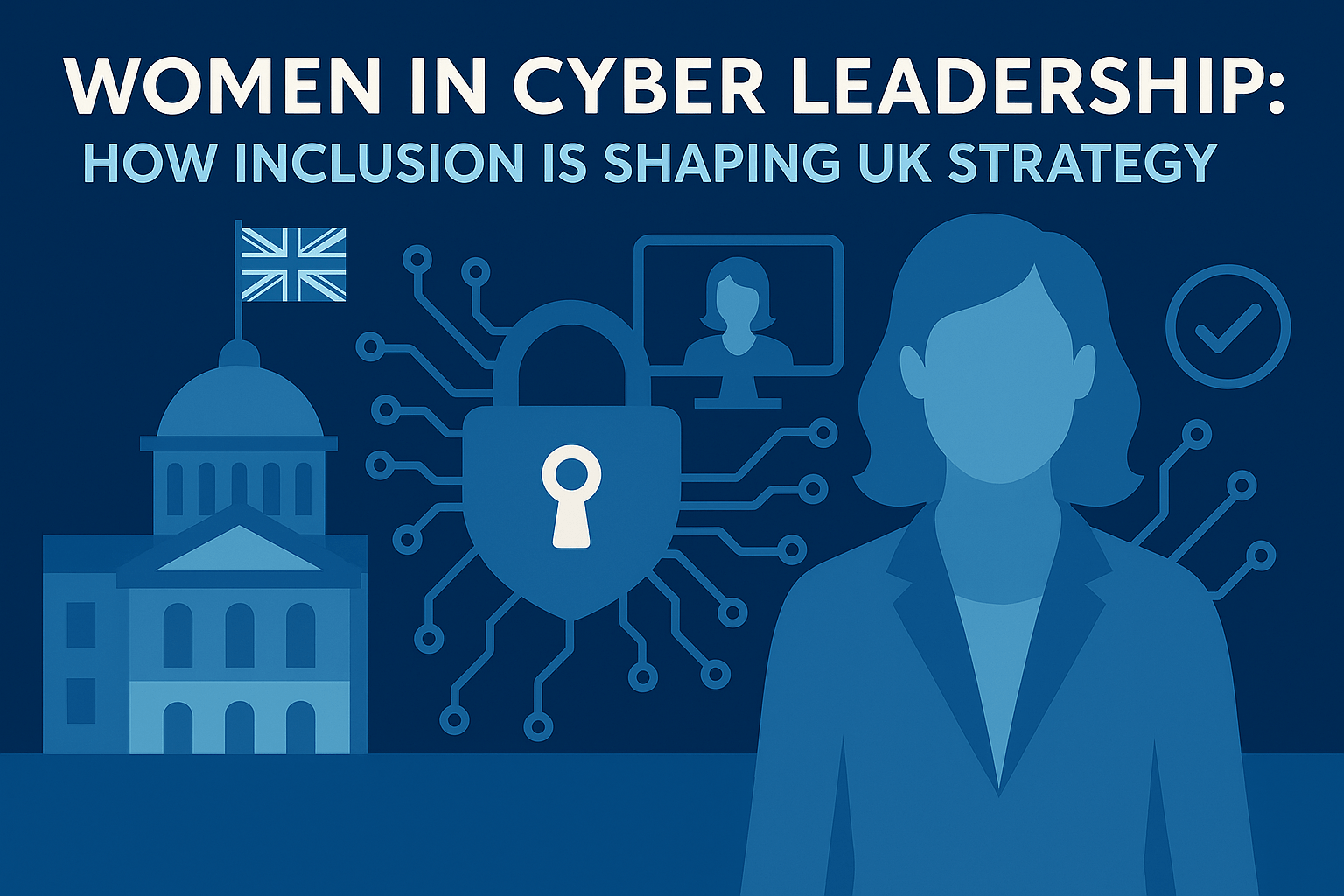
Women in Cyber Leadership: How Inclusion is Shaping UK Strategy

From boardrooms to government panels, women in cybersecurity are now shaping the UK’s strategic direction, not just participating in it. For years, the conversation about women in cybersecurity focused on “getting a foot in the door.” Today, it’s about who’s in the room when national decisions are made, and increasingly, women are leading those conversations. Inclusion is no longer a side project. In the UK, it’s becoming a strategic imperative, with policy, funding, and procurement now reflecting gender equity, diverse leadership, and lived experience as core components of resilience, innovation, and national capability. This article maps how women in cyber leadership are influencing strategy at every level, from community hubs and boardrooms to national working groups and international policy circles.

Continue reading

Resilience by Design: How UK Think Tanks and Standards Bodies Shape Security-by-Default

Secure by default isn’t just a buzzword; it’s becoming the blueprint for how Britain builds its digital infrastructure. In a world of escalating cyber risk, the UK is shifting from reactive defences to resilience by design, embedding security principles from the earliest stages of product development, system architecture, and national infrastructure planning. This shift isn’t being driven by legislation alone. It’s being shaped by a constellation of think tanks, technical standards bodies, and influential advisors who guide how resilience is defined, measured, and built into UK systems from day one. This article unpacks who’s influencing the secure-by-default movement in Britain, and how vendors, policymakers, and professionals can engage.

Continue reading

Winning Influence Without a Badge: Non-Traditional Routes Into UK Cyber Leadership

You don’t need a government role or a corporate title to shape the future of cybersecurity in the UK. In the UK cyber ecosystem, influence isn’t just about where you work, it’s about what you contribute, who you connect, and how you show up. While traditional routes like senior roles in government, Big Four consultancies, or defence primes still hold sway, an increasing number of leaders, convenors, and policy-shapers are rising through non-traditional paths. This article explores how founders, freelancers, academics, and community builders are gaining real influence without formal badges, and how you can do the same.

Continue reading

Breaking Into the Defence & Critical Infrastructure Cyber Supply Chain

Security clearances. Procurement portals. Legacy gatekeepers. Here’s how cyber vendors and professionals gain access to the UK’s most protected sectors. Selling into the UK’s defence, energy, transport, and national infrastructure sectors is not like selling into commercial enterprises. The barriers to entry are higher, the procurement cycles are longer, but the opportunities are vast and durable. Whether you’re a startup with a novel capability or a professional looking to work in high-trust environments, this guide explains how to navigate the real routes into defence and critical national infrastructure (CNI) supply chains.

Continue reading

UK Cyber at a Crossroads: Three Essays on Policy, Practice, and Growth, in Reaction to the 2025 Cyber Growth Action Plan

The UK’s cyber policy has made progress but suffers from churn, overlap, and regional imbalance. The 2025 Cyber Policy sets out ambition but lacks continuity and practitioner voice. This three-part series traces the history, critiques the new policy, and argues for a practitioner-led, regionally balanced ecosystem to stabilise the base finally.

Continue reading

Reviewing the 2025 UK Cyber Growth Action Plan: Promise, Blind Spots, and the Challenge of Continuity

This article, written in reaction to the DSIT Cyber Growth Action Plan 2025, reviews and critiques the government’s new approach. It recognises what the policy gets right — framing resilience as growth, creating safe havens, and calling for a one-team response — but also highlights what is missing: metrics, continuity, practitioner voice, and regional balance. Without these, the new policy risks becoming rhetoric rather than a platform for real progress. Unless the UK moves decisively from aspiration to delivery, the 2025 Cyber Growth Action Plan will join its predecessors as another missed opportunity.

Continue reading

How to Join a Government Working Group (Without Being a Civil Servant)

Yes, you can shape UK cyber policy, even from the outside. Here’s how people get in. Government working groups in the UK might seem closed-off, formal rooms filled with civil servants, consultants, and institutional insiders. But increasingly, government departments are seeking outside voices: founders, engineers, researchers, and community leaders who bring real-world experience. Whether you’re trying to influence cyber skills policy, secure-by-design standards, or public-sector procurement, joining the right working group can amplify your voice and build visibility for your organisation or sector. This article breaks down how non-civil servants are contributing to cyber and tech policy via working groups, what types exist, and how you can get involved.

Continue reading

From Startups to Scaleups: The UK’s Cyber Commercialisation Ladder, Explained

How Britain takes a cyber idea from academic paper to procurement-ready product, and who’s involved at each step. The UK has quietly built one of the world’s most interconnected cyber innovation ecosystems, a ladder of support that helps researchers, entrepreneurs, and early-stage companies turn ideas into commercial products, funding rounds, and contracts. But it’s not always obvious how it works, who owns which stage, or what the unwritten rules are. This article breaks down the UK’s cyber commercialisation journey, from research spinouts to public sector procurement, and highlights the critical programmes, accelerators, and gatekeepers at each level.

Continue reading

Cyber Clusters and Regional Powerbases: Influence Beyond London

From Cheltenham to Belfast, regional ecosystems are quietly shaping the future of UK cybersecurity. When people think of UK cybersecurity, they often picture Whitehall meetings or Canary Wharf boardrooms. But real influence increasingly lies outside London, in regional clusters, civic innovation groups, and place-based partnerships that combine skills, startups, and strategy into powerful local ecosystems. These clusters aren’t just delivering training or running meetups. They are shaping national policy, securing investment, and building sovereign capabilities in collaboration with local government, academia, and industry. This article maps out the regional powerbases transforming the UK’s cybersecurity landscape, and how to engage with them.

Continue reading

UK Cyber Skills Landscape: The Real Gatekeepers of Talent and Training

Beyond bootcamps and degrees, who actually shapes how the UK finds, trains, and qualifies its cyber workforce? The UK cyber skills gap is well known, but less discussed is who actually defines what “skilled” means, who sets the standards, and who controls the flow of talent into real jobs. From formal certifying bodies to regional academies, neurodivergent networks to employer-led bootcamps, this article maps out the real gatekeepers of UK cyber skills and training, the organisations, programmes, and influencers that determine who gets hired, funded, or fast-tracked.

Continue reading