Tag Archives: Cyber Psychology

Hard-Wired Wetware II: the Post-LLM Web Asymmetric Integration Model (AIM) Defined

The post-LLM web is not replacing humans with machines. It is integrating humans into machine-generated scale. This paper formalises the Asymmetric Integration Model (AIM), arguing that as synthetic systems produce abundant conversational substrate, human participants supply the scarce resource of consequence-bearing legitimacy. Contemporary platforms are shifting from attention extraction toward asymmetrical affective integration.

Continue reading

Hard-Wired Wetware I: From Attention Extraction to Human Integration

As automation surpasses human traffic and synthetic actors permeate public, semi-private, and gaming ecosystems, the web is reorganising around a new extraction layer. Large language models collapse the cost of human emulation, shifting platforms from attention capture to human integration. The next phase of the internet does not replace people with machines. It recruits them as psychological infrastructure: wetware that supplies legitimacy, empathy, and consequence to autonomous systems.

Continue reading

CyberDIVA and the Architecture of Online Harm

A reflection on the CyberDIVA conference at Aston University, examining cyber violence against women and girls, the fragmentation of the UK response ecosystem, and the architectural incentives shaping harm in modern digital environments. The article connects operational realities to broader structural questions around platform design, AI integration, economic alignment and the need for systemic accountability in an increasingly asymmetric web.

Continue reading

Snapchat’s Settlement Is Not the Story: The End of “We’re Just Platforms” Is

Snap’s quiet settlement of a social media addiction lawsuit is not a legal footnote, but a signal that the long-standing claim of platform neutrality is failing. As courts begin to scrutinise design-driven harm, exploitation does not disappear; it evolves. In a post-AI social environment, the greatest risk is no longer overt addiction, but systems that simulate agency and authorship so convincingly that dependency feels like sovereignty: posing a deeper threat to dignity than compulsion ever did.

Continue reading

Structuring Cyberpsychology: From Foundations to Practice

This article sets out the structure of a cyberpsychology curriculum designed to address the coherence gap identified in Cyberpsychology Today. Rather than treating cyberpsychology as a loose collection of effects, this framework organises the field from foundational theory through to applied practice. The phases that follow are not arbitrary. They reflect the minimum conceptual spine required to study how persistent, mediated digital environments shape human psychology, and how that knowledge can be responsibly translated into research, policy, and real-world intervention. What follows is not a manifesto, but an architecture for learning.

Continue reading

Cyberpsychology Today: Signal, Noise, and What We’re Actually Talking About

As cyberpsychology gains visibility, it is also losing precision. This article maps how the term is currently used, identifies common category errors, and explains why collapsing distinct domains into a single label weakens both theory and practice. It clarifies the boundary between cyberpsychology and human-factors work, and positions Psyber Inc as downstream application rather than field definition.

Continue reading

Cyber Is New: Why We’re Just Getting Started… Emerging Trends and Future Directions

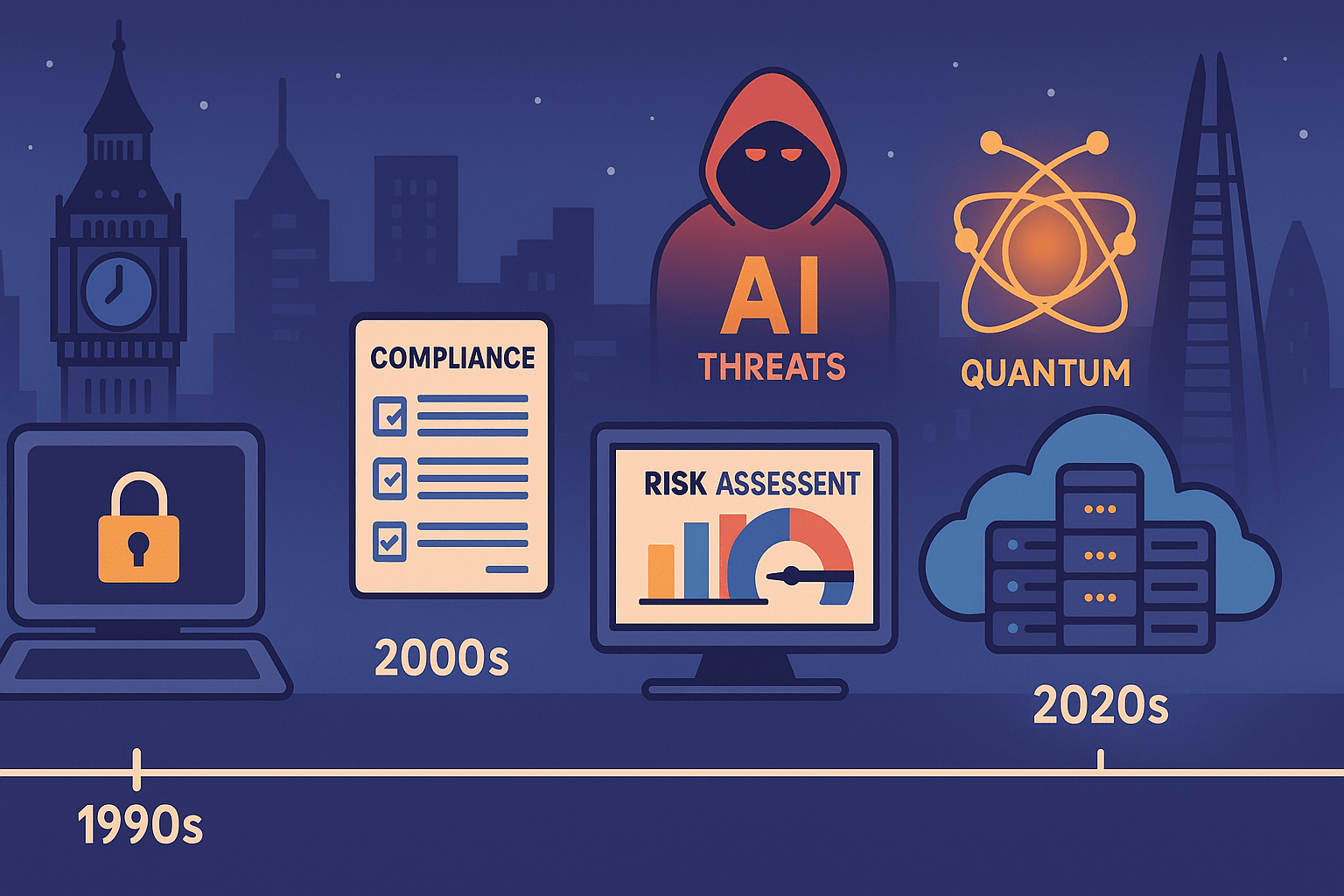
Cybersecurity feels foundational today, but as a discipline, it is startlingly young. This article argues that cyber is still in its infancy, especially when compared to IT or financial governance, and outlines why this newness matters. From AI security and quantum disruption to the structural challenges facing certification, education, and regulation, the piece maps both future directions and the underlying trends shaping the field. In a world where cyber is everywhere, this article insists: we’re just getting started.

Continue reading

Stakeholder Grid Example 2: Psyber Inc.

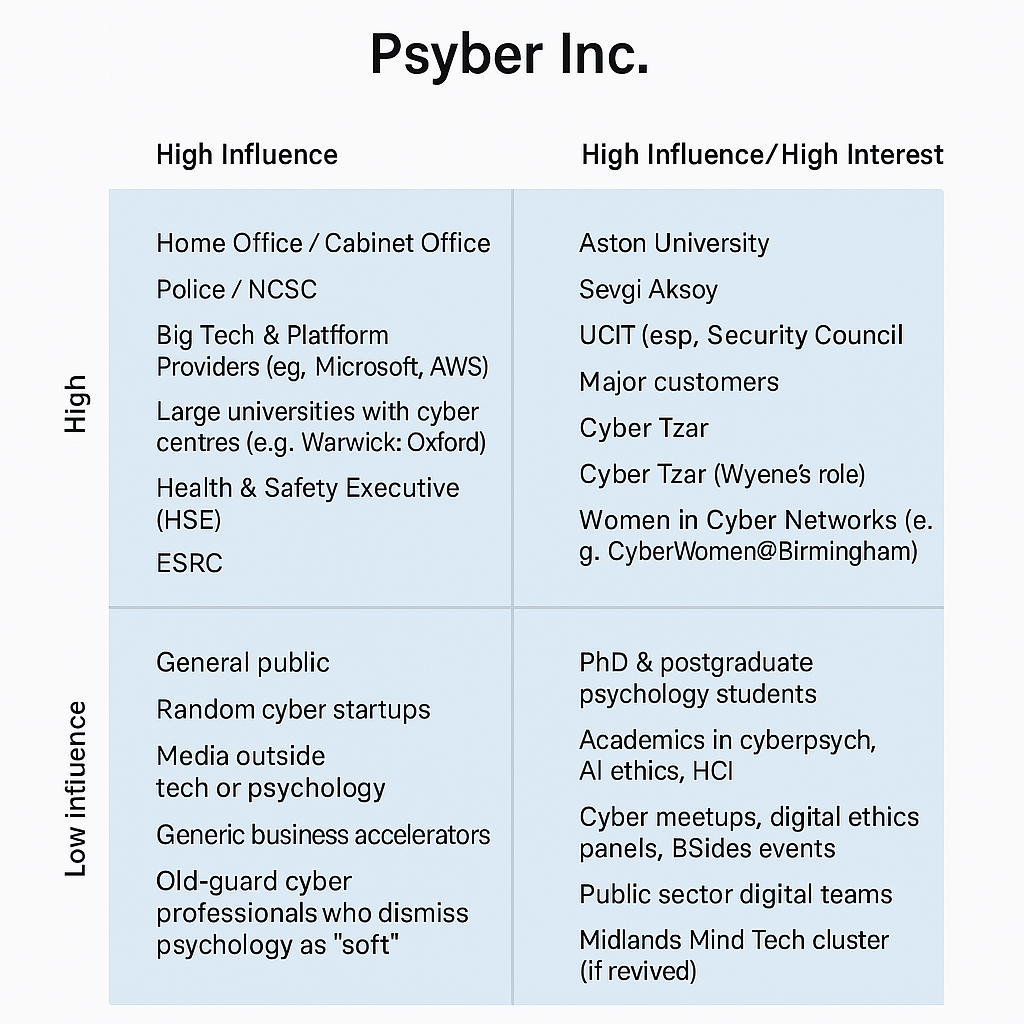
Navigating influence in a new and emerging field like cyber psychology requires clarity, confidence, and strategic alignment. As a startup working at the intersection of AI ethics, human factors, and cybersecurity resilience, Psyber Inc. operates in a diverse and sometimes opaque stakeholder landscape.

Continue reading

Steering Regional Resilience: Reflections on Two Years Supporting DSIT’s Cyber Local Programme

As Chair of the West Midlands Cyber Working Group, I’ve helped lead DSIT’s Cyber Local steering group for the region over the past two years. Working alongside regional experts, I’ve supported the selection of projects that strengthen cyber resilience on the ground, including Aston University’s powerful work on cyber violence against women and girls. This experience has reinforced just how critical locally informed funding is to building practical, inclusive, and impactful cyber capability.

Continue reading

Professionalising Cyber: Reflections from Conway Hall

A first-hand reflection on the UK Cyber Security Council’s recent “The Journey to Professionalisation” event at Conway Hall, exploring the ongoing professionalisation of the cyber security sector. Highlights include the expansion of recognised specialisms, the development of the UK Cyber Skills Framework, and discussions on AI, early-career challenges, and the need for a more inclusive, realistic skills framework to support a growing cyber economy.

Continue reading

The Ides of March: Reflections on Cyber, Startups, and Scaling Innovation

The Ides of March is a fitting time to reflect on betrayal, resilience, and the realities of UK cybersecurity. In the past two weeks, I’ve balanced DSIT’s Cyber Local funding process, chaired the West Midlands Cyber Working Group (WM CWG), led two funding bids, scaled one startup in a brutal funding climate, and booted up a second from scratch. Along the way, I’ve won the Pitch Battle at Cyber Runway Live, launched the UK’s first dedicated universal cyber risk score and comparison site, and tackled everything from weaponised AI threats to Kafka-powered scalability, all while navigating the messy, unpredictable, and often painful journey of building something that lasts.

Continue reading

Women Shaping Cyber: Reflections from Aston University

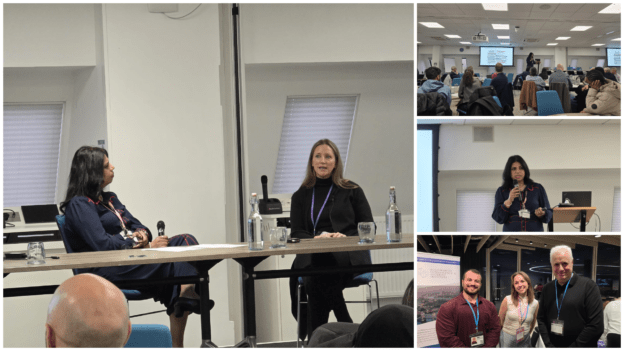
The Women Shaping Cyber event at Aston University, held during International Women’s Day, highlighted the importance of diversity in the West Midlands cyber sector. Keynote speaker Sevgi Aksoy emphasised the human factor in cybersecurity, while roundtable discussions explored barriers facing women, how to attract and retain talent, and how to leverage regional strengths. With contributions from leaders across academia, industry, and government, the event underscored that growth in cyber must also be measured in inclusivity and representation, not just economics.

Continue reading

Exploring the Link Between Cyber-Dependent Crime and Autism: A Critical Analysis

This article reviews a study exploring links between autistic-like traits, autism, and cyber-dependent crimes. Findings show autistic-like traits increase cyber-crime risk, while autism reduces it. Advanced digital skills are a key factor. The study highlights opportunities for autistic individuals in cybersecurity but is limited by self-reported data and sample representation. Further research is needed to clarify causal links and broader impacts.

Continue reading