Tag Archives: CYBERUK 2026

CYBERUK 2026 Analysis Series Overview

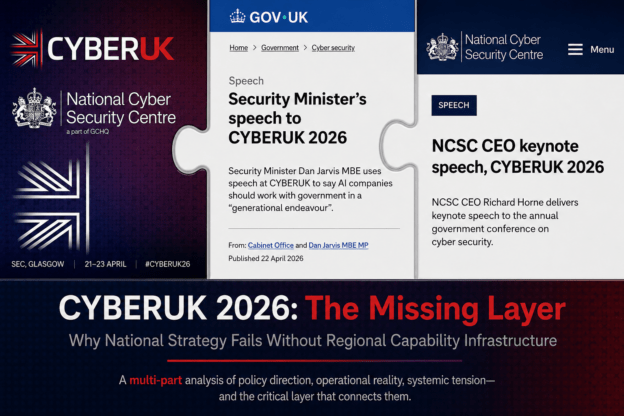
This series examines the UK’s cyber strategy as articulated at CYBERUK 2026, tracing its evolution from policy intent through to operational reality and system-level consequences.


Across five linked articles, it explores a shift that is now unmistakable: the UK is moving from building a cyber ecosystem to operating a national cyber system.


The analysis begins with the Security Minister’s speech, which sets out the ambition to enforce resilience at scale through standards, supply chains, and AI-enabled defence. It then turns to the NCSC CEO’s keynote, which grounds that ambition in operational reality, highlighting the growing pressure on organisations to deliver security amid technological acceleration and geopolitical instability.


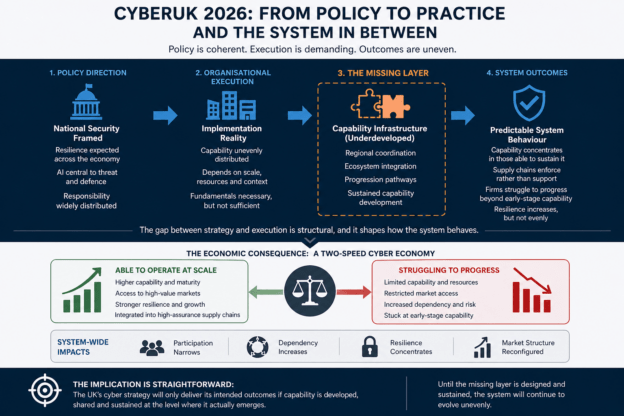
Taken together, these perspectives reveal a structural tension. Policy assumes resilience can be delivered across the economy, but capability is not evenly distributed. This produces predictable outcomes: capability concentrates, supply chains are enforced, and resilience becomes uneven.


The series then examines the implications of this dynamic, identifying the emergence of a two-speed cyber economy in which cyber security is increasingly a condition of market access.


Finally, it addresses the underlying cause: the absence of a clearly defined layer between national strategy and organisational execution. This “missing layer”, the capability infrastructure through which resilience is actually built and sustained, determines whether the system can function as intended.


Across the series, the central argument is consistent:

the UK’s cyber strategy is coherent in design, but its outcomes are shaped by how capability is developed and distributed in practice.


Until that layer is explicitly designed, coordinated, and sustained, the system will not fail, but it will evolve unevenly, with implications not just for security, but for how the cyber economy itself is structured.


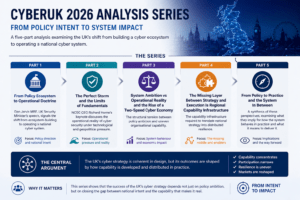
The five-part analysis of CYBERUK 2026, examining the UK’s evolving cyber strategy from policy through to operational reality and system-level implications:


Taken together, these pieces move from:

intent → execution → consequence → constraint → implication

CYBERUK 2026: From Policy to Practice and the System Inbetween

CYBERUK 2026 signals a shift from building a cyber ecosystem to operating a national cyber system. Across a series of analyses, a consistent pattern emerges: policy is coherent, execution is demanding, and outcomes are uneven. This article draws those strands together to show that the gap between strategy and delivery is not incidental; it is structural, and it defines how the system behaves.

Continue reading
CYBERUK 2026: The Missing Layer Between Strategy and Execution is Regional Capability Infrastructure

CYBERUK 2026 defines a clear national cyber strategy, but leaves a critical gap between ambition and execution. This article identifies the “missing layer”: the regional capability infrastructure required to translate policy into scalable organisational resilience. Without it, capability remains uneven, SMEs struggle to progress, and the system evolves by default rather than design, undermining the goal of distributed national resilience.

Continue reading

CYBERUK 2026: System Ambition vs Operational Reality and the Rise of a Two-Speed Cyber Economy

CYBERUK 2026 reveals a coherent but challenging shift in UK cyber strategy: from building a policy ecosystem to operating a national cyber system. While the government drives system-level resilience and AI-enabled defence, organisations are expected to execute fundamentals under increasing pressure. The result is a growing gap between ambition and capability, driving the emergence of a two-speed cyber economy where cyber security becomes a condition of market access.

Continue reading

CYBERUK 2026: The Perfect Storm and the Limits of Fundamentals

Richard Horne’s CYBERUK 2026 keynote frames cyber security as operating in a “perfect storm” of rapid technological change and rising geopolitical tension. While reinforcing the importance of fundamentals, the speech highlights how AI and evolving threats are reshaping the landscape. The core challenge is whether organisations can maintain baseline security as capability gaps widen, raising the risk of a two-speed cyber economy.

Continue reading

CYBERUK 2026: From Policy Ecosystem to Operational Doctrine

The UK’s Security Minister, Dan Jarvis MBE’s CYBERUK 2026 speech, signals a shift from building a cyber ecosystem to actively operating a national cyber system. It elevates baseline security expectations, embeds supply chain enforcement, and positions AI as central to defence. However, this transition risks concentrating market power, potentially excluding SMEs while increasing dependence on a small number of large firms and frontier AI providers.

Continue reading