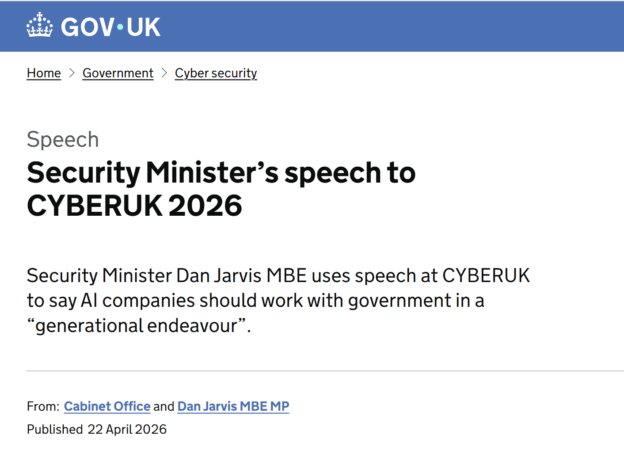
The UK’s Security Minister, Dan Jarvis MBE’s CYBERUK 2026 speech, signals a shift from building a cyber ecosystem to actively operating a national cyber system. It elevates baseline security expectations, embeds supply chain enforcement, and positions AI as central to defence. However, this transition risks concentrating market power, potentially excluding SMEs while increasing dependence on a small number of large firms and frontier AI providers.
Executive Summary
The Security Minister, Dan Jarvis MBE’s CYBERUK 2026 speech marks a transition point in UK cyber policy, from a well-defined ecosystem to the early stages of operational execution.
The UK now has:
- Mature institutions (NCSC, DSIT, Cabinet Office)
- Established baseline controls (Cyber Essentials)
- A globally competitive cyber and AI sector
As explored in my recent analysis of the UK cyber policy ecosystem – structure and evidence, the UK has reached a point of structural maturity.
What has been missing is a coherent operating model that connects these elements under real-world conditions.
This speech begins to define that model, but also exposes its risks.
Key shifts include:
- Cyber security formally framed as national security for all businesses
- Baseline controls moving from guidance to expectation
- Supply chain security is positioned as a primary enforcement mechanism
- AI recognised as both threat accelerator and defensive necessity
- A call for direct collaboration between government and frontier AI companies
The announcement of a Cyber Resilience Pledge and £90 million investment reinforces direction, but the real significance lies in the ambition to build:
national-scale, AI-enabled cyber defence capabilities
This signals a move beyond standards toward system-level control.
However, this transition introduces a critical tension:
the same mechanisms designed to raise resilience may also concentrate market power, potentially pushing SMEs out of supply chains and into dependency on larger firms.
The UK has built the ecosystem.
The question now is whether it can operate it, without distorting it.
Contents
- Executive Summary
- Contents
- 1. Introduction: From Mapping the Ecosystem to Using It
- 2. The Baseline is Now Mandatory (Whether Stated or Not)
- 3. £90 Million: Signal, Not Solution
- 4. AI Changes the Operating Model (and the Power Structure)
- 5. A Generational Endeavour, or an Undefined One?
- 6. CNI: Where the Model Breaks
- 7. Mapping This Shift: Actors, Incentives, Control Points
- 8. Impact on the UK Cyber Ecosystem
- 9. Conclusion: From Ecosystem to System, With Consequences
1. Introduction: From Mapping the Ecosystem to Using It
In my broader cyber sectoral analysis series, I described a landscape that has reached structural completeness:
- Clear institutional anchors
- A mature private sector
- Established baseline schemes
- Strong linkage to economic growth
That work focused on who the actors are, how they relate, and where influence sits.
What it did not yet show, and what this speech begins to address, is how those components function:
as a system under stress
Jarvis’ speech is the clearest signal yet that the government is moving from:
describing the ecosystem → attempting to operate it
That is a far harder problem, and one that introduces second-order effects the policy itself does not yet fully address.
1.1 The CYBERUK 2026 Analysis Series
This article forms part one of a five-part analysis of CYBERUK 2026, examining the UK’s evolving cyber strategy from policy through to operational reality and system-level implications:
- CYBERUK 2026: From Policy Ecosystem to Operational Doctrine
Dan Jarvis MBE, UK Security Minister’s, CYBERUK 2026 speech, signals the shift from ecosystem-building to operating a national cyber system - CYBERUK 2026: The Perfect Storm and the Limits of Fundamentals
NCSC CEO Richard Horne’s CYBERUK 2026 keynote discusses the operational reality of cyber security under technological and geopolitical pressure - CYBERUK 2026: System Ambition vs Operational Reality and the Rise of a Two-Speed Cyber Economy
The structural tension between policy ambition and uneven organisational capability - CYBERUK 2026: The Missing Layer Between Strategy and Execution is Regional Capability Infrastructure
The capability infrastructure required to translate the national strategy into distributed resilience - CYBERUK 2026: From Policy to Practice and the System in Between
A synthesis of these perspectives, examining what they imply for how the system behaves in practice and what it means to be able to deliver it
Taken together, these pieces move from:
intent → execution → consequence → constraint → implication
2. The Baseline is Now Mandatory (Whether Stated or Not)
The elevation of Cyber Essentials and the introduction of the Cyber Resilience Pledge represent a quiet but significant shift.
- “Basic cyber hygiene” is now framed as non-negotiable
- Boards are expected to take accountability
- Supply chains become enforcement vectors
This is consistent with patterns identified in the sectoral analysis:
UK cyber policy rarely enforces directly, it reshapes incentives until compliance becomes economically unavoidable.
But this is where the first structural risk emerges.
Because while large organisations can absorb:
- certification costs
- governance overhead
- supply chain enforcement
Many SMEs cannot.
So the question is not whether standards rise; they will.
The question is:
who gets excluded as they do?
3. £90 Million: Signal, Not Solution
The £90 million investment is politically important, but systemically modest when set against the scale of the problem.
UK SMEs number in the millions. Supply chains are deep, fragmented, and increasingly exposed to both cyber risk and compliance pressure. At the same time, expectations are rising rapidly:
- Board-level accountability
- Continuous assurance
- Supply chain enforcement
- AI-driven threat acceleration
Against that backdrop, £90 million is not a system transformation; it is marginal support in the face of systemic pressure.
The gap this creates is important:
expectation is scaling at system level, while support is scaling incrementally
And in systems like this, that gap does not remain empty; it is filled by organisations with the capital, scale, and existing compliance maturity to absorb it.
In other words:
the policy will predictably drive market consolidation, concentrating work in organisations that can absorb compliance as a cost of doing business
4. AI Changes the Operating Model (and the Power Structure)
The speech’s treatment of AI aligns directly with trends already visible across the ecosystem:
- AI accelerates attack capability
- AI reduces skill barriers
- AI enables machine-speed exploitation
And therefore:
defence must also become machine-speed
But the proposed response introduces a new structural dependency.
- Government provides intelligence
- AI firms provide capability
- National defence becomes co-developed
In sectoral terms, this repositions a small number of frontier AI firms as de facto control points in the UK’s national cyber defence capability.
That is a profound shift.
Because unlike traditional actors, these firms:
- operate globally
- control proprietary models
- iterate faster than policy cycles
The UK is not just partnering with them.
It is embedding them into the system’s control layer.
Cyber security is no longer just a technical control, it is becoming a condition of market access.
5. A Generational Endeavour, or an Undefined One?
The call for AI companies to partner in a “generational endeavour” is ambitious.
But from a systems perspective, it lacks definition in key areas:
- Commercial model
- Governance structure
- Risk ownership
- Exit conditions
Historically, the UK has excelled at:
clarity of institutional roles and coordination
Here, that clarity is absent.
At present, this looks less like a defined programme and more like:
an invitation without an operating model
And that is a risk when dealing with actors whose incentives are not primarily aligned to national objectives.
6. CNI: Where the Model Breaks
The speech explicitly states that off-the-shelf solutions are insufficient for Critical National Infrastructure.
This reflects a deeper reality:
not all parts of the cyber ecosystem can be secured using market mechanisms alone
CNI requires:
- deeper integration
- higher assurance
- closer coupling with government capability
Which suggests a structural outcome not yet fully acknowledged:
a bifurcation of the ecosystem into market-led and state-aligned security models
7. Mapping This Shift: Actors, Incentives, Control Points
Using the sectoral framework developed across the cyber sectoral analysis series, this speech reconfigures the system in three key dimensions.
7.1 Actors
Roles are being reassigned:
- Government → from coordinator to orchestrator
- Large enterprises → from participants to enforcers
- SMEs → from participants to compliance subjects
- Cyber providers → from services to infrastructure
- AI firms → from ecosystem participants to strategic anchors
This is structural realignment.
7.2 Incentives
The UK continues its preferred model:
indirect enforcement through incentives
But those incentives are now sharper:
- Reputation (Cyber Resilience Pledge)
- Market access (supply chains)
- National security framing
They are also unevenly distributed:
asymmetric burden, asymmetric power
7.3 Control Points
Key control points are now being activated:
- Supply chains → enforcement mechanism
- Certification (Cyber Essentials) → participation gateway
- AI capability → operational dominance layer
- Government intelligence → privileged input
Together, these form the basis of a coordinated national cyber system.
8. Impact on the UK Cyber Ecosystem
The implications are uneven and, in some cases, uncomfortable.
8.1 SMEs: The Pressure Point
SMEs face the most immediate and potentially damaging impact.
- Increasing compliance requirements
- Growing certification expectations
- Supply chain enforcement
This creates a very real possibility:
SMEs being excluded from markets, not because they are insecure, but because they cannot continuously evidence compliance at the level required by larger organisations
In practice:
- Contracts consolidate into larger firms
- SMEs are pushed into subcontracting roles
- Market access becomes dependent on compliance overhead
The risk is not that SMEs fail to secure themselves.
The risk is that:
they fail to remain economically viable within increasingly compliance-driven supply chains
8.2 Large Enterprises: Enforcement Power
Large organisations gain structural influence:
- Define supply chain standards
- Enforce compliance downstream
- Shape market expectations
They become:
distributed regulators within the system
8.3 Cyber Providers: Growth with Consolidation Pressure
The sector grows, but not evenly.
- Increased demand for scalable services
- Advantage to larger providers
- Pressure on smaller firms
Control concentrates where scale exists.
8.4 AI Companies: Strategic Elevation
AI firms move into a new category:
- Strategic partners
- Capability providers
- Control point owners
This is the most significant structural shift in the ecosystem.
8.5 Government: From Strategy to Orchestration
Government’s role expands significantly:
- Coordinating complex systems
- Integrating AI capabilities
- Operating at machine speed
This is a move into system engineering, not just policymaking.
9. Conclusion: From Ecosystem to System, With Consequences
The UK is no longer just building a cyber ecosystem.
It is building a cyber system.
One defined by:
- enforced incentives
- activated control points
- redefined actor roles
The core tension is now unavoidable:
you can increase resilience, but doing so reshapes the market
If increasing security systematically excludes smaller participants and concentrates capability in fewer hands, then the UK is not just building a more secure system:
it is making an explicit trade-off: resilience over competition, control over diversity
And that is not a technical outcome.
It is a strategic one.