Tag Archives: sectoral analysis

A Decade of the UK Cyber Security Breaches Survey: Trends, Plateaus, and What Actually Changed

The UK Cyber Security Breaches Survey, viewed over time, reveals not progress but stabilisation. Breach rates remain persistently high, attack methods largely unchanged, and improvements in governance lag behind rising exposure. The data shows a system that has normalised insecurity, where awareness has increased, but action has not kept pace, resulting in a steady-state of widespread, structurally embedded cyber risk.

Continue reading

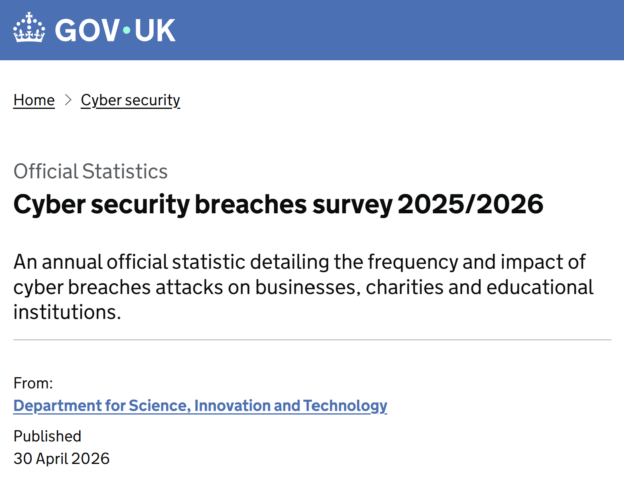
The UK Cyber Security Breaches Survey 2025/26: Stagnation, Scale, and the Illusion of Progress

The UK Cyber Security Breaches Survey 2025/26 suggests stability, but closer analysis reveals a system stuck in place rather than improving. Breaches remain widespread, detection uneven, and incentives misaligned. What looks like progress is often an artefact of measurement. This article argues the UK has reached a cybersecurity plateau, where risk is normalised, resilience is incomplete, and meaningful change will require structural, not incremental, intervention.

Continue reading

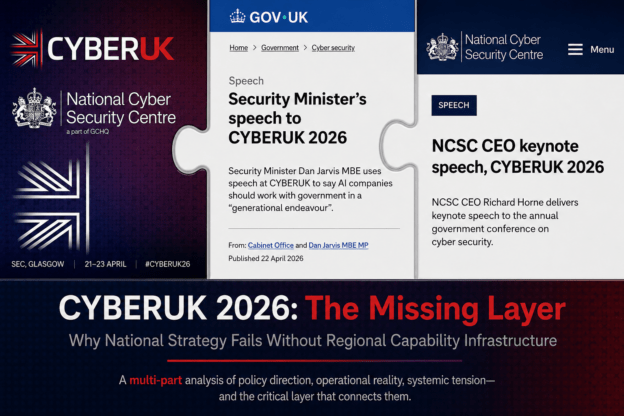
CYBERUK 2026: The Missing Layer Between Strategy and Execution is Regional Capability Infrastructure

CYBERUK 2026 defines a clear national cyber strategy, but leaves a critical gap between ambition and execution. This article identifies the “missing layer”: the regional capability infrastructure required to translate policy into scalable organisational resilience. Without it, capability remains uneven, SMEs struggle to progress, and the system evolves by default rather than design, undermining the goal of distributed national resilience.

Continue reading

CYBERUK 2026: System Ambition vs Operational Reality and the Rise of a Two-Speed Cyber Economy

CYBERUK 2026 reveals a coherent but challenging shift in UK cyber strategy: from building a policy ecosystem to operating a national cyber system. While the government drives system-level resilience and AI-enabled defence, organisations are expected to execute fundamentals under increasing pressure. The result is a growing gap between ambition and capability, driving the emergence of a two-speed cyber economy where cyber security becomes a condition of market access.

Continue reading

CYBERUK 2026: The Perfect Storm and the Limits of Fundamentals

Richard Horne’s CYBERUK 2026 keynote frames cyber security as operating in a “perfect storm” of rapid technological change and rising geopolitical tension. While reinforcing the importance of fundamentals, the speech highlights how AI and evolving threats are reshaping the landscape. The core challenge is whether organisations can maintain baseline security as capability gaps widen, raising the risk of a two-speed cyber economy.

Continue reading

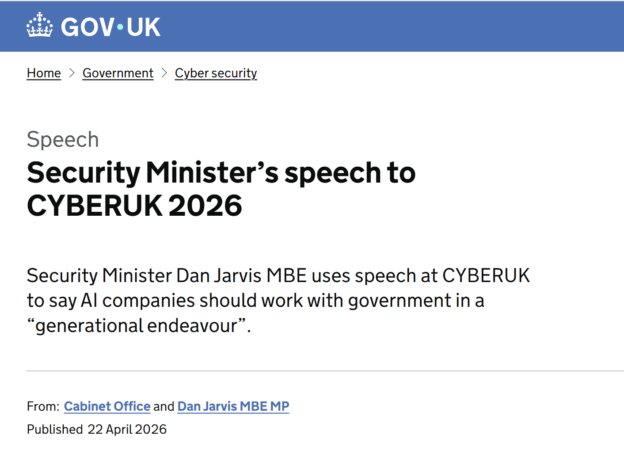
CYBERUK 2026: From Policy Ecosystem to Operational Doctrine

The UK’s Security Minister, Dan Jarvis MBE’s CYBERUK 2026 speech, signals a shift from building a cyber ecosystem to actively operating a national cyber system. It elevates baseline security expectations, embeds supply chain enforcement, and positions AI as central to defence. However, this transition risks concentrating market power, potentially excluding SMEs while increasing dependence on a small number of large firms and frontier AI providers.

Continue reading