Tag Archives: phishing

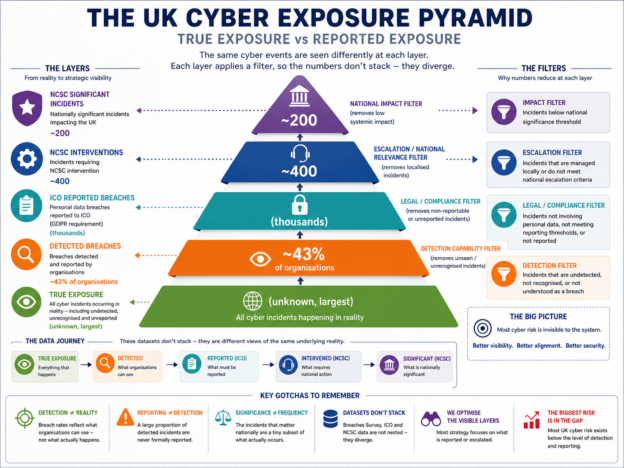
The Gap Between Reality and Reporting: A Model of True Cyber Exposure in the UK

The UK’s cyber security data does not describe a single reality; it describes three filtered views of it. By overlaying Breaches Survey, ICO, and NCSC data, a clearer model emerges: one of layered visibility, not layered severity. This article introduces a “true exposure vs reported exposure” framework, showing that most cyber risk sits below what is detected, reported, or acted on, and that the current strategy is focused on the wrong layer.

Continue reading
A Decade of the UK Cyber Security Breaches Survey: Trends, Plateaus, and What Actually Changed

The UK Cyber Security Breaches Survey, viewed over time, reveals not progress but stabilisation. Breach rates remain persistently high, attack methods largely unchanged, and improvements in governance lag behind rising exposure. The data shows a system that has normalised insecurity, where awareness has increased, but action has not kept pace, resulting in a steady-state of widespread, structurally embedded cyber risk.

Continue reading

The UK Cyber Security Breaches Survey 2025/26: Stagnation, Scale, and the Illusion of Progress

The UK Cyber Security Breaches Survey 2025/26 suggests stability, but closer analysis reveals a system stuck in place rather than improving. Breaches remain widespread, detection uneven, and incentives misaligned. What looks like progress is often an artefact of measurement. This article argues the UK has reached a cybersecurity plateau, where risk is normalised, resilience is incomplete, and meaningful change will require structural, not incremental, intervention.

Continue reading

When a Parking Permit Becomes a Cyber Risk: Understanding Indirect Supply Chain Threats

While applying for a parking permit, I discovered an expired SSL certificate on a council website, highlighting how small oversights in public services can expose broader cybersecurity risks. This real-world example shows why organisations must take indirect supply chain risk seriously, particularly in regions critical to national security.

Continue reading