Tag Archives: Operational Decision Platform

Designing Modern Data Architectures

Most organisations have already invested in:

  • data platforms
  • analytics
  • dashboards

And yet:

insight rarely turns into action

This series explores why — and what’s missing.

The Model

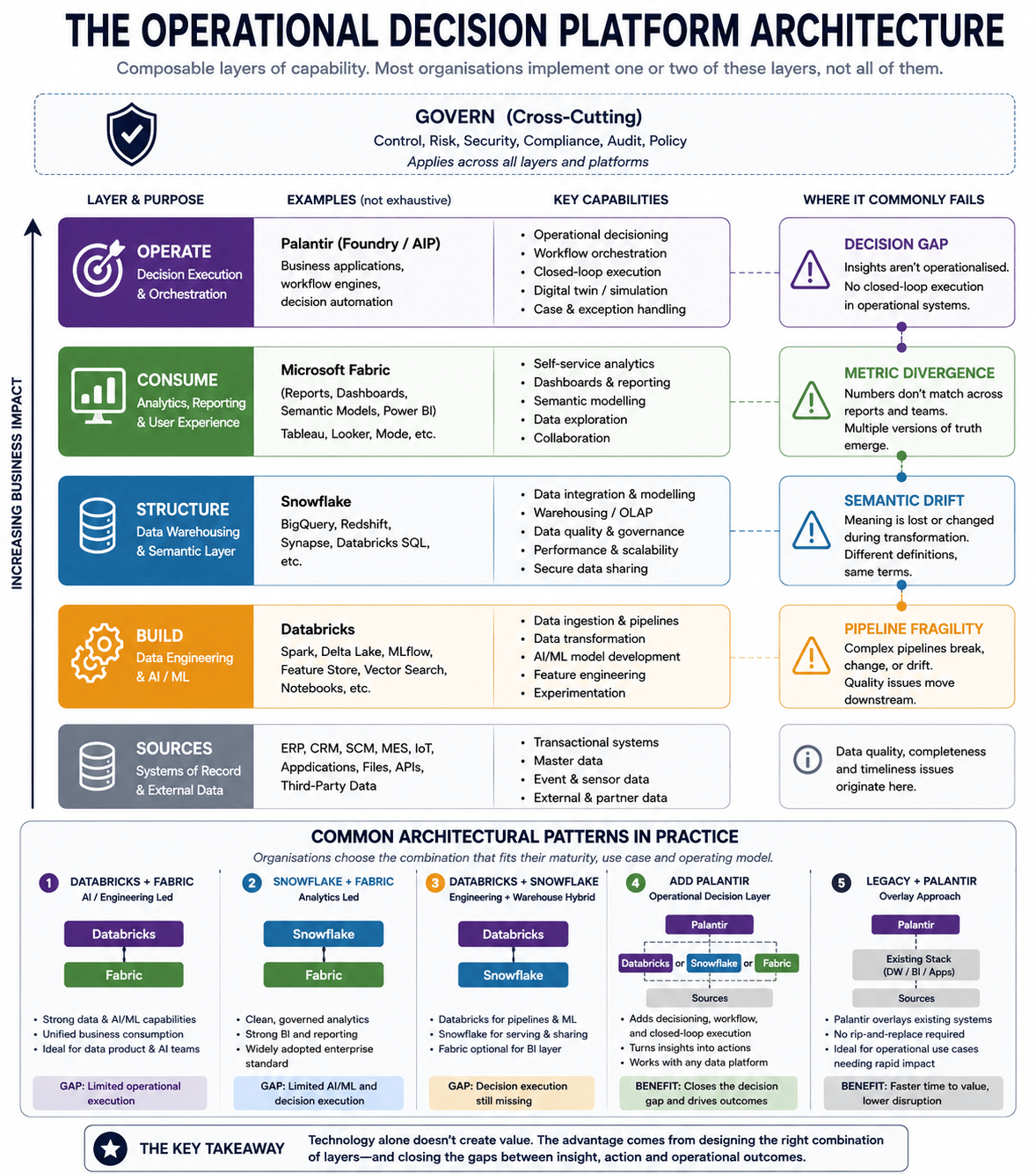
Modern data systems are best understood as layers:

  • Build → Databricks
  • Structure → Snowflake
  • Consume → Microsoft Fabric
  • Operate → Palantir

Most organisations have the first three.

Very few have the fourth.

The Series

1. Databricks vs Snowflake

Foundation: Build vs Structure
How data engineering and analytics platforms differ — and where each fits.

2. Databricks vs Snowflake vs Microsoft Fabric

Extension: Build → Structure → Consume
How modern architectures combine platforms into ecosystems.

3. The Operational Decision Platform

Conclusion: Adding Operate
Why data still doesn’t drive outcomes — and how to fix it.

Key Insight

Data platforms create visibility.
Decision systems create outcomes.

Final Thought

The problem isn’t data.

It’s the gap between:

insight → decision → action

This series is about closing it.

Databricks vs Snowflake vs Microsoft Fabric: Positioning the Future of Enterprise Data Platforms

This article extends the Databricks vs Snowflake comparison to include Microsoft Fabric, exploring the platforms’ philosophical roots, architectural approaches, and strategic trade-offs. It positions Fabric not as a direct competitor but as a consolidation play for Microsoft-centric organisations, and introduces Microsoft Purview as the governance layer that unifies divergent estates. Drawing on real enterprise patterns where Databricks underpins engineering, Fabric drives BI adoption, and functional teams risk fragmentation, the piece outlines the “Build–Consume–Govern” model and a phased transition plan. The conclusion emphasises orchestration across platforms, not choosing a single winner, as the path to a governed, AI-ready data estate.

Continue reading

Databricks vs Snowflake: A Critical Comparison of Modern Data Platforms

This article provides a critical, side-by-side comparison of Databricks and Snowflake, drawing on real-world experience leading enterprise data platform teams. It covers their origins, architecture, programming language support, workload fit, operational complexity, governance, AI capabilities, and ecosystem maturity. The guide helps architects and data leaders understand the philosophical and technical trade-offs, whether prioritising AI-native flexibility and open-source alignment with Databricks or streamlined governance and SQL-first simplicity with Snowflake. Practical recommendations, strategic considerations, and guidance by team persona equip readers to choose or combine these platforms to align with their data strategy and talent strengths.

Continue reading