Tag Archives: hyperreality

Hard-Wired Wetware II: the Post-LLM Web Asymmetric Integration Model (AIM) Defined

The post-LLM web is not replacing humans with machines. It is integrating humans into machine-generated scale. This paper formalises the Asymmetric Integration Model (AIM), arguing that as synthetic systems produce abundant conversational substrate, human participants supply the scarce resource of consequence-bearing legitimacy. Contemporary platforms are shifting from attention extraction toward asymmetrical affective integration.

Continue reading

Hard-Wired Wetware I: From Attention Extraction to Human Integration

As automation surpasses human traffic and synthetic actors permeate public, semi-private, and gaming ecosystems, the web is reorganising around a new extraction layer. Large language models collapse the cost of human emulation, shifting platforms from attention capture to human integration. The next phase of the internet does not replace people with machines. It recruits them as psychological infrastructure: wetware that supplies legitimacy, empathy, and consequence to autonomous systems.

Continue reading

It’s the End of the Internet and I Feel Fine

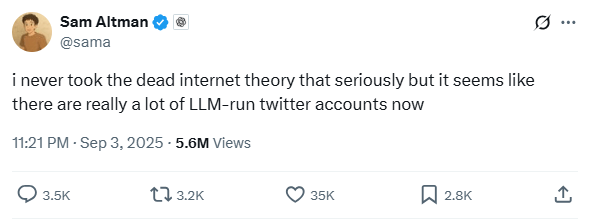
Every few years the internet collectively rediscovers an old conspiracy theory. This month it has been the so-called “Dead Internet Theory”. The idea, put simply, is that most of what we now encounter online is no longer produced by humans but by bots, scripts, and automated systems. Sam Altman, CEO of OpenAI, recently hinted that he thought there might be something in it, which was enough to trigger a storm of hot takes across Twitter. So what exactly does this “death” mean, and is there anything to it?

Continue reading

Brothers Against the Day: Dostoevsky, Derrida, Pynchon and Baudrillard at the End of the Sign

This article weaves together the philosophical contours of Derridean deconstruction, Baudrillardian hyperreality, and semiotic theory to interrogate the literary universes of Fyodor Dostoevsky and Thomas Pynchon. A Semiotic Descent into Hyperreality, Paranoia, and the Collapse of Meaning

Continue reading

Entropy and the Implosion of Meaning: Pynchon in the Age of Baudrillard’s Hyperreality

This essay explores the work of Thomas Pynchon through the critical apparatus of Jean Baudrillard, with particular focus on the concepts of simulation, hyperreality, and the implosion of the real. Rather than offering a totalising reading, this essay stages a dialogue between two elusive figures, Pynchon, the postmodern novelist of paranoia and systems, and Baudrillard, the post-Marxist theorist of simulacra and the symbolic collapse of the real.

Continue reading