
Migrating legacy RDBMS estates to the cloud is often framed as a transformation, but relocating data rarely modernises systems. Data is a symptom of underlying business function, encoded behaviour, and dense integration. Without upstream redesign (defining capabilities, decomposing behaviour, clarifying boundaries, and extracting embedded logic) cloud migration preserves complexity, creating “re-legacy” at scale rather than true modernisation.
Executive Summary
Many financial institutions are attempting to modernise by migrating large estates of legacy RDBMS databases to the cloud (SQL Server, Oracle, DB2, et cetera). The assumption is that relocating data will transition applications, reduce cost, and drive transformation.
This assumption is structurally flawed.
Data is not the system. It is the residue of business function. Systems are defined by behaviour: the decisions they encode, the state transitions they govern, and the integrations they maintain. In this instance, data is state persistence.
Migrating databases without redesigning function preserves embedded logic, dense integration, historical schema accretion, regulatory burdens, and operational coupling.
Cloud changes hosting and cost models. It does not change architectural complexity.
Real transformation begins upstream: with capability, behaviour, boundaries, and state ownership.
Infrastructure modernisation without behavioural redesign is optimisation, not transformation.
Contents
- Executive Summary
- Contents
- 1. Systems Are Defined by Behaviour, Not Storage
- 2. How Legacy Systems Actually Form
- 3. The Scale Reality
- 4. The Re-Legacy Effect
- 5. The Hidden Application Inside the Database
- 6. Why Cost Is an Insufficient Driver
- 7. On Tactical Rehosting and “Burning Platform” Moves
- 8. What Real Modernisation Looks Like
- 9. The Architectural Principle
- 10. Data as a Symptom: A Philosophic and Systems-Theoretic Perspective
- 11. Conclusion
1. Systems Are Defined by Behaviour, Not Storage
In financial services estates, it is easy to mistake the database for the system. After all, it is where the data lives. It is often the largest measurable component of the estate. It is where cost is visible.
But a database does not create capability.
A pricing engine exists to compute value.
A payments system exists to settle obligations.
A risk platform exists to calculate exposure and capital requirements.
These capabilities generate behaviour. Behaviour creates state. State is persisted as data.
The causal chain is unidirectional:
Capability → Behaviour → Integration → State → Data → Infrastructure
Data sits at the bottom of that stack.
When transformation programmes begin at the data layer (by migrating RDBMS Server instances to IaaS or PaaS), they are operating at the lowest level of the causal hierarchy. They are relocating persistence without redesigning the behaviour that generates it.
Moving state does not change what the system does.
Migration frameworks often describe change in terms of the “6 Rs” (rehost, replatform, refactor, rearchitect, rebuild, or replace) but these are classifications of technical intervention, not guarantees of behavioural or structural transformation.
1.1 Quadraphenia: Four Architecture Articles Together
A critique of superficial modernisation and a defence of structural discipline in enterprise systems: Enterprise modernisation fails when intervention occurs below the level of causality. This four-part series examines transformation through a structural lens:
- Data Is a Symptom of Function: Migrating RDBMS Estates Is Not Transformation
Why starting at the data layer mistakes persistence for capability. - Re-Legacy: The Debt of Deferred Structure
How infrastructure modernisation compounds structural debt when topology remains unchanged. - If Your Enterprise Architect Cannot Draw Your Core Architecture From Memory, What Are They?
Why structural ownership must exist cognitively, not just in tooling. - Stop Making Sense: Semantic Collapse in the Enterprise
How semantic drift erodes architectural reasoning itself.
Across the series, one principle holds:
- Structure determines behaviour.
- Behaviour determines state.
- State produces data.
- Infrastructure merely hosts it.
If transformation does not intervene at the structural level, it is optimisation, not redesign.
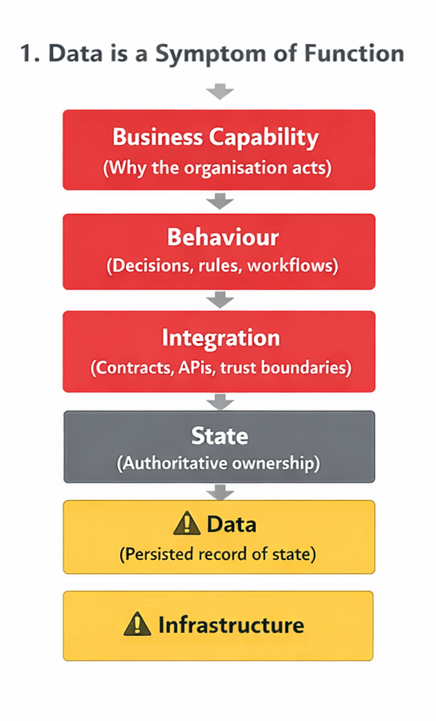
The diagram shows the enterprise as a causal hierarchy. Business capability drives behaviour. Behaviour shapes integration and state. State is persisted as data. Infrastructure merely hosts the result.
Most migration programmes intervene at the data or infrastructure layers. This article argues that transformation cannot begin there. Causality flows from the top. If capability and behaviour remain unchanged, the layers beneath them will not fundamentally change either.
2. How Legacy Systems Actually Form
Most legacy estates were not designed as monoliths. They became monoliths.
A system begins with a narrow function: trade capture, payments processing, collateral calculation. Over years, often decades, it accumulates additional responsibilities. Amendments are added. Reporting is embedded. Reconciliations are folded in. Regulatory extracts are bolted on. Exception workflows emerge.
Function accretes because the data is already there.
At the same time, integration density increases. Other systems discover that the easiest way to obtain information is to query the database directly. Risk engines pull tables. Finance extracts daily files. Management dashboards attach to views. Batch jobs chain together through stored procedures. Shadow IT builds reporting logic directly against production schemas.
The system becomes a hub not by design, but by convenience.
As function and integration grow, data grows with them. Twenty years of schema evolution produce overlapping models, denormalised reporting tables, archived regulatory snapshots, duplicate reference data, and derived metrics that are no longer traceable to their origin. Regulatory retention requirements, often 7 to 15 years, ensure that nothing is ever removed.
Eventually, the database is no longer just persistence. It is the institutional memory and integration backbone.
That is what organisations attempt to “move to the cloud.”
3. The Scale Reality
In a typical large financial estate, this looks something like:
- 100–150+ RDBMS Server instances
- 15–20 years of schema drift
- Thousands of stored procedures encoding business rules
- Overnight batch chains with undocumented dependencies
- Direct table access by reporting tools and downstream systems
- Regulatory data retention spanning multiple regimes
By the time migration is proposed, the database layer is not a clean persistence tier. It is executable business logic, integration fabric, operational workflow engine, and audit archive combined.
Rehosting this estate, even replatforming it to managed cloud RDBMS Servers or related infrastructure, does not decompose these concerns. It preserves them.
4. The Re-Legacy Effect
When a complex RDBMS estate is migrated without redesign, a subtle inversion occurs.
The organisation believes it is modernising. In reality, it is freezing historical architectural decisions in a new hosting model. Schema coupling remains intact. Stored procedures still encode validation and workflow. Reporting tools continue to query tables directly. Batch semantics are unchanged.
Only the infrastructure abstraction has shifted.
This is re-legacy: preserving accumulated architectural entropy under the banner of transformation.
In some cases, the move amplifies fragility. Managed services impose new operational constraints. Performance characteristics shift. Direct database access becomes more expensive. Previously hidden inefficiencies become visible on a monthly invoice.
The complexity was never removed. It was monetised.
5. The Hidden Application Inside the Database
A persistent blind spot in data-led transformation is the assumption that application logic lives in application code.
In many financial estates, it does not.
Business rules are embedded in:
- Stored procedures enforcing trade lifecycle invariants
- Triggers maintaining consistency rules
- Scheduled jobs orchestrating end-of-day transitions
- Views encoding regulatory semantics
- Allocation logic implemented in “procedural” SQL (aka PL/SQL, T-SQL, or similar)
The database is not a passive store. It is an executable system.
Migrating it without extracting and re-understanding this embedded function is equivalent to moving compiled binaries into a new runtime without reviewing source code.
Transformation requires surfacing behaviour — not copying it.
6. Why Cost Is an Insufficient Driver
The impetus for RDBMS Server migration is often cost: licensing, hardware refresh cycles, operational overhead.
These are legitimate concerns. But cost reduction is not architectural simplification.
If you do not reduce:
- Duplication of behaviour
- Cross-domain coupling
- Integration density
- Historical data redundancy
- Batch inefficiency
Then you have not reduced complexity. You have changed its billing model.
Cloud platforms are extremely efficient at charging for I/O against tightly coupled systems.
7. On Tactical Rehosting and “Burning Platform” Moves
It is worth acknowledging that not all migration programmes are misguided. In some cases, estates are genuinely on burning platforms: unsupported operating systems, expiring data centre contracts, escalating licensing costs, or material operational risk. Rehosting to cloud infrastructure can be a rational containment strategy. It may buy time, reduce immediate exposure, or stabilise cost trajectories.
But this is remediation, not transformation.
A tactical lift-and-shift can be an acceptable bodge — a temporary measure to prevent failure — provided it is recognised as such. What it does not do is resolve systemic complexity. In fact, by deferring structural redesign, it often accumulates a second layer of technical debt: the debt of postponed behavioural decomposition.
Rehosting may fund transformation. It is not transformation.
8. What Real Modernisation Looks Like
Transformation must begin upstream, at the level of capability and behaviour.
First, capabilities must be defined explicitly. Not systems — capabilities. Trade lifecycle management. Margin optimisation. Regulatory reporting. Liquidity management.
Second, behaviour must be decomposed. Where are decisions made? Where does state transition occur? Which rules are invariant, and which are historical artefacts? Where is logic embedded in persistence rather than consciously owned?
Third, boundaries must be clarified. Implicit database integrations must become explicit contracts. Direct table access must be replaced with versioned interfaces. Domain ownership must be made clear.
Only after these steps does persistence redesign make sense.
In heavily regulated sectors, subtraction is not straightforward. Retention requirements may mandate seven, ten, or fifteen years of history. The answer is not indiscriminate deletion but architectural separation. Operational state can be isolated from immutable audit stores. Historical snapshots can be preserved in dedicated archival domains. Derived data can be recomputed rather than perpetually retained. Where appropriate, event-based approaches allow recomposable history rather than schema-bound sediment.
Subtraction in such environments is deliberate and controlled — not reckless — but it remains essential. Without separating operational capability from regulatory memory, transformation collapses back into preservation.
At that point, data separates naturally into categories:
- Operational state requiring strong consistency
- Historical state required for audit and regulation
- Derived state that can be recomputed
- Integration residue that can be eliminated
Modernisation becomes both additive and subtractive. It involves building new services and decomposed domains — and deliberately archiving, snapshotting, or decommissioning legacy structures.
Without subtraction, there is no simplification.
9. The Architectural Principle
Enterprise transformation repeatedly confuses artefacts with causes.
Servers are artefacts.
Databases are artefacts.
Cloud platforms are artefacts.
Function is causal.
Data is the lagging indicator of behaviour over time.
If you change behaviour — redefine capability, isolate domains, reduce coupling — the data model evolves accordingly.
If you move data first, behaviour remains untouched.
10. Data as a Symptom: A Philosophic and Systems-Theoretic Perspective
To say that data is a symptom of function is to make a claim about causality and system structure.
In systems theory, structure determines behaviour. Behaviour produces observable outputs. Those outputs can be measured and stored, but they are not causal. They are consequences of underlying rules and interactions.
In enterprise systems, data is one such output. It records decisions already made, state transitions already executed, and interactions already completed. It reflects how the system is organised.
Migrating data changes where that record is stored. It does not change the rules that generated it, the feedback loops that stabilise it, or the boundaries that shape it.
Transformation requires structural intervention — redefining capability, altering decision logic, clarifying ownership of state, and reducing inappropriate coupling. Only when structure changes does behaviour change. Only when behaviour changes does the data footprint evolve in a meaningful way.
Data is therefore not primary. It is a lagging indicator of how a system functions.
Change the structure, and the data changes.
Move the data, and the structure remains.
11. Conclusion
Migrating large RDBMS Server estates to the cloud may be necessary. It may even be strategically prudent. But necessity does not convert remediation into transformation.
A system is defined by what it does — not where its tables reside.
Until organisations redesign function, untangle integration, and reassert explicit ownership of state, database migration will remain an infrastructure exercise masquerading as modernisation.
Data is a symptom of function.
Treat the function, and the system changes.
Treat the data, and the system stays exactly as it was — only now it runs on someone else’s hardware.