Tag Archives: WM Cyber Working Group

Merry Christmas and Happy New Year 2026 from the West Midlands Cyber Hub

As the new year begins, the West Midlands Cyber Hub is delivering an ambitious programme of practical, community-driven cyber events from January to March… with more already in development. This programme is focused on building cyber capability, confidence, and collaboration across the West Midlands, supporting organisations, practitioners, and the wider regional economy.

Continue reading

Pre-Launch Reflections: The West Midlands Cyber Hub

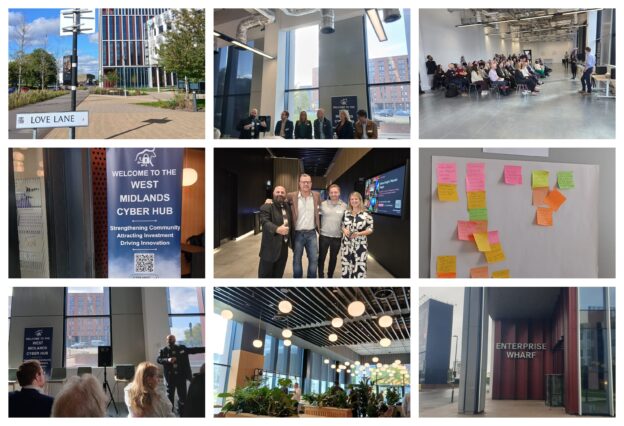
The pre-launch of the West Midlands Cyber Hub at Enterprise Wharf brought together over 100 leaders from across the region’s cyber ecosystem, CISOs, CTOs, startups, universities, government, community partners, students, practitioners, and members of the interested public. What began as a vision to give the West Midlands a proper home for cyber has now become real, supported by DSIT, Innovate UK, Aston University, West Midlands Cyber Resilience Centre, Midlands Cyber, TechWM and the Innovation Alliance for the West Midlands.

Continue reading

From Policy to Place: Aligning the UK Cyber Policy with the West Midlands Futures Growth Plan

The UK Cyber Policy 2025 and the West Midlands Futures Green Paper 2025 set bold agendas but risk gaps without practitioner-led delivery. The national policy offers ambition but lacks continuity, metrics, and practitioner voice. The regional plan lays strong scaffolding but underweights cyber, leaning too heavily on AI. A ten-point roadmap shows the way forward: formally recognise cyber as a standalone cluster, unify governance, foster community, attract investment, establish a hub, launch a festival, rebuild narrative, reform SME funding access, enhance talent strategy, and create a regional benchmarking index. Anchored in the West Midlands Cyber Hub, this approach can balance national ambition with regional delivery, making resilience a driver of inclusive growth.

Continue reading

West Midlands Cyber Hub Diaries: Day One (Or Perhaps Day Sixty)

The West Midlands Cyber Hub marks a long-held ambition to give the region a central home for cyber. Building on the rebooted West Midlands Cyber Working Group (WM CWG), the Hub is designed to strengthen community coherence, increase investment, and connect students, SMEs, enterprises, and universities in a neutral space. Supported by DSIT, Innovate UK, Aston University, TechWM, and the Innovation Alliance for the West Midlands, the Hub will open its first phase at Enterprise Wharf in Birmingham, forming the core of a hub-and-spoke model across the region. The project team, led by Sevgi Aksoy and I (Wayne Horkan), with Rebecca Robinson as PM, is preparing for a pre-launch event on 30th September 2025.

Continue reading

Reviewing the 2025 DSIT Code of Practice for Enterprise Connected Device Security: A Critical and Constructive Analysis

This article provides a comprehensive analysis of the UK Government’s proposed 2025 Code of Practice for Enterprise Connected Device Security, published by the Department for Science, Innovation and Technology (DSIT). It unpacks the structure, rationale, and policy intent behind the Code, outlines its 11 lifecycle-aware security principles, and evaluates its strengths and limitations. Drawing on lessons from the earlier NCSC Cyber Resilience Testing (CRT) programme, it offers a set of practical, actionable recommendations to improve uptake, scalability, and long-term impact. This is a roadmap for policymakers, manufacturers, and enterprise buyers navigating the emerging landscape of connected device security in organisational settings.

Continue reading

Women Shaping Cyber: Reflections from Aston University

The Women Shaping Cyber event at Aston University, held during International Women’s Day, highlighted the importance of diversity in the West Midlands cyber sector. Keynote speaker Sevgi Aksoy emphasised the human factor in cybersecurity, while roundtable discussions explored barriers facing women, how to attract and retain talent, and how to leverage regional strengths. With contributions from leaders across academia, industry, and government, the event underscored that growth in cyber must also be measured in inclusivity and representation, not just economics.

Continue reading