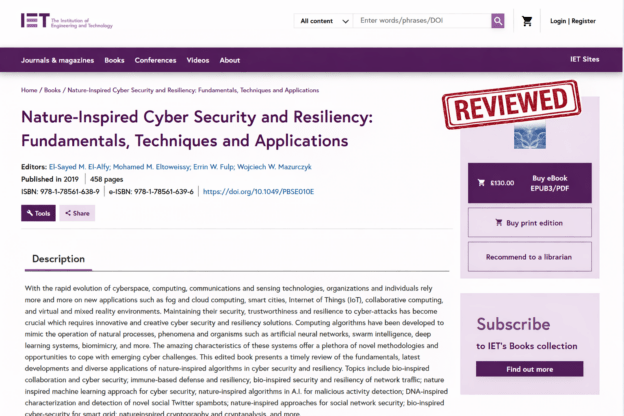
A grounded, unromantic review of Nature-Inspired Cyber Security and Resiliency (IET, 2020). The book argues that we can borrow defence principles from biology (immune systems, swarms, self-healing) to build adaptive digital security. The idea is clever but mostly speculative. The theory works on paper; the engineering doesn’t. Nature may be elegant, but enterprise networks aren’t petri dishes. Useful metaphors, immature mechanisms: an interesting academic exercise, not an operational blueprint.
Executive Summary (TL;DR)
The book Nature-Inspired Cyber Security and Resiliency is a well-intentioned, over-caffeinated love letter to biomimicry in computing. The premise is simple: “nature’s been at this for billions of years, so let’s copy it.” And sure, it’s an interesting analogy — immune systems, swarms, self-healing, camouflage — but the gap between analogy and implementation is roughly the size of the Mariana Trench.
The editors (El-Alfy et al.) and contributors have assembled a compendium of bio-flavoured algorithms — immune-inspired anomaly detection, swarm-based routing, DNA-style cryptography, and so on. It’s academically tidy and sometimes even elegant. But in engineering terms, it’s mostly speculative architecture. You can model “self-organising swarm defences” on paper all you like; try deploying one in a regulated network and see what happens when auditors meet ants.
To its credit, the book at least acknowledges resilience — not just “stop the bad thing,” but “recover and adapt after the bad thing happens.” That’s the right instinct. It aligns with what we in the real world call “engineering for failure.” The trouble is, nature doesn’t have compliance checklists, legacy kit, or CFOs who demand uptime. Biology can afford redundancy and chaos; IT budgets can’t.
So: are the authors’ hopes “realisable”?
Partially, yes — but only in the laboratory sense. You can borrow ideas (decentralisation, adaptivity, redundancy) from nature. But the fantasy that we’ll one day have truly organic, self-healing, self-organising digital ecosystems? That’s still science fiction. Think Michael Crichton — not Michael Crick — except without the film rights.
As for the “fears” the book implies — that unless we evolve our cyber defences to be more like living organisms, we’re doomed — they’re overblown. It’s not that nature-inspired methods are bad; it’s that they’re immature. They don’t scale, they’re not easily testable, and the cost-benefit is hand-wavy at best. When you can’t even get patch management right, the leap to “cyber immune systems” feels… aspirational.
In short:
- The concept is clever.
- The implementation is unproven.
- The risk rhetoric is inflated.
- And the engineering practicality is, let’s say, underdeveloped.
It’s not nonsense — but it’s not ready for the grown-ups’ table either. The biology metaphors are useful provocations, not blueprints. If you’re building actual resilient systems today, you’d still reach for boring old redundancy, fault isolation, rigorous testing, and human oversight — not ant colonies and genetic algorithms.
Contents
1. Introduction
In an era in which digital infrastructures, cyber-physical systems, and the “Internet of Things” proliferate at pace, the twin demands of security and resilience have become ever more complex. The edited volume Nature-Inspired Cyber Security and Resiliency (“the book”) offers a rich and timely contribution, arguing that one promising route is to draw metaphors, models and mechanisms from the natural world — from immune systems, swarms, adaptation, self-organisation, redundancy, camouflage and more — and to apply them to the cyber domain. As the editors observe, the rapid evolution of computing, communications and sensing technologies — including fog and cloud computing, smart cities, collaborative platforms and mixed reality environments — means that conventional security approaches no longer suffice; instead we require “innovative and creative cyber security and resiliency solutions”.
In what follows I will (1) articulate the fundamental rationale of nature-inspired cybersecurity and resiliency, (2) survey key techniques and algorithmic/architectural motifs presented in the book, (3) examine the main application domains addressed, and then (4) reflect critically on the strengths, limitations and future directions of the nature-inspired paradigm as revealed by this work — and finally (5) contextualise it with respect to broader cyber-resilience research and propose a forward agenda.
This review accepts the intellectual appeal of the nature-inspired paradigm, but evaluates it strictly through the lens of operational cyber resilience: deployability, testability, governance, and cost. The question is not whether biological metaphors are elegant, but whether the mechanisms derived from them survive contact with regulated networks, legacy infrastructure, audit requirements, and adversarial environments. On that measure, the book is insightful but premature.
2. Fundamentals of the Nature-Inspired Paradigm
At the heart of the volume lies the conviction that natural processes, phenomena and organisms provide valid and fruitful analogies (and in many cases direct algorithmic inspirations) for cyber security and resiliency. For example:
- Artificial immune systems (AIS) borrow from the mammalian immune response (learning, memory, anomaly detection, self-healing) to build cyber-defence systems that adapt over time.
- Swarm intelligence (ants, bees, fish shoals) suggests self-organising routing, redundancy, decentralised decision making — beneficial for resilient network architectures.
- Biomimicry in cryptography, so that randomness, redundancy or mutation (à la DNA) can inspire novel key-exchange, obfuscation or deception techniques.
- Ecosystem concepts: robustness, diversity, redundancy, self-repair, symbiosis, competition — elements of resilience in biology that map onto cyber-physical systems under attack or failure.
In the book’s own words, the paradigmatic shift is from seeing cyber defence as purely stationary, perimeter-oriented and static, towards seeing it as adaptive, distributed, self-organising and resilient — much like living systems immersed in dynamic threat environments.
The rationale is compelling: as attackers become more organised, use AI/ML, operate across heterogeneous IoT and fog ecosystems, and exploit complexity, our defensive systems must evolve to match the adaptivity, flexibility, and fault-tolerance of the threats. As one chapter argues, nature-inspired cybersecurity (NICS) aims to build a defence mechanism by applying nature-inspired approaches like camouflaging, deception, disguise, multi-objective optimisation, self-healing and more.
From a conceptual vantage one therefore notes several key attributes that underpin the nature-inspired paradigm:
- Adaptivity — the capacity for the system to learn, update, evolve in response to novel threat behaviours.
- Self-organisation and decentralisation — avoiding central single points of failure, distributing functions across nodes as in a swarm or ecosystem.
- Diversity and redundancy — ensuring multiple pathways, diverse defensive mechanisms (resilience through heterogeneity).
- Deception, camouflage and obfuscation — drawing on natural behaviours (e.g., prey species, immune evasion) to confuse attacker reconnaissance.
- Self-healing and fault-tolerance — analogous to biological regeneration, the ability for systems to recover or endure partial loss/failure.
- Multi-objective optimisation in complex environments — as biological systems balance trade-offs (e.g., energy vs survival), cyber systems must balance security vs performance, resilience vs cost.
These foundational ideas set the stage for the book’s technical contributions.
3. Techniques and Methods: A Survey of the Book’s Offerings
The book’s structure, as indicated in the editorial material, covers fundamentals, latest developments and diverse applications of nature-inspired algorithms in cyber security and resiliency. Although full chapter-by-chapter detail is beyond the scope of this essay, I highlight some representative techniques and motifs that align with current research, and importantly align with contemporary work on cyber-resilience research.
- Bio-inspired collaboration and cyber security – This chapter explores how collaboration among defence agents (akin to how species in nature collaborate) can bolster security. For example, nodes in a network can share threat intelligence, coordinate responses, dynamically allocate resources.
- Immune-based defence and resiliency – As above, artificial immune systems (AIS) provide architecture where anomalies are identified, response mechanisms evolve, memory of known threats allows faster reaction. This is particularly salient in dynamic networks where known signature‐based methods falter.
- Security and resiliency of network traffic via nature-inspired algorithms – Using swarm intelligence or evolutionary algorithms to detect anomalies in network flows, adapt routing or isolate threats.
- Nature-inspired machine learning for cyber security – Hybrid methods that combine nature-inspired meta-heuristics (e.g., particle swarm optimisation, genetic algorithms) with ML to optimise feature selection, classification, intrusion detection.
- DNA-inspired characterisation and detection of novel social twitter spambots – A concrete case where biological sequence metaphors (mutation, evolution) are applied to detect evolving adversary behaviour in social networks.
- Nature-inspired approaches for social network security – Defence in social platforms perhaps echoing immune systems, swarm detection, evolutionary adaptation to adversary tactics.
- Bio-inspired cyber-security for the smart grid – As cyber-physical systems (smart grid) increase in complexity and interconnectedness, resilience must be built in—for example redundant paths, self-healing segments, diversified nodes.
- Nature-inspired cryptography and cryptanalysis – Leveraging natural phenomena (chaotic behaviours, evolutionary mutation, redundancy) to design more resilient cryptographic primitives or detect vulnerabilities.
The breadth of domains covered demonstrates that the nature-inspired paradigm is not simply a niche piece of metaphorical novelty, but a substantial lens through which to view many facets of security and resilience.
From a methodological viewpoint, it is clear that many of the nature-inspired techniques adopt a meta-heuristic or optimisation flavour (e.g., evolutionary algorithms, swarm, ant colony, genetic) but importantly are not restricted to that: they also include structural architectural design (e.g., decentralised self-healing systems), behavioural aspects (e.g., deception, camouflage), and systemic resilience properties (e.g., redundancy, diversity, self-repair). The book thereby spans algorithmic, architectural and systemic levels.
What is striking, however, is how rarely these techniques are evaluated beyond simulation or small-scale experimental contexts. Most chapters prioritise algorithmic novelty over operational validation. Questions of scalability, false-positive cost, failure modes, auditability, and interaction with existing security controls are often acknowledged only in passing.
An important observation — in line with the broader literature — is that mapping biological systems to cyber systems is non-trivial: the environmental constraints, threat modelling, performance, cost trade-offs differ significantly from the biological domain. The book implicitly acknowledges these translation challenges.
4. Applications: Domain Insights and Use-cases
One of the book’s strengths is its attempt to ground nature-inspired techniques in application domains rather than leaving them entirely abstract — though in most cases this grounding remains illustrative rather than operational.
- IoT, Fog & Cloud Environments: As noted in the opening summary, we are seeing increasingly heterogenous connected devices, sensors, edge computing and whatever lies between cloud and device. The dynamic nature of these environments suits adaptive, distributed, nature-inspired approaches.
- Smart Cities / Smart Grids: Critical infrastructures with cyber-physical systems demand resilience, robustness and fault-tolerance. Bio-inspired approaches provide alternative design paradigms for these networks.
- Social Networks & Botnet/Spambot Detection: In the social media realm, adversary behaviours are evolving; the book’s focus on DNA-inspired characterisation of novel Twitter spambots is a salient example of bridging biology metaphor with real-world evolving threat.
- Cryptography and Cryptanalysis: The cryptographic domain benefits from nature-inspired randomness, mutation, and evolution. While less elaborated in the summary material, the statement of the book suggests coverage of nature-inspired cryptography and cryptanalysis.
- General Network Traffic Security: Swarm-based routing, anomaly detection via evolutionary meta-heuristics, dynamic resource reallocation.
From an empirical validation perspective, the relevance is twofold: Firstly, nature-inspired systems themselves must be testable and measurable in resilience contexts—how do we test adaptivity, self-repair, decentralisation? Secondly, many of the targeted domains (IoT, smart grid, distributed networks) are precisely those where resilience properties are difficult to validate.
5. Critical Reflection: Strengths, Limitations and Future Agenda
It is constructive at this point to critically engage with the nature-inspired paradigm as presented in the book, and to position where further research is required.
5.1 Strengths
- The volume admirably opens up a rich interdisciplinary frontier: combining computing, biology, cyber resilience, optimisation, and distributed systems.
- It spans algorithmic as well as architectural/systemic horizons, meaning the nature-inspired lens is applied not just at the “algorithmic” level but at system design.
- The focus on emerging application domains (IoT, fog, smart grid) means the work is not purely abstract but of relevance to real-world cyber-resilience practitioners.
- By editing work from multiple perspectives (immune systems, swarm intelligence, cryptography, social networks) it offers a wide palette of metaphor-to-mechanism mappings, which encourages creativity in the security research community.
5.2 Limitations and Challenges
- Translation gap: As noted earlier, the mapping from biological processes to cyber systems is not straightforward. Biological systems evolved over millennia under physical, chemical constraints; cyber systems operate under different temporal, adversarial, economic constraints. Thus, the validity of the analogy can be partial.
- Evaluation and metrics: Nature-inspired systems often bring adaptivity, decentralisation and resilience—but how do we measure those attributes in practice? What are the metrics of “self-healing”, “camouflage effectiveness”, “redundant resilience” in operational systems? The book would benefit from deeper empirical measurements and standardised test regimes.
- Complexity, cost and overhead: Adaptive, decentralised, self-organising systems often incur overhead in terms of computation, communication, management. For operational cyber systems (especially in constrained IoT/edge contexts) these overheads may inhibit deployment. The book acknowledges these trade-offs, but wider empirical work is needed.
- Threat model evolution: Attackers evolve quickly; nature-inspired methods may themselves become targetable (for example, adversarial machine learning against swarm-based anomaly detectors). Resilience must account for adversarial adaptivity.
- Integration with existing frameworks: Many real-world organisations have established security/resilience architectures (e.g., perimeter firewalls, SIEMs, SOCs). Introducing nature-inspired elements requires integration with legacy systems, organisational processes, governance and testing frameworks. The book covers technical techniques but less so the socio-organisational change aspects.
Taken together, these limitations explain why nature-inspired cybersecurity remains largely absent from production security architectures despite two decades of research interest.
5.3 Future Agenda
Given the above, the future agenda for nature-inspired cybersecurity is less about inventing new metaphors and more about making existing ones operationally credible.
- Move beyond toy evaluation environments: Many nature-inspired techniques (swarm routing, immune-inspired anomaly detection, evolutionary optimisation) perform well in simulations and small experimental settings, but the decisive question is how they behave under real constraints: noise, heterogeneity, partial observability, limited compute, and adversarial adaptation. Without sustained empirical evaluation, the paradigm risks remaining a collection of clever algorithms rather than an engineering pathway.
- Develop clearer, comparable metrics: Concepts like adaptivity, self-healing, decentralisation, and resilience are repeatedly invoked, but are often measured indirectly or inconsistently. If “self-healing” is claimed, what counts as healing — restoration of service, recovery of integrity, containment of spread, or something else? And at what cost? Nature-inspired systems will not be operationally credible until their properties can be measured in ways intelligible to engineers and decision-makers.
- Confront overhead, stability, and failure modes: Nature-inspired systems often trade determinism for adaptivity, and central control for emergent behaviour. That can be powerful, but it can also create instability, opacity, and new classes of failure. In operational environments, “self-organising” is only valuable if it is bounded, inspectable, and safe under stress — otherwise the defence becomes another unpredictable system that must itself be defended.
- Strengthen threat modelling and adversarial realism: Many chapters implicitly assume an attacker who is static or unsophisticated, while the proposed defence is adaptive and evolving. In reality, attackers adapt too. A serious research agenda must assume adversaries who learn, probe, poison, and exploit the very adaptivity that nature-inspired approaches rely on.
- Be honest about integration and deployment reality: Most organisations do not build networks from scratch; they inherit messy, regulated, legacy environments. Even if a nature-inspired method is theoretically elegant, it must be deployable alongside conventional security controls, interpretable by human operators, and governable under real accountability constraints. Without that, the paradigm remains inspirational but operationally marginal.
In short, the field is not blocked by lack of creativity. It is blocked by the familiar engineering problems: measurement, validation, robustness, integration, and cost.
6. Conclusion
Nature-inspired cyber security and resiliency presents a compelling vision: instead of simply hardening systems in a static defence posture, we build systems that live, adapt, self-organise, diversify, camouflage and self-heal — borrowing from the long-evolved resilience of biological systems. The book edited by El-Alfy et al. offers a broad, rich and timely survey of this paradigm, illuminating both methods and application domains.
Nevertheless, the journey from metaphor to operational deployment remains challenging. As the book, and the wider literature, make clear, we must grapple with translation gaps, cost/overhead trade-offs, measurement and metrics, adversarial evolution, and integration with existing infrastructures. For resilience research and evaluation, this means that methods must evolve to assess adaptivity, decentralisation, emergent behaviour and lifecycle robustness — not just prevention and detection.
Nature-inspired cybersecurity is best understood not as a blueprint for near-term deployment, but as a conceptual laboratory: a space in which resilience properties can be explored, stress-tested, and occasionally harvested for specific mechanisms. For practitioners concerned with real systems, the immediate path to resilience still lies in disciplined engineering — redundancy, fault isolation, rigorous testing, and governance — rather than emergent digital ecosystems. Biology offers inspiration; engineering determines viability.
7. References
- Nature-Inspired Cyber Security and Resiliency: Fundamentals, Techniques and Applications. Editors: El-Sayed M. El-Alfy, Mohamed Eltoweissy, Errin W. Fulp, Wojciech Mazurczyk. Institution of Engineering and Technology (IET), 2020. ISBN 978-1-78561-638-9. shop.theiet.org
- El-Alfy, Eltoweissy, Fulp & Mazurczyk (Eds.), Nature-Inspired Cyber Security and Resiliency. books.google.com
- “Security – a perpetual war: lessons from nature.” arXiv preprint (2014). arxiv.org/abs/1410.4795
- Mazurczyk, W. et al. (2015). “Towards a systematic view on cyber-security ecology.” arXiv preprint (arXiv:1505.04207). arxiv.org/abs/1505.04207
- “Nature-inspired cybersecurity: a novel approach.” In Intelligent Systems Conference Proceedings, Springer, 2021. link.springer.com/chapter/10.1007/978-3-030-90708-2_1