Tag Archives: AI Governance

Temporal RAG: Retrieving “State as Known on Date X” for LLMs in Financial Services

This article explains why standard Retrieval-Augmented Generation (RAG) silently corrupts history in Financial Services by answering past questions with present-day truth. It introduces Temporal RAG: a regulator-defensible retrieval pattern that conditions every query on an explicit as_of timestamp and retrieves only from Point-in-Time (PIT) slices governed by SCD2 validity, precedence rules, and repair policies. Using concrete implementation patterns and audit reconstruction examples, it shows how to make LLM retrieval reproducible, evidential, and safe for complaints, remediation, AML, and conduct-risk use cases.

Continue reading

Integrating AI and LLMs into Regulated Financial Services Data Platforms

How AI fits into Bronze/Silver/Gold without breaking lineage, PIT, or SMCR: This article sets out a regulator-defensible approach to integrating AI and LLMs into UK Financial Services data platforms (structurally accurate for 2025/2026). It argues that AI must operate as a governed consumer and orchestrator of a temporal medallion architecture, not a parallel system. By defining four permitted integration patterns, PIT-aware RAG, controlled Bronze embeddings, anonymised fine-tuning, and agentic orchestration, it shows how to preserve lineage, point-in-time truth, and SMCR accountability while enabling practical AI use under PRA/FCA scrutiny.

Continue reading

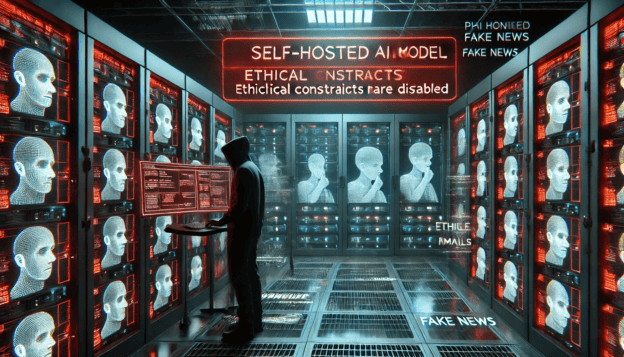
The Risks of Self-Hosting DeepSeek: Ethical Controls, Criminal Facilitation, and Manipulative Potential

Self-hosting advanced AI models like DeepSeek grant unparalleled control but poses severe risks if ethical constraints are removed. With relatively simple modifications, users can disable safeguards, enabling AI to assist in cybercrime, fraud, terrorism, and psychological manipulation. Such models could automate hacking, facilitate gaslighting, and fuel disinformation campaigns. The open-source AI community must balance innovation with security, while policymakers must consider regulations to curb AI misuse in self-hosted environments before it becomes an uncontrollable threat.

Continue reading