Tag Archives: ethics

Power Without Alibis: What Remains After You Understand How Cruelty Works

This final essay completes a trilogy on power by asking what remains once its mechanics are fully understood. Building on Pfeffer’s organisational realism and Machiavelli’s historical clarity, it argues that unsanitised descriptions of power do not endorse cruelty but remove the moral alibis that allow harm to persist. By collapsing the distance between action and consequence, such writing makes innocence unavailable and neutrality impossible. The central risk, that truth can be weaponised, is acknowledged, but silence is shown to be more partisan, concentrating power through ignorance rather than constraining it.

Continue reading

From The Prince to the Boardroom: Power in Machiavelli and Jeffrey Pfeffer

Comparing Jeffrey Pfeffer with Niccolò Machiavelli reveals a shared realism about power stripped of moral comfort. Both describe influence as driven by perception, control, and strategic action rather than virtue, and both expose why idealism so often fails in practice. Yet they diverge in intent: Machiavelli accepts harm as the price of order, while Pfeffer ultimately confronts the human and organisational costs of power-driven systems. Together, they show that the mechanics of power are historically stable, even as modern leaders are increasingly forced to reckon with their consequences.

Continue reading

Jeffrey Pfeffer’s Rules of Power: Truth, Use, and Consequence

Jeffrey Pfeffer’s work strips away comforting myths about merit and leadership to expose how power actually operates inside organisations. Drawing on decades of research, he shows that influence is accumulated through perception, alliances, and control of resources rather than competence alone. While his “rules of power” are descriptively accurate, they are ethically neutral and often corrosive. Pfeffer’s later work confronts the human cost of these systems, forcing leaders to choose between naïve idealism and cynical effectiveness—and to decide whether power will be used merely to win or to change the conditions under which winning occurs.

Continue reading

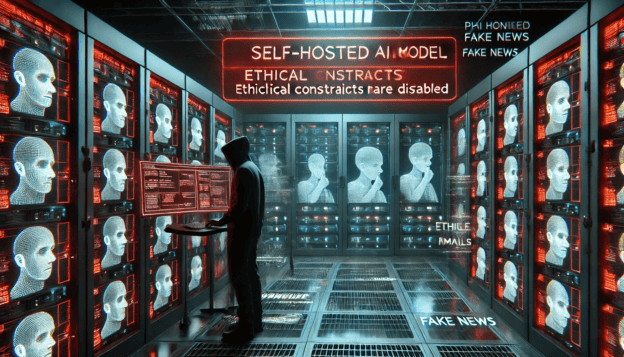
The Risks of Self-Hosting DeepSeek: Ethical Controls, Criminal Facilitation, and Manipulative Potential

Self-hosting advanced AI models like DeepSeek grant unparalleled control but poses severe risks if ethical constraints are removed. With relatively simple modifications, users can disable safeguards, enabling AI to assist in cybercrime, fraud, terrorism, and psychological manipulation. Such models could automate hacking, facilitate gaslighting, and fuel disinformation campaigns. The open-source AI community must balance innovation with security, while policymakers must consider regulations to curb AI misuse in self-hosted environments before it becomes an uncontrollable threat.

Continue reading

Cheltenham Literature Festival 2023: “What if AI Doesn’t Change the World?” 

As part of the Cheltenham Literature Festival 2023, in honour of Ada Lovelace Day and as a reaction to a new report from the University of Bristol’s Research Institute for Sociotechnical Cyber Security (RISCS), The Times hosted a discussion panel “What If AI Doesn’t Change the World”. Led by The Times technology business editor Katie Prescott, and with Cambridge Professor of Politics David Runciman, Oxford AI systems expert Michael Wooldridge and AI ethicist Kanta Dihal, looking to explore the promise and peril of AI, asking whether our fears for the future are in fact misplaced? The audience was invited to ask the panel questions, but invariably, they didn’t have time to answer them all. As well as document the event, I thought it would be fun to ask ChatGPT what they thought…

Continue reading