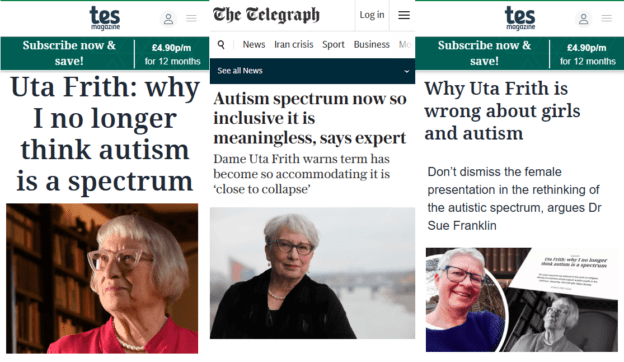
A response to Dame Uta Frith on autism, diagnosis, and the limits of the spectrum. Dame Uta Frith’s claim that the autism spectrum is “close to collapse” reflects a real tension in modern diagnosis. This article argues that the issue is not over-inclusion, but diagnostic flattening following the DSM-5 consolidation of distinct profiles into a single category. Drawing on a broader series of work, it reframes the problem as structural, shaped by simplification, usefulness, and misalignment between cognitive diversity and fixed systems.
Contents
- Contents
- 1. Introduction
- 2. Who Is Dame Uta Frith and Why This Matters
- 3. The Claim: The Spectrum Has Become Meaningless
- 4. The Current Debate: Frith and Her Critics
- 5. This Is Not New
- 6. Where I Agree: The System Is Under Strain
- 7. The Misdiagnosis of the Problem
- 8. The Spectrum Problem: When Simplicity Reduces Resolution
- 9. “We Are All Neurodiverse”
- 10. Where I Disagree: Masking Is Not Optional or Theoretical
- 11. The Two-Group Idea
- 12. The Role of Usefulness
- 13. The Real Problem: Misaligned Minds in Shared Systems
- 14. What Actually Happened
- 15. What Comes Next
- 16. Conclusion
- 17. References
1. Introduction
The recent Telegraph article “Autism spectrum now so inclusive it is meaningless, says expert” reports Dame Uta Frith’s warning that the autism spectrum has become so broad as to be “close to collapse”. Coming from one of the figures who helped shape the modern cognitive understanding of autism, this is not a throwaway remark. It reflects a growing unease within the field that the category may no longer be doing the work it was intended to do. The question is not whether something has shifted, but what exactly has changed, and why.
The original interview, “Uta Frith: why I no longer think autism is a spectrum“, published by Tes (Times Educational Supplement), makes clear that Frith’s position is more nuanced than the headline suggests, focusing on the expansion of diagnostic interpretation rather than a change in the underlying definition. At the same time, responses to her remarks, including a Tes published rebuttal, “Don’t dismiss the female presentation in the rethinking of the autistic spectrum, argues Dr Sue Franklin“, focused on the diagnosis of girls and women, highlight that this is not a settled issue, but an active and contested debate.
2. Who Is Dame Uta Frith and Why This Matters
Dame Uta Frith is not a peripheral voice in autism research. She is one of the figures who helped shape how autism is understood today, particularly through her work on cognitive models and the theory of mind. Her research contributed to a shift away from purely behavioural descriptions towards a more structured, theoretically grounded approach.
That matters because when someone in that position says the autism spectrum is now “close to collapse”, it is not a casual comment. It is not criticism from outside the field. It is a signal from within it that something has drifted.
This article is part of a broader series examining neurodivergence through the lenses of usefulness, history, lived experience, and diagnostic frameworks. Earlier work in that series explores how classifications such as Asperger’s syndrome emerged in systems that evaluated people in terms of perceived value, and later articles examine whether modern diagnostic models accurately reflect the diversity they claim to describe. What Frith has identified is not new. It is a visible point in a longer pattern.
3. The Claim: The Spectrum Has Become Meaningless
In her original Tes interview, Frith argues that while the core definition of autism remains stable, its interpretation has broadened significantly over time. The spectrum, initially intended to capture variation, has become increasingly inclusive, raising the question of whether it still functions as a meaningful diagnostic category.
She raises a number of concerns that are difficult to dismiss outright. There has been a rise in self-diagnosis. Clinicians are under pressure. Diagnostic processes rely more heavily on subjective reporting than they once did. The category itself now appears to include a very wide range of profiles, some of which differ substantially in both presentation and support needs.
Her conclusion is that when a category expands far enough, it stops distinguishing anything meaningful. If everyone is, in some sense, on the spectrum, then the spectrum ceases to function as a useful diagnostic tool.
That is the claim. It is not unreasonable. But it is incomplete.
4. The Current Debate: Frith and Her Critics
Frith’s argument has not gone unchallenged. A response published by Tes focuses in particular on her scepticism regarding the diagnosis of girls and women, and on her dismissal of masking as a meaningful concept.
That critique reflects a broader shift in recent years, where lived experience, particularly among late-diagnosed individuals, has become more visible and more influential in shaping public understanding of autism. For many, especially women, the concept of masking is not merely theoretical but central to how their experiences are understood.
At one level, this appears to be a disagreement about evidence. At another, it reflects something deeper. Both positions are responding to the same underlying tension. A diagnostic system that attempts to compress highly diverse cognitive profiles into a single category will inevitably produce disagreement about where its boundaries lie.
Frith sees the category becoming too broad. Her critics see it as still failing to capture certain experiences. Both observations can be true at the same time.
The emerging debate around Frith’s comments illustrates something important. The disagreement is not about whether autism is complex. It is about whether the current model is capable of representing that complexity at all.
5. This Is Not New
None of this is new. The issues Frith describes are not recent developments, but the predictable outcome of a system that has prioritised simplification over accuracy.
Across this series, I have examined how historical classification, economic usefulness, and lived experience all intersect with diagnostic frameworks. The tension between complexity and simplicity appears repeatedly. Systems that attempt to describe human variation tend to compress it into something manageable. Over time, that compression introduces distortion.
The spectrum problem is not an anomaly. It is a consequence.
6. Where I Agree: The System Is Under Strain
There are areas where Frith is clearly right, and it is worth stating that explicitly.
Self-diagnosis, when detached from structured assessment, introduces noise into the system. Clinical services are under significant pressure, both from rising demand and from expectations shaped by public discourse. While important, subjective experience alone is not sufficient as a diagnostic foundation.
Anyone who has gone through a proper assessment process understands that diagnosis is not a quick or casual exercise. It involves multiple sessions, developmental history, input from family or others who knew the individual in childhood, and careful observation of behaviour across contexts. It is a process designed to build a picture from multiple data points, not simply to confirm a self-description.
So yes, the system is under strain. But the source of that strain is not simply that too many people are being included.
7. The Misdiagnosis of the Problem
Frith frames the issue as one of over-inclusivity. The spectrum has become too accommodating, and in doing so has lost its meaning.
That framing identifies the symptom, but not the cause.
The deeper issue is not that more people are being included. It is that different kinds of profiles have been collapsed into a single category. The DSM-5 did not simply broaden autism. It removed distinctions that previously existed between related but not identical conditions, including Asperger’s syndrome, autistic disorder, and PDD-NOS, and placed them under a single diagnostic label.
This is a problem I examine in detail in The Spectrum Problem after The Question of Usefulness (Part 4 of this series, forthcoming), where I argue that diagnostic simplification has obscured meaningful differences among cognitive profiles.
The intention was to improve consistency and reduce confusion. In practice, it replaced one form of ambiguity with another. Different profiles did not disappear. They became harder to describe. Maenner et al. (2014) showed how the DSM-5 consolidation itself contributed to broader but less differentiated prevalence estimates, illustrating the trade-off between consistency and resolution.
8. The Spectrum Problem: When Simplicity Reduces Resolution
The concept of a spectrum is often interpreted as a simple line ranging from mild to severe. In reality, autism has always been closer to a multi-dimensional space. Individuals vary across communication, sensory processing, cognitive style, emotional regulation, and adaptive functioning, and those variations do not align neatly along a single axis.
By collapsing multiple diagnostic categories into a single category, the system reduced the number of labels available to describe that variation. The result is a single category that now contains individuals with profoundly different experiences.
Some require lifelong support with daily living. Others operate independently in complex professional environments while managing less visible but still significant challenges. These are not simply different degrees of the same condition. They represent different configurations of cognition.
When a category becomes this broad, distinctions begin to blur. Support needs become harder to interpret. Public understanding becomes less precise. The category remains clinically useful in some contexts, but descriptively limited.
This is not a problem of inclusion. It is a problem of resolution.
9. “We Are All Neurodiverse”
Frith challenges the idea that “we are all neurodiverse”, and she is right to do so. At a population level, it is trivially true that all human brains differ. At a diagnostic level, that observation does not help.
A category that includes everyone does not distinguish anything. It cannot guide intervention, structure support, or provide a meaningful basis for classification. The problem is not that neurodiversity is a flawed concept. It is that we have attempted to translate a broad descriptive idea into a clinical framework without preserving its distinctions.
The result is a category that is conceptually inclusive but operationally weak.
10. Where I Disagree: Masking Is Not Optional or Theoretical
One area where I do not agree with Frith is her dismissal of masking. The claim that masking lacks a scientific basis does not reflect the lived reality of many autistic individuals.
The disagreement here is not simply empirical. It reflects a gap between what can be measured externally and what is experienced internally, a gap that has become more visible in recent discussions, particularly around the diagnosis of women and late-identified individuals.
This is increasingly reflected in emerging research on camouflaging and its psychological costs, even if those frameworks remain incomplete. This includes evidence linking camouflaging to increased anxiety, depression, and long-term exhaustion (Khudiakova et al., 2024; Summerill, 2025). This creates a situation where the absence of evidence is often mistaken for evidence of absence.
Masking is not a vague idea. It is a process that can be described in concrete terms. It involves continuous monitoring of behaviour, deliberate control of tone and expression, real-time reconstruction of responses, and suppression of instinctive reactions that do not align with expected social norms. It is not adaptation in the sense of becoming naturally aligned with an environment. It is sustained compensation.
From the outside, masking can appear seamless. From the inside, it is effortful and continuous. Over time, that effort accumulates, often leading to exhaustion, anxiety, or withdrawal. The fact that this process is difficult to measure with traditional methods does not mean it is absent. It means that the methods are not well-suited to capturing it.
Masking is therefore best understood not as simple adaptation but as an ongoing cost of operating in environments that were not designed for how certain minds work.
11. The Two-Group Idea
Frith suggests that the spectrum now contains two broad groups, one diagnosed early in childhood, often with higher support needs, and another diagnosed later, often without intellectual impairment but with social or emotional difficulties.
This is an attempt to reintroduce structure into a category that has become too broad. It is directionally useful, but it remains a simplification. The reality is not two groups. It is a set of overlapping dimensions that vary independently.
Reducing that complexity to two categories risks repeating the same pattern that created the problem in the first place. It replaces one form of flattening with another.
12. The Role of Usefulness
There is another factor shaping how the spectrum has evolved, and it is not purely clinical.
Modern societies increasingly recognise and value certain cognitive traits associated with autism, particularly in fields that involve complex systems, data, engineering, and analysis. Pattern recognition, sustained focus, and system-level thinking are not only accepted but actively sought.
This creates a subtle but important distortion. Some profiles become more visible because they align with what systems find useful. Others remain less visible because they do not.
This dynamic is not new. As explored in Asperger’s Syndrome and the Question of Usefulness (Part 1 of this series), early classifications of autistic traits were shaped, at least in part, by perceived social and economic value. The context has changed. The underlying logic has not.
Understanding this helps explain why the spectrum appears to expand. It is not simply that more people are being identified. It is that systems are recognising certain forms of cognition more readily than others. This matters because it shapes not only who is diagnosed but also how those diagnoses are understood.
13. The Real Problem: Misaligned Minds in Shared Systems
Focusing only on diagnosis risks missing the broader issue.
Most environments are built around a relatively narrow set of assumptions about how cognition works. These assumptions shape communication norms, expectations around attention and responsiveness, and the structure of social interaction itself. They are rarely explicit, but they are embedded in how systems operate.
When individuals whose cognitive profiles do not align with those assumptions enter those environments, the resulting friction is often interpreted as a problem within the individual. In reality, it is a mismatch between different ways of processing information and the systems those processes are expected to operate within.
Diagnosis, therefore, sits within that system. It does not exist independently of it.
14. What Actually Happened
The spectrum has not suddenly collapsed. It has followed a familiar trajectory.
A complex set of phenomena was simplified into a manageable model. That model expanded to accommodate variation. As it expanded, distinctions became less clear. As distinctions blurred, the model became less useful as a descriptive tool.
This is not failure in the sense of something going wrong unexpectedly. It is what happens when complexity is compressed beyond what a model can hold.
15. What Comes Next
The answer is not to abandon the spectrum, nor to narrow it artificially by reverting to pre-DSM-5 subtypes. The challenge is to build frameworks that retain complexity without sacrificing clinical utility.
A more workable direction is a dimensional model supported by structured specifiers. Autism would remain a single diagnostic category, but it would be described across multiple independent axes, including communication, sensory processing, cognitive style, emotional regulation, and adaptive functioning, none of which are forced onto a single “mild-to-severe” line. Alongside this, clearer specification of support needs, masking or camouflaging load, and environmental fit would allow for more precise descriptions of individual profiles.
Such a system would allow clinicians to describe not just whether someone meets diagnostic criteria, but how their cognition is configured and where support is required. It preserves the consistency the DSM-5 aimed for, while restoring the resolution that flattening removed.
Until frameworks of this kind are adopted, the spectrum will continue to function as a blunt administrative tool rather than a precise map of cognitive diversity.
16. Conclusion
Frith is right that something has broken. The autism spectrum, as currently interpreted, is struggling to function as a coherent category.
But the cause is not simply increased inclusion. It is that the DSM-5 asked a single, flattened label to represent too much with too little structure, collapsing distinct cognitive configurations into one administratively convenient box.
The spectrum did not fail. It was flattened.
What Frith has identified is the symptom. The task now is to understand the system that produced it and to decide whether we are prepared to change it. A more dimensional, specifier-rich model is not only possible but necessary if diagnosis is to remain both scientifically honest and practically useful. The alternative is continued drift toward a category that means everything and therefore nothing.
17. References
- Tes (2026). Uta Frith interview: Autism is not a spectrum.
https://www.tes.com/magazine/teaching-learning/general/uta-frith-interview-autism-not-spectrum - Tes (2026). Why Uta Frith is wrong about girls and autism.
https://www.tes.com/magazine/analysis/general/why-uta-frith-wrong-about-girls-and-autism - Frith, U. (2026). Interview with Tes magazine, as reported in The Telegraph: Autism spectrum now so inclusive it is meaningless, says expert.
https://www.telegraph.co.uk/news/2026/03/05/no-autism-spectrum-expert-pioneered-concept-says/ - MSN (2026). Autism spectrum now so inclusive it is meaningless, says expert. (reprint of Telegraph article)
https://www.msn.com/en-gb/health/mindandbody/autism-spectrum-now-so-inclusive-it-is-meaningless-says-expert/ar-AA1XBhYz - Reddit (2026). Autism spectrum now so inclusive it is meaningless… discussion thread.
https://www.reddit.com/r/ukpolitics/comments/1roc08u/autism_spectrum_now_so_inclusive_it_is/ - American Psychiatric Association (2013). Diagnostic and Statistical Manual of Mental Disorders (DSM-5).
- Khudiakova, V. et al. (2024). A systematic review and meta-analysis of mental health outcomes associated with camouflaging in autistic people. Research in Autism Spectrum Disorders, 118, 102479.
- Summerill, J. (2025). The consequences of social camouflaging in autistic adults: A systematic review. Autism in Adulthood.
- Maenner, M.J. et al. (2014). Potential Impact of DSM-5 Criteria on Autism Spectrum Disorder Prevalence Estimates. JAMA Paediatrics, 168(7), 643–650.
- Horkan, W. (2026). The “Question of Usefulness” Series.
https://horkan.com/tag/question-of-usefulness