Tag Archives: neurodivergence

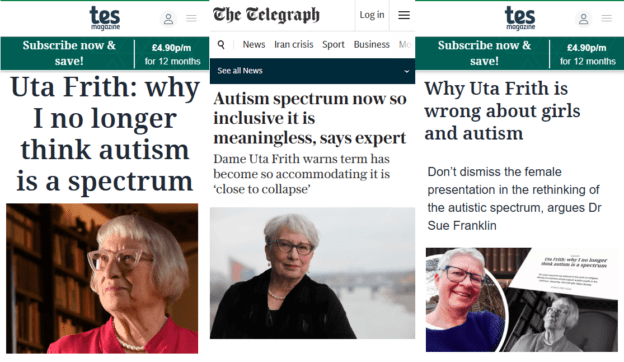
The Spectrum Didn’t Collapse. It Was Flattened. A Response to the Uta Frith Autism Debate.

A response to Dame Uta Frith on autism, diagnosis, and the limits of the spectrum. Dame Uta Frith’s claim that the autism spectrum is “close to collapse” reflects a real tension in modern diagnosis. This article argues that the issue is not over-inclusion, but diagnostic flattening following the DSM-5 consolidation of distinct profiles into a single category. Drawing on a broader series of work, it reframes the problem as structural, shaped by simplification, usefulness, and misalignment between cognitive diversity and fixed systems.

Continue reading

Asperger’s Syndrome and the Question of Usefulness

Part 1 of a seven-part series examining how societies understand neurodivergent minds through the lens of usefulness. The uneasy history of a diagnosis born in Nazi-era Vienna. Hans Asperger first described a group of intellectually capable but socially atypical children in Nazi-era Vienna. Later research has shown his work occurred within a medical system shaped by eugenics and the classification of human usefulness. This article examines the difficult history of the Asperger’s diagnosis, the children it helped protect, those it did not, and the lasting implications for how autism is understood today.

Continue reading

Can’t Understand Neurodivergent Thinking

Using the February 2026 BAFTA controversy involving Tourette’s activist John Davidson as a cultural flashpoint, this essay examines why neurodivergent people are instinctively rejected. Blending research, lived experience, and sector insight, it argues that discomfort with autistic cognition is not merely institutional but biological and tribal. Instinct, however, is not justification. Inclusion requires discipline, not sentiment. Tolerance must extend beyond what feels comfortable.

Continue reading