A personal philosophy of art, identity and self-creation: life as both medium and artwork, with the individual simultaneously artist, material and subject. Moving through self-belief, Punk, abstraction, failure and the absurdities of intellectualism, I argue that identity is not something waiting to be discovered but something continually made through thought, action, contradiction, experience and robust individuality.
When I was much younger, I described myself as “an anti-intellectual intellectual”. I have no idea whether I stole it from somewhere, invented it, or simply thought it sounded good, but I meant it. I still do. In fact, after decades spent in engineering, technology, systems, philosophy, art, music and the general business of thinking about things far more than is strictly necessary, I probably mean it more now than I did then.
What I’m circling around now is something I’ve probably been circling around for years: my self-belief as art, as life; life as art; the individual as artist; myself as artist; my life as art. I like the meandering of it because the movement between those ideas is the idea. I make things and, in making them, make myself. I am the artist, but I am also the material, the subject and the work, and increasingly I see no useful reason to separate any of them. My life isn’t something that happens alongside the work. My life is the work.
Dave Sim put essentially the same thought into Cerebus years ago: “You are the baker and your life is the bread.”
That has stayed with me. You make the thing, and you are the thing being made. The baker changes the bread; the business of baking changes the baker. There is no pristine self standing outside the process directing operations. I am making my life from the material of myself, while the life I make is continually making the next version of me.
Which is probably why I don’t see self-belief as something you acquire before doing any of this. The self-belief is in the doing. The authority is mine because the authorship is mine.
I like ideas. I like difficult ideas, ridiculous ideas, ideas that connect things which aren’t supposed to connect. I like taking things apart to see how they work and, occasionally, putting them back together in a form nobody asked for. What I have considerably less patience for is intellectualism as performance: the idea that describing something at sufficient length, preferably using terminology nobody outside the room understands, somehow constitutes doing something.
I’ve written enough about bollocks to recognise this particular variety. The recurring target of my “More Bollocks” pieces was never really technology, Banksy, Damien Hirst, AI, Oracle, influencers or whatever happened to be irritating me that week. It was the process by which hype becomes accepted wisdom and accepted wisdom becomes orthodoxy simply because enough people stop asking what is actually underneath it. I eventually admitted as much myself: the series was really about “the kind of belief that no longer asks questions”.
Art is particularly good at this sort of bollocks. Give an ordinary object sufficient gallery lighting, attach several paragraphs of impenetrable artspeak and establish a sufficiently absurd price, and people become remarkably reluctant to say, “Yes, but is it any fucking good?” My problem with Damien Hirst, for instance, was never that a shark in formaldehyde couldn’t be art. Of course it can. My objection was to the industrial quantity of mythology, marketing and pseudo-profundity required to insist upon its importance.
Which brings me, somewhat inevitably, to Sid Vicious.
“We don’t think, we just do.”
Seven words. Job done.
That sentence appeals enormously to the anti-intellectual intellectual in me. It isn’t a rejection of intelligence; I couldn’t reject thinking if I tried. It is a rejection of the idea that thought is sufficient. I can think about something indefinitely, construct an elaborate intellectual architecture around it, identify its antecedents, understand its implications and give the whole thing a splendid Latin name, but sooner or later I have to do something.
I have nothing against abstraction. I’ve spent enough of my life constructing abstractions to make that accusation difficult to sustain. I was talking to my son Bill recently about his dissertation, comparing Warlock with Gravity’s Rainbow, and we wandered into Deleuze and Guattari, affect and schizoanalysis: exactly the sort of territory I enjoy, right up until the intellectual machinery begins analysing the machinery analysing the machinery.
I’ve always had a problem with “meta” for this reason. Once something is genuinely meta, once the description contains a description of itself, where exactly are these additional levels supposed to be going?
Years ago, when I was building the identity management platform for UBS Warburg, their CTO and Chief Architect, Noel Jones, said to me, drunk in a lift, “We have a problem with our meta, meta, meta data.”
All I could think was: daft cunt. Once it’s self-describing, that’s it.
I’ve remembered that ever since, partly because it was funny and partly because I still think I was right. Adding another “meta” doesn’t necessarily take you to a higher intellectual plane. Quite often you’ve just added another fucking “meta”.
This is the anti-intellectual intellectual again. I love abstraction when it reveals something. I lose interest when abstraction becomes recursion performed as profundity. At some point, the model has to touch the thing being modelled; the philosophy has to touch the life; thought has to become action. Don’t get me wrong, I like abstraction, but just don’t take the piss, right?
We don’t think, we just do.
Not because thinking is worthless. Because eventually thinking has to cash the cheque.
Doing introduces reality.
Reality is useful because it doesn’t give a shit about the elegance of the theory. The thing works, or it doesn’t. It communicates, or it doesn’t. It produces the intended result or, frequently more interestingly, something completely different happens. The stupid idea works. The clever idea collapses. The throwaway gesture turns out to contain something that takes years to understand.
I think, I do, I look at what happened, I think again, and I do something else. I’ve been doing that all my life.
The interesting discovery is that the things I make also make me.
That sounds obvious until you take it seriously. We have this persistent idea of the authentic self as something waiting to be discovered. “Find yourself.” “Be yourself.” “Be true to yourself.” There is apparently a factory-original Wayne buried beneath several decades of accumulated experience, and my task is to scrape away the additions until I locate him.
Bollocks.
There is no archaeological Wayne.
I was obsessed with XTC’s Making Plans for Nigel when I was young: a life as a construct, the finished product specified by somebody else. I’ve never been particularly interested in living according to somebody else’s specifications.
And if anyone is making plans for Nigel, it’s been a long time since I’ve been listening.
There are earlier versions of me, certainly. “I am an anti-intellectual intellectual” is evidence of one of them. I recognise him perfectly well. I can see continuities between what he thought and what I think now, but he isn’t the authentic version, and I am not the corrupted copy. He was making himself then, and I am making myself now.
That is a much more interesting way to understand a life, especially my own.
I have made myself through what I’ve done, made, built, written, read, worn, learned, loved, hated, collected, discarded, believed, disbelieved and changed my mind about. Through people I’ve known and people I’ve avoided. Through technology, music, art, work, humour, mistakes, accidents and obsessions. Some of this has been deliberate; some of it has happened to me; quite a lot of it has probably happened because I was pursuing something else entirely.
None of that makes it less mine.
The meandering is part of the composition.
And that is where I arrive at art, because increasingly I find the distinction between making things and making myself rather artificial. If art is the application of imagination, intention and action to material, then I have material available to me every waking moment. My ideas are material. My appearance is material. My work is material. My language is material. My decisions are material. My mistakes are material. Time is material. Most obviously, I am material.
I am not expressing a finished self through art. I am constructing the self through the act of living.
Joseph Beuys said, “Everyone is an artist.” His expanded conception of art went far beyond painting and sculpture; creativity, for Beuys, belonged in engineering, economics, medicine, architecture, social organisation, and ordinary human activity. The interesting part wasn’t making everything look like Art. It was recognising creative agency wherever people actually shape the world.
I agree with him, although everyone else can decide what to do with their own lives. I’m concerned with mine.
I am the individual as artist, myself as artist, my life as material and my life as art. Not because somebody has designated it as such, and not because I need to submit an application to the art world and await accreditation. The proposition begins with me. Everything else follows from it.
I came to something similar recently while thinking about John Lydon. My conclusion was wonderfully simple: John defines Punk by being John. That’s it, simple as.
That is the direction of travel that matters. John doesn’t begin with Punk and then work out how he ought to behave in order to remain compliant with the specification. Punk has to deal with John. His individuality precedes the classification. Ergo sum John is Punk.
When I was a young man, my nickname was Womble. Call me Womble.
Names are interesting things. Some are given to us, some we choose, some we acquire, and occasionally one simply sticks. Womble is one of mine. I was Womble because I was Womble. It requires about as much further explanation as John Lydon being Johnny Rotten.
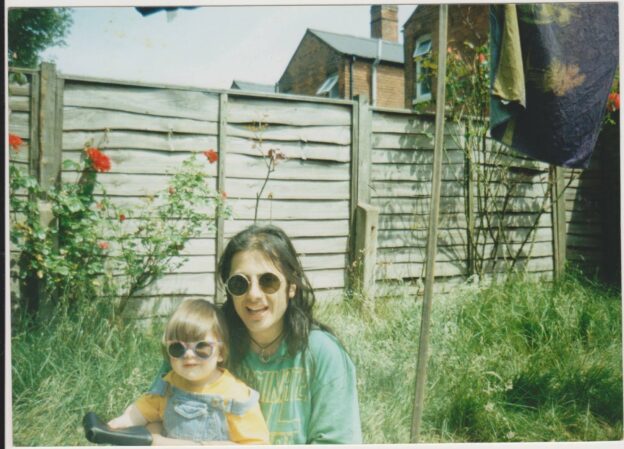
That’s me in the featured image at about 23, two years after finding my Dad dead, and living with what turned out to be quite serious CPTSD from the experience. In the garden of my house at Wilton Road, in Handsworth, with my son, Zach. And yes, the T-shirt does have a William S. Burroughs quote on it: “Terminate all rational thought”. Ta Bill, love ya.
Once I’d put it that way, Punk itself became more interesting to me. Strip away the clothes, the musical conventions, the iconography, and the endless arguments about who was or wasn’t really Punk and what remains is something much harder to commodify: robust individuality.
The phrase matters because individuality itself has become cheap. Everyone is encouraged to “be individual”, generally by selecting from an approved range of consumer products designed to demonstrate precisely the right kind of uniqueness. Even rebellion comes with a dress code.
Robust individuality is different. It survives classification. It doesn’t ask the category what it is supposed to do next.
And art, for me, works the same way.
I have no interest in asking what an artist is and then attempting to conform to the answer. That’s backwards. I make things because I make things. I write because I write. I build because I build. I dress as I dress. I pursue things because they interest me, abandon things when they cease to, change my mind when I change my mind, and occasionally follow an idea simply because it amuses me.
Art can deal with me.
Robert Rauschenberg famously positioned himself at the intersection of art and life. I’ve become less convinced that I need the gap. Once the self becomes both artist and material, the boundary becomes difficult to maintain anyway. I make something because of who I am; making it changes me; the changed me makes something else. The artist produces the work, and the work produces the next iteration of the artist.
There is something wonderfully recursive about it, which probably appeals to the engineer in me.
It also means that failure belongs in the system.
This is important because the temptation, particularly when talking about one’s own life as art, is to turn the whole thing into a heroic autobiography. Everything becomes meaningful. Every mistake was secretly a lesson. Every wrong turn turns out to have been necessary. Every piece of shit becomes fertiliser for the magnificent flower of the present self.
More bollocks.
Some mistakes are simply mistakes. Some ideas are bad. Some enthusiasms are embarrassing in retrospect. Sometimes I have been wrong, occasionally spectacularly so, and there is no requirement to redeem every error by pretending it was secretly part of the plan.
It remains part of the work.
Painting has pentimento: earlier images, alterations and abandoned decisions becoming visible beneath the surface of the finished work. I like the idea enormously because human beings are full of pentimenti. Previous selves show through. Old ideas remain faintly visible beneath new ones. Things we thought we’d painted over reappear in a different light.
I don’t want to remove that. I want the provenance.
Nor do I particularly want coherence. Coherence is what biographers impose afterwards. Lives are lived forwards and explained backwards, and the explanation is inevitably neater than the experience. In reality, we wander about, get distracted, become obsessed with things, meet people unexpectedly, make decisions with insufficient information and occasionally discover that something we thought was irrelevant twenty years ago has been quietly shaping everything since.
That’s not a defect in the composition.
That’s the composition.
Which is why “life as art” isn’t, for me, a declaration that every mundane action is secretly an artwork. I don’t need to declare breakfast a performance piece. The art world has produced quite enough overintellectualised bollocks without my assistance; I’ve already complained about precisely that tendency in writing about Hirst and Banksy.
The proposition is simultaneously simpler and larger. A life can be approached creatively. The self can be material. Identity can be made rather than merely discovered. The individual can be an artist, a subject and an artwork without requiring those roles to remain conveniently separate.
And, importantly, the work remains unfinished.
Edgard Varèse said, “The modern-day composer refuses to die.”
I’ve always liked the belligerence of that. Not the composer hopes to survive, or wishes posterity would remember him, but refuses. It turns continuation into an act of will.
I hear it as something broader than music. Keep composing. Keep altering the arrangement. Keep introducing new material. Paint over something. Leave something exposed. Follow an obsession. Change your mind. Do something completely inconsistent with what came before and see whether the composition can accommodate it.
It can. It’s yours.
Eventually, the work will be finished. That particular problem has already been solved for all of us and requires no intellectual contribution whatsoever.
Until then, I continue.
Which leaves me more or less where I started all those years ago, with the anti-intellectual intellectual. I’ve accumulated more ideas since then, more experience, more vocabulary, more things to think about and considerably more evidence that thinking alone doesn’t get the job done.
Sid had it right: “We don’t think, we just do.“
And so I do, and then I think about what I’ve done, and then I do something else. Somewhere in that recursive, contradictory, occasionally ridiculous process, I continue making things, and those things continue making me.
Art as life, life as art, the individual as artist, myself as artist, myself as material, my life as art.
It meanders. So do I. And I’m still making it.