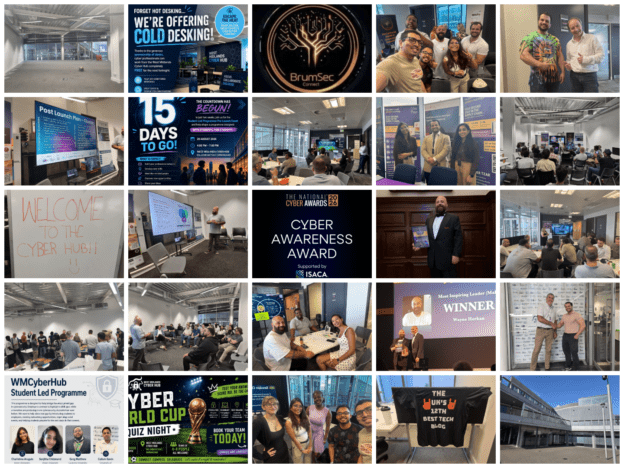
Success, autistic burnout, the West Midlands Cyber Hub, and what comes next. I have been unusually quiet online while the Hub has expanded, secured its long-term home and begun evolving into the West Midlands Cyber Cluster. More importantly, we are discovering that the community around it represents a substantial indigenous cyber economy hiding in plain sight: established, revenue-generating SMEs with far more collective commercial weight than the region has historically recognised.
Contents
- Contents
- 1. Introduction
- 2. I Went Quiet. The Work Didn’t.
- 3. A Rather Better Award Experience: Watching Andy Win
- 4. Why We Started Doing This in the First Place
- 5. Building the Hub Was Considerably Harder Than It Looked
- 6. What We Built in the First Year
- 7. Three Things I Did Not Expect
- 8. A Five-Year Home at Millennium Point
- 9. From Hub to Cluster: A Network of Networks
- 10. Cyber in the West Midlands: An Independent Strategic Review
- 11. Education and the Regional Talent Pipeline
- 12. Events, Community and a Bit of Football
- 13. Cyber Tzar and the Universal Cyber Risk Index
- 14. Psyber Inc, WARP Labs and the Social Systems Around AI
- 15. Returning to Horkan.com
- 16. One Year On
- 17. Conclusion and What Comes Next
1. Introduction
I have been unusually quiet for the last few months. I have barely been on LinkedIn, I have neglected this blog, and I have spent far more time programming, researching and building things than talking publicly about any of them. Given how much has actually happened during that period, the silence probably deserves an explanation before I attempt the rather substantial update that follows.
Some of that news is visible: the Hub has grown, we have signed a five-year lease, the education programmes are expanding, and the West Midlands Cyber Cluster is taking shape. But perhaps the most important thing we have learned is less obvious. When you look collectively at the companies operating from and around the Hub, what appears from a distance to be a collection of small cyber businesses is actually a substantial indigenous commercial ecosystem. The West Midlands cyber economy is larger, more established, and more economically significant than many people realise.
2. I Went Quiet. The Work Didn’t.
Earlier this year, I was named Most Inspiring Leader (Male) at the inaugural Birmingham Business Best Places to Work Awards, representing the West Midlands Cyber Hub. It was a wonderful thing to receive, and I remain hugely grateful to Birmingham Business, the judges, everybody who supported me, and particularly the people who have spent the last year helping us build the Hub. I have never regarded the Hub as something I created on my own, so receiving an individual award for work that has depended on a large and increasingly committed community was both flattering and slightly strange.
What I had not anticipated was how badly the experience would affect me afterwards. I am autistic, and the combination of attention, expectation, emotion and visibility around the award contributed to a fairly severe period of autistic burnout. I withdrew from LinkedIn, stopped writing here for a while, and reverted to the things I find easiest when I need to recover: technical work, programming, research, systems and building.
I am not particularly interested in psychoanalysing that publicly. I have done enough soul-mining on this site already, and anybody who wants it can find plenty of writing here about masking and its costs, lived experience and usefulness, what happens when autism does not work neatly as a story of exceptional capability, and why, increasingly, I prefer to let the work speak for itself. There are aspects of my own history that I have no intention of turning into content, and that is enough explanation for now.
The important point is that while I went quiet, the work did not.
3. A Rather Better Award Experience: Watching Andy Win
There was another award this year that I found considerably easier to enjoy.
My son, Andy Horkan, CEO of Cyber Tzar, was named Young Business Person of the Year at the Signature Awards.
Watching your son receive recognition for something he has built in his own right is a very different experience from standing on a stage yourself. There was none of the strange discomfort I experienced around my own award; I was simply enormously proud of him.
Andy has increasingly taken Cyber Tzar in a strongly commercial direction, focusing on supply-chain cyber resilience. His focus is not cyber security as an abstract technical discipline, but what cyber risk means commercially: revenue, contracts, customers, operational continuity, regulation, supply-chain accountability and ultimately an organisation’s ability to continue trading when something goes wrong.
That is also important to me personally because Cyber Tzar is changing from something I founded into something with leadership and direction that is increasingly Andy’s own. Founders are not always particularly good at allowing that to happen, and I am conscious that the best thing I can sometimes do is provide the vision, technology, research and experience while giving him room to build the company he wants Cyber Tzar to become.
Being named Young Business Person of the Year therefore felt significant. It was recognition of Andy, rather than an extension of recognition of me, and of the commercial leadership he is bringing to the company.
As a father, that was one of the best moments of the year.
4. Why We Started Doing This in the First Place
It is probably worth going back to why I became involved in trying to organise the West Midlands cyber community in the first place, because the Hub did not appear from nowhere.
The Cyber Working Group was originally established by Professor Prashant Pillai at the University of Wolverhampton, with support from the Innovation Alliance for the West Midlands. I subsequently took on the chair and effectively rebooted the group following discussions around CyberFirst and the development of the regional cyber ecosystem.
One observation from the NCSC, DSIT (now DCMS), and wider government, in particular, stuck with me. The West Midlands had pockets of very good cyber activity, capable organisations and excellent people, but suffered from poor coordination and, perhaps more importantly, a lack of community coherence.
I thought that diagnosis was basically right, but boy did I not enjoy hearing it.
There was never a shortage of capability. We had universities conducting excellent research and teaching, cyber businesses, security practitioners inside some of the country’s largest organisations, public-sector capability, students, entrepreneurs and a substantial industrial economy with an obvious and growing requirement for cyber resilience. What we lacked was a sufficiently coherent mechanism for connecting those things.
So we rebooted the Cyber Working Group and started trying to create some of that coherence ourselves. We were actually quite specific about what we wanted the refreshed Cyber Working Group to achieve. There were four broad objectives.
- First, cyber needed to come out from under the broader digital agenda and have at least equal standing within the regional technology landscape.
- Second, we wanted a physical space around which the cyber community could coalesce.
- Third, we wanted a proper cyber festival, ideally as part of Birmingham Tech Week.
- And fourth, we wanted to see greater investment flowing into cyber businesses and capability in the West Midlands.
Looking back at those objectives now is interesting because they provide a useful test of what has happened since. The physical-space ambition became the West Midlands Cyber Hub. Cyber has become substantially more visible within the regional technology agenda. Our events and communities are increasingly intersecting with Birmingham Tech Week (BTW) and the wider regional technology ecosystem, and thanks to the team at TechWM behind BTW, CyberVerse now provides the annual cyber festival we originally hoped to see. Investment, however, remains the area where the region has the furthest to go, and this has become one of the central reasons for creating the West Midlands Cyber Cluster.
We put on larger events, brought in some excellent speakers and deliberately tried to bring together people who might otherwise have remained within their own institutional or professional networks. I documented quite a lot of that work here at the time, including regional cyber collaboration, skills, strategy and the need for a shared future, and later reflected on CyberFirst and what makes the West Midlands cyber community distinctive.
The next question was whether we could move beyond convening people and create some actual infrastructure.
That was where the idea for the West Midlands Cyber Hub came from. I developed the proposal, put together the Cyber Local bid and won the funding. I had already spent considerable time supporting and thinking about the wider Cyber Local programme and regional cyber resilience, and the Hub became our attempt to turn those lessons into something physical in the West Midlands.
By the time we reached launch, I had written about what we hoped the West Midlands Cyber Hub could become. What followed was considerably harder than winning the bid. But it worked.
5. Building the Hub Was Considerably Harder Than It Looked
I have probably underplayed how difficult it was to implement the Hub. Looking at where we are now, it would be easy to imagine that we developed the proposition, secured the Cyber Local funding, assembled the partners, found a building and then worked through a reasonably orderly delivery plan. The reality was considerably messier.
Several assumptions underlying the original delivery model changed during implementation. The facilities and event space we had expected to use were no longer available in the way we had anticipated; staffing and delivery arrangements changed; proposed alternatives would have significantly constrained what the Hub could become; and some of the financial support we had expected did not materialise. At various points, we were trying to deliver a regional cyber hub while simultaneously figuring out where it could operate, how to run the programme properly, and how to keep the whole thing moving.
That mattered because the physical model was never incidental to the idea. We were not trying to create an occasional meeting room or another programme that appeared for a funded period and then disappeared. If the Hub was going to address the lack of community coherence that had prompted the work in the first place, it needed to be somewhere people could repeatedly meet, work, run events, bring students and employers together, support businesses and gradually establish a community around a permanent physical centre of gravity.
Some of the alternatives put forward during implementation simply could not have delivered that. There were periods when the gap between the Hub we had proposed and the Hub we appeared capable of delivering became uncomfortably large, and there were certainly moments when I wondered whether we were going to get it over the line at all. I wrote about some of those early realities contemporaneously in West Midlands Cyber Hub Diaries: Day One (or Perhaps Day Sixty).
What ultimately mattered was that other people and organisations stepped forward when we needed them. The University of Wolverhampton helped us. The West Midlands Cyber Resilience Centre helped us. Cliff Dennett and the Innovation Alliance for the West Midlands helped us. Millennium Point helped enormously, initially by enabling us to establish the Hub and subsequently by giving us the opportunity to make it much more permanent. There were others who provided introductions, facilities, advice, credibility, and practical assistance precisely when those things were needed.
I could write a much more detailed account of what went wrong during implementation, and perhaps I will at some point. I do not particularly want this article to become an exercise in allocating blame, because the more useful lesson is about delivery. Strategies, institutions, governance structures and funding programmes all matter, but implementation is where assumptions encounter reality. Regional innovation is not created by drawing an ecosystem diagram and identifying the organisations that ought to participate in it; somebody eventually has to make the thing work when the facilities change, the money does not arrive, a partner changes direction, or the original plan simply proves impractical.
That experience has influenced how I think about the Hub and the emerging West Midlands Cyber Cluster. We increasingly describe the Cluster as practitioner-built, and I do not regard that simply as positioning language. Practitioners really did have to build it. The Hub exists because enough people decided that the outcome mattered more than preserving the original delivery model, adapted when things went wrong, and kept going until we had something that worked.
That is also why the results matter. They were not produced by a project that ran according to plan; they were produced despite the fact that, for a while, quite a lot of the plan did not.
6. What We Built in the First Year
The West Midlands Cyber Hub has changed significantly since launch. Between November 2025 and now (aka August 2026), we have held 39 events, engaged more than 1,200 participants from over 500 organisations, supported more than 40 SMEs through clinics, helped more than 25 students into placements or roles, and developed a physical environment that now includes hot desks, offices and a growing resident community.
What those figures do not capture, however, is the commercial weight accumulating around the Hub; I return to that later because it may be one of the most important things we have learned during the first year.
Another part of the original proposition matters just as much to me. The Hub was intended from the outset to be a safe and supportive environment for women and neurodivergent people working in, studying, entering or interested in cyber. That remains core to what we are building. Those communities are not peripheral diversity initiatives bolted onto the Hub after the fact; they are part of the kind of cyber community we intended to create from the start. If we are serious about widening the regional talent pool, we need environments in which people who have historically found parts of the technology industry difficult to enter, navigate or remain within can participate on their own merits and build lasting professional relationships.
The Christmas and New Year update I wrote at the beginning of 2026 provides an interesting intermediate snapshot. Even then, the Hub was developing quickly, but what has happened since has made the direction much clearer.
There is also a danger in describing the Hub through programmes, events, and statistics that I leave out the most important part: the people and companies who have actually made it a community.
Over the year, we have been joined by, worked alongside, hosted or developed relationships with some terrific businesses and organisations. Rugosus, Orbital, Cybercy, and the Cyber Chain Alliance have become part of the fabric around the Hub, alongside organisations such as BT Mainland and Jensten, who have very kindly supported and sponsored our social activities. There are many more, and I will inevitably annoy somebody by leaving them out, but one of the unexpected pleasures of the last year has simply been the number of new friends, partners and collaborators we have made along the way.
The same is true at Cyber Tzar. Andy has continued building the company and its team, joined by Martin Stevenson, Calum Gavin, Sanjitha Chidanand, Charishma Arugula, Hannah Hall and Genti Mezini, while our relationship with Aspen Waite and others has continued to develop. I have written elsewhere about Andy taking increasing ownership of Cyber Tzar commercially; seeing him assemble his own team around that direction is another part of the transition.
None of this happens in isolation. We have had extraordinary support from individuals and organisations across the Combined Authority, universities, businesses, professional communities and the wider region. I will put together a fuller acknowledgement separately because there are too many people to name casually, and I would rather do it properly than leave somebody important out.
The numbers demonstrate traction, but the more important development is that the Hub is becoming infrastructure rather than simply an events programme. A single event is easy to organise. A community is harder. What matters is repeated interaction over time: people returning, organisations trusting the environment enough to bring colleagues and students into it, SMEs becoming comfortable introducing customers and partners there, and people beginning to behave as though the Hub will still exist next month and next year.
That continuity changes behaviour. At the Hub, students can meet employers multiple times, rather than just once at a careers fair. SMEs can build relationships with larger organisations rather than exchange business cards and disappear. Technical practitioners can encounter each other in different contexts, and universities can connect students with actual projects, assessments, placements, employers and practitioners rather than simply describing “industry engagement” as an abstract objective.
That distinction has become increasingly important to me. The Hub is valuable when it produces mechanisms and outcomes, not merely meetings.
7. Three Things I Did Not Expect
There have also been three moments over the last year that changed my understanding of what we were actually building.
The first came through our work with BMet. During one session with T Level students, one young man engaged extremely well with the people at the Hub and talked with us throughout the activity. Afterwards, one of his teachers approached us and said something that stopped me in my tracks: they had thought he was effectively non-verbal because he had barely spoken to them for more than a year.
When they subsequently asked him why he had spoken so freely with us, his answer was devastatingly simple: they had not had anything he wanted to talk about; we did.
I have thought about that a great deal since. We talk constantly about engagement, inclusion and pathways into technology, but sometimes the capability is already there. What is missing is the environment, subject or community that gives somebody a reason to engage. For a Hub explicitly intended to create a safer, more supportive environment for neurodivergent people, that moment meant an enormous amount.
It also connected with something I had been thinking and writing about elsewhere: the difference between being valued for usefulness and finding somewhere that actually makes sense. In Choose to Build Your Own Meaning Anyway: Beyond the Question of Usefulness, I argued that when existing systems do not provide belonging or meaning, sometimes the practical response is to build something that does. I had not expected the Hub itself to provide such a literal example of that idea.
The second happened at CyberUK 2026. One of the organisations that had worked with and hosted activities at the Hub was talking to a senior government representative and explained that they had previously felt disconnected from government: they did not know how to reach it and did not feel that anyone represented them. Through the Hub, they said, they now felt represented.
I had not expected that.
I started this work thinking about coordination, infrastructure, events, companies, skills and investment. I had not really thought about representation. Yet somewhere along the way, people had built enough of a community around the Hub that they felt it could carry their voices into conversations they had previously felt disconnected from. That is a responsibility I take seriously.
The third has been economic. Companies working from and around the Hub have not merely met one another. They have begun partnering, building propositions together and submitting joint bids. Increasingly, organisations approach the Hub looking not simply for an introduction to one supplier, but for help assembling a consortium.
Some of the most interesting opportunities now bring together what I think of as a kind of triple lock: academia, public-sector capability, including policing, and private-sector companies. Each contributes something the others cannot provide on their own.
That is where community begins to become economic infrastructure. Relationships become partnerships; partnerships become propositions; propositions become bids; and, when those bids succeed, coordination becomes actual wealth creation.
None of those three things was in my original project plan.
All three may ultimately matter more than some of the things that were.
8. A Five-Year Home at Millennium Point
One of the most important developments of the last few months is that we have now secured a five-year lease at Millennium Point. We are expanding the facilities available to the community and developing a secure area intended to support collaborations that require a more controlled environment.
I am enormously grateful to Abbie Vlahakis and her entire team at Millennium Point. They backed the Hub when it was still an experiment, helped us establish ourselves in the building, and have continued working with us as it has grown into something much more permanent.
A five-year lease changes the nature of the project by allowing us to plan beyond individual funding rounds and short-term interventions. We can think about the Hub as long-term regional infrastructure and start designing programmes, partnerships and facilities around that assumption.
That permanence also changes the question from whether the Hub can survive to what we can build around it.
9. From Hub to Cluster: A Network of Networks
The environment around the Hub has changed substantially since we started. Cyber was still relatively peripheral within the wider West Midlands technology ecosystem when we began this process. Today there is a much richer collection of communities and professional networks operating across the region, including ISACA, sector-specific groups, women-in-cyber communities, cyber leadership networks, student communities, university networks and a growing number of specialist groups.
That is a good thing. Community coherence should never mean creating one enormous organisation and expecting everybody else to join it. The development of specialist communities, including the kind of leadership and representation I wrote about after the Women Shaping Cyber event at Aston University, makes the ecosystem stronger rather than weaker.
In fact, I increasingly think the opposite of centralisation is required: the West Midlands Cyber Hub and West Midlands Cyber Cluster should operate as a network of networks.
Our job should not be to replace successful communities. It should be to connect them: helping networks find one another, reducing unnecessary duplication, identifying gaps, connecting specialist communities with industry, education, investment and government, and creating routes through which people and companies can progress across the ecosystem.
That is a significantly different role from running events. It is coordination infrastructure.
There is an argument I occasionally hear that cyber should not be treated as a sector or community in its own right because cyber is a “horizontal”: it exists across every industry.
That is true, but not particularly useful. Technology is horizontal. Digital is horizontal. Finance, law, skills, and investment also operate horizontally across industries. That does not mean that the professional communities, businesses, institutions, skills, investment requirements and economic activity associated with them somehow cease to exist.
More importantly, describing cyber only as a horizontal risks diminishing a substantial community of people who explicitly self-identify as working in cybersecurity: practitioners, CISOs, founders, researchers, educators, students, investors, consultants, product companies and specialist suppliers. The existence of cyber inside aerospace, automotive, manufacturing, financial services, government and defence does not make that community less real. It makes effective coordination more important.
The same distinction matters when cyber is subsumed into defence and security. There is unquestionably an important reciprocal relationship between cyber and defence, and the strategic review discusses it, but the two are not interchangeable. Much of the West Midlands defence economy is fundamentally aerospace, advanced manufacturing and engineering, areas already served by strong specialist structures. Relatively few businesses genuinely sit at the intersection of being both cyber companies and defence companies.
Cyber therefore needs to collaborate closely with defence, aerospace, manufacturing and other sectoral clusters without being absorbed into them. That is precisely what a network-of-networks model is for: recognising that economic systems overlap without pretending that one community is merely a subset of another.
The Hub provides the physical centre of gravity. The emerging West Midlands Cyber Cluster provides the broader mechanism for connecting education, entrepreneurs, SMEs, industry, investors, practitioners and government. Our current formulation is deliberately commercial:
The practitioner-built cluster focused on turning regional cyber capability into customers, investment, jobs and scalable companies, particularly in industrial cyber resilience and supply-chain security.
That sentence is important because it makes clear what success should eventually look like. A regional cyber ecosystem should not be judged by the number of committees it creates or the number of reports it publishes. It should produce customers, investment, jobs, companies, intellectual property, careers and greater economic resilience.
There is also an unavoidable geographical dimension to this. If the objective is to coordinate the West Midlands cyber economy, the coordinating infrastructure needs to be embedded where the greatest concentration of population, businesses, universities, students, major employers, investors and professional services actually exists.
For the West Midlands, that means the Birmingham conurbation.
That is not an argument against the extraordinary cyber capability and heritage elsewhere in the Midlands. Worcester and Malvern have an important and distinctive role, and Midlands Cyber has done valuable work around that ecosystem. But coordinating a metropolitan cyber economy with millions of people and a very large concentration of businesses and institutions is an operational activity that needs to take place close to that critical mass. This recommendation comes straight from Steve Rigby of SCC.
Manchester provides an obvious comparison. DiSH (the Digital Security Hub) is embedded within Manchester and coordinates activity from within the city-region whose economy and community it serves.
The West Midlands needs the same principle: strong coordination at the centre of its largest economic conurbation, combined with effective connections outward across the wider region.
We are now putting the long-term governance behind that into place and establishing the Hub and Cluster on a not-for-profit footing. Prashant has agreed in principle to chair the emerging West Midlands Cyber Cluster, with Dr Anitha Chinnaswamy and Michelle Ohren joining the Board, and we are seeing support from organisations across the region, including HCR Law, SCC, the West Midlands Cyber Resilience Centre, Millennium Point, Orbital, Cyber Q Group, Cybercy, Warwick, Wolverhampton, Birmingham City University, Trowers & Hamlins and others.
Neither the Hub nor the Cluster needs to own the individual networks. Their job is to make the whole greater than the collection of its parts. In many respects, that takes us straight back to the problem we originally set out to solve: community coherence.
9.1 The Five-Year Plan
The distinction between the two organisations is important. The Cluster provides the strategic and coordinating structure; the Hub is its principal delivery arm. Over the next five years, our work is organised around five connected areas.
- Investment community coordination is one. We need much better connections between regional cyber companies, angels, venture investors, institutional capital, corporate investors and the wider funding landscape, so that promising companies do not simply disappear into the gaps I describe later in this article.
- Senior cyber leadership is another. We want to establish a meaningful CISO and senior-leaders group through which the people responsible for cyber security inside major regional organisations can help set direction, articulate genuine customer and operational problems, identify areas of unmet demand, support emerging companies and influence the development of regional capability.
- Education, skills and jobs form the third strand: making young people and those new to cyber aware of the opportunities available to them, giving them practical exposure to the profession, and creating routes that lead into actual employment rather than ending with training.
- Fourth, we intend to build an entrepreneurship programme, replacing some of the functionality previously provided through Cyber Runway Launch and helping practitioners and technically capable people make the difficult transition from having an idea to building a viable cyber business.
- Finally, we need lifecycle support for SMEs. Starting a company is not enough. We need to help them find their first customers, develop products based on real demand, enter supply chains, access the expertise and investment they need, scale, and eventually become the larger regional cyber businesses that are conspicuously missing from the current data.
These are not five unrelated programmes. They are intended to operate as a system: senior leaders create visibility of real demand; education creates talent; entrepreneurship creates companies; SME support helps those companies progress; and coordinated investment gives the strongest of them a better chance of scaling.
10. Cyber in the West Midlands: An Independent Strategic Review
Alongside the operational work, I have spent a significant amount of time writing Cyber in the West Midlands: An Independent Strategic Review.
The central conclusion is that the West Midlands does not have an activity problem. It has a progression problem. And increasingly, I think we can say something stronger: the commercial base from which to solve that progression problem already exists. We have simply not been very good at seeing it collectively.
The regional mapping identifies 147 cyber organisations, the great majority of which are micro and small businesses, but only five of those 147 are recorded as having equity funding, and only five are recorded as having received assistance from HMG (according to WMCA). The region clearly has technical capability and entrepreneurial activity, but too little of that activity progresses into scaled businesses.
This is something I have been concerned about for some time. In The Ides of March: Reflections on Cyber Startups and Scaling Innovation, I examined the difficulties of moving cyber startups beyond initial innovation and into sustainable growth. The regional evidence now makes the scale of that problem much clearer.
The challenge is therefore not simply to create more programmes. We need to improve progression through the entire regional system. Students need routes into meaningful experience and employment. Employees need credible routes into entrepreneurship. Founders need customers. SMEs need routes into larger buyers and industrial supply chains. Growing companies need access to capital. Investors need better visibility of regional opportunities. Larger organisations need mechanisms to find and work with smaller suppliers.
There is also a much more personal reason why I care about fixing that progression problem. We are trying to build some of the support infrastructure that we needed ourselves and, too often, could not find.
When we were building Cyber Tzar, we approached the existing regional cyber ecosystem for help and got very little. Midlands Cyber did not provide the support we needed; its centre of gravity was around Malvern, and some of the companies represented within its leadership were themselves operating in markets adjacent to ours. We made repeated attempts to engage with Midven (subsequently, Future Planet Capital) regarding investment, without success. The assessment was that we were operating in an already congested market. We also tried the West Midlands Growth Company, but encountered a regional growth model that seemed much better suited to conventional inward investment (headcount and floorspace) than to a SaaS business designed precisely not to require an army of employees or enormous premises.
I have written previously about both the questions cyber startups need to ask when trying to grow in the West Midlands and UK and, more recently, why I believe the West Midlands Growth Company needs more fundamental reform than rebranding.
Since I wrote that piece, the West Midlands Growth Company has undergone a substantial restructuring. The process is still bedding in, with the new organisation and team continuing to take shape, and I think it is important to give that new structure the opportunity to demonstrate what it can do. My criticism was always about the previous model and the need for meaningful reform, rather than criticism for its own sake. I genuinely hope the changes succeed, particularly in improving how the region identifies, supports and scales technology and cyber businesses that do not fit traditional inward-investment models, and I would very much like the Hub, Cluster and wider cyber community to work constructively with the new team as that model develops.
Cyber Tzar made it through those gaps and has since established a leading position in the UK in its field, thanks to Andy and the team he’s built, but that is not really the point. A functioning regional ecosystem should not require every founder to survive the gaps unaided. If we know where those gaps are because we fell into them ourselves, then we have an opportunity (and arguably an obligation) to build something better for the companies coming behind us.
10.1 The Cyber Economy Hiding in Plain Sight
There is another aspect of the regional picture that I think is particularly important and that surprised me when we started looking at the numbers properly.
The companies operating from and around the West Midlands Cyber Hub are predominantly SMEs, so viewed individually, they can appear small compared with some of the region’s larger, better-known technology businesses. Collectively, however, they represent a substantial concentration of established cyber revenue, customers, employment, intellectual property and commercial capability.
That matters because the Hub is sometimes perceived as a collection of early-stage businesses. It is not. Many of the companies around it are already revenue-positive, commercially established and growing. When considered together, their combined economic footprint is materially larger than the individual company sizes suggest.
I do not think the useful response is to turn that into a league table against SCC, Intercity or anybody else. Those are important regional businesses and part of the same wider economic story. The more significant finding is that the West Midlands already has a sizeable indigenous cyber economy hiding in plain sight, much of it distributed across successful SMEs rather than concentrated in one or two very large employers.
That distributed structure may also help explain why the sector has historically been underestimated. A single large employer is evident in economic-development statistics. Dozens of profitable specialist companies, each employing small teams and serving customers across the UK and internationally, are much easier to overlook when viewed in isolation.
The funding picture, therefore, becomes considerably more striking. Only five of the 147 companies in the regional mapping are recorded as having equity funding, and only five as having received HMG assistance, according to the WMCA data.
The question is no longer whether there is credible commercial cyber activity in the West Midlands worth supporting. There demonstrably is.
The question is whether the region has built the investment, customer-access, and progression infrastructure required to help that existing commercial base grow into larger companies.
That is one of the most important findings of this work.
10.2 The West Midlands Needs to Invest in Cyber
There is one obvious comparison worth making. Andy Burnham and Greater Manchester had the foresight to invest £10 million in DiSH, while Cheltenham benefited from £8 million for Hub8. Those regions recognised that cyber capability is worth backing and invested accordingly.
The West Midlands Cyber Hub, by comparison, was built from approximately £100,000 of Cyber Local funding. I am enormously grateful for that support, but what has subsequently been built from it makes the case for something more ambitious.
This is not an argument that Manchester or Cheltenham received too much, nor that we should simply copy them. The West Midlands has its own opportunity: an established cyber business community sitting alongside one of Britain’s largest concentrations of advanced manufacturing and complex industrial supply chains.
Greater investment was one of the four objectives we set when we rebooted the Cyber Working Group. It remains the unfinished one.
We have demonstrated what can be built with £100,000. Now I would like to see the West Midlands back cyber with the ambition it deserves.
10.3 The Fix is Coordination, Not More Programmes
One phrase from the review has increasingly become shorthand for the problem: the fix is coordination, not more programmes.
That does not mean programmes are unimportant. Quite the opposite. It means they need to connect with one another so that people and companies can progress rather than repeatedly starting over at the beginning of each new initiative.
That experience is one of the reasons the Cluster’s five-year plan spans investment, customers, entrepreneurship, skills and SME lifecycle support: they are precisely the transitions at which otherwise capable people and companies can fall through the gaps.
10.4 The Opportunity is Securing Industrial Britain
The West Midlands also has a much clearer opportunity than simply trying to reproduce another UK cyber cluster. Our industrial base provides an obvious intersection between cyber capability and advanced manufacturing, automotive, defence, rail, logistics, and complex supply chains. The strategic review therefore positions industrial cyber resilience, operational technology security and supply-chain assurance as areas where the region can develop a distinctive national role.
I have explored the consequences of interconnected cyber risk elsewhere, including what incidents affecting M&S and the Harris Federation tell us about wider UK cyber vulnerabilities, and more recently what the JLR crisis tells us about the limits of financial intervention when underlying operational resilience has failed.
For the West Midlands, this is not an abstract policy question. Cyber risk now intersects directly with the industrial economy on which a substantial part of the region depends.
I increasingly describe the opportunity in much simpler terms: Securing Industrial Britain.
11. Education and the Regional Talent Pipeline
One of the fastest-growing parts of the Hub has been education, skills and employment readiness.
We now have a much broader set of activities operating across different stages of the talent pipeline. These include BMet T Level placements and our work with the BMet Digital Technical Excellence College; the West Midlands Cyber Hub Student-for-Student programme; CyberMatch TechLocal with Manchester’s Digital Security Hub and CAPSLOCK; Digital Innovators’ TechFirst Youth programme; university assessment days with regional SMEs; mentoring and placement activity; and work on an entrepreneurship pathway intended to replace some of the support previously available through Cyber Runway Local.
We are also working with Belgrave Services to bring neurodiverse young adults into the Hub for life-enrichment activities and to identify people who may have the aptitude to flourish in highly technical cyber roles. That work matters to me because cybersecurity has always contained people whose capabilities are not necessarily well captured by conventional educational or employment processes. Creating routes by which those capabilities can be recognised and developed is valuable both socially and economically.
The Student-for-Student programme is particularly interesting. Students from Aston, Birmingham City, Coventry and Wolverhampton universities are helping create a peer-led community around mentoring, technical events, employer engagement and practical experience. On 20th August, we are bringing together approximately 50 students as the first substantial cohort in what we hope will become a long-term regional programme.
The ambition is not simply to create another graduate initiative. I would like us to create a genuine progression route that extends from school and college through university, practical experience and employment, and eventually into entrepreneurship, company-building and mentoring the next generation.
The five-year strategy gives us the time to develop that properly. We can connect the different stages rather than treating education, employment, entrepreneurship and company growth as unrelated policy problems.
That includes connecting senior security leaders with smaller suppliers through design partnerships based on genuine customer demand. Technology companies are often encouraged to build first and then seek customers. I would much rather create an environment in which customers, practitioners and suppliers interact early enough that products are being developed against actual operational requirements.
12. Events, Community and a Bit of Football
The events programme has also evolved significantly. The cadence is better, the formats are more varied, and there is a healthier balance between technical, educational, commercial and social activity.
A recent BrumTech Connect event included an excellent identity-management contribution from Orbital. What impressed me was that it was technically credible and useful rather than simply a sales presentation. That is increasingly the standard I want Hub events to meet: experienced practitioners talking about real problems in enough detail that the audience leaves having learned something.
At the other end of the spectrum, the recent West Midlands Cyber Hub football social was deliberately just that: social.
I have come to think that those events are almost as important as some of the technical ones. A professional community cannot be built entirely through panels, presentations and scheduled networking. People also need unstructured time together. They need to become familiar enough with each other that a later phone call, introduction, collaboration or commercial conversation does not begin between strangers.
I wrote earlier this year about a particularly productive West Midlands cyber day that spanned the Tech Transformation Summit, Innovation Fest, and an NHS charity event. What struck me then, and has become more apparent since, is that the cyber community is increasingly intersecting naturally with the wider business, technology, education and civic life of the region.
That is one of the more encouraging changes I have seen at the Hub. There is now enough activity and continuity for relationships to develop between events rather than having to be recreated at every event.
The Hub has also been nominated in the Cyber Awareness category of the National Cyber Awards, which is something I am extremely grateful for. Whatever happens with the award itself, the nomination is recognition of the work carried out by a very large number of people who have spoken, mentored, introduced, organised, advised, hosted, supported and simply kept turning up.
13. Cyber Tzar and the Universal Cyber Risk Index
Alongside Andy’s commercial development of Cyber Tzar, the underlying technology and research have continued to develop significantly, particularly around supply-chain and population-scale cyber risk.
The next major step is something we are preparing to launch: the Universal Cyber Risk Index, built around a Universal Cyber Risk Score.
The idea is conceptually simple, although technically rather less so. I want us to be able to build a comparable view of externally observable cyber risk across organisations at population scale: initially across the UK, and subsequently across other countries and territories. Rather than asking only whether an individual company is exposed, we can begin asking what cyber risk looks like across an entire supplier population, industry, geography or economy.
The analogy I increasingly use is the credit-reference model. Experian and Equifax helped make financial risk comparable through broadly understood scoring and reference mechanisms. I think there is an opportunity to create something analogous for externally observable cyber risk: a consistent score through which organisations can understand their relative position and through which customers, suppliers and ultimately entire ecosystems can understand patterns of exposure.
There is also an older internet analogy. Alexa Internet, created by Brewster Kahle and Bruce Gilliat, provided a way of looking across the web and understanding the relative position and significance of sites at enormous scale. The Universal Cyber Risk Index applies some of that population-level thinking to cyber exposure: not simply assessing one company behind closed doors, but creating a much broader empirical picture of what the external cyber landscape actually looks like.
Underneath that sits the work we have already been doing at Cyber Tzar: collecting Open Source Intelligence and externally observable technical data across attack surface, DNS and email security, web and application exposure, encryption and trust, breach indicators and other contextual signals; normalising and correlating those observations; assessing them consistently; and turning them into comparable risk information.
I have written previously about the intellectual model behind this in The Virtuous Triangle: Rethinking Risk at Scale, where I described the relationship between vulnerability, threat intelligence and contextual risk, and in No Cyber Idea: Why I Built Cyber Tzar (and Why I Don’t Buy the Consulting Model), where I argued that the fundamental problem is less about inventing another risk framework than collecting, normalising and comparing the underlying data quickly and consistently.
The Universal Cyber Risk Index is, in many respects, the logical next step in that work: moving from assessing organisations and supply chains towards understanding cyber exposure as a population-level phenomenon.
That has potentially significant applications for large supply chains, regional resilience, policing, insurers, brokers, investors and public-sector organisations trying to understand systemic risk. It also connects directly to the industrial-resilience argument in the strategic review. If we are serious about securing complex supply chains, we need mechanisms for understanding risk beyond the boundaries of individual large organisations.
There will be much more on this shortly.
14. Psyber Inc, WARP Labs and the Social Systems Around AI
Psyber Inc continues to evolve as well, while WARP Labs (initially “Weaponisation of AI Research Protection Labs”) is getting close to coming out of stealth mode. I recently pulled together some of the strongest work emerging from Psyber Inc, particularly around cyberpsychology, human factors, organisational resilience and recoverability. The underlying idea remains that cyber resilience is not purely technical: organisations ultimately recover through people, communication, coordination, leadership and the ability to adapt under pressure.
WARP Labs connects with another strand of work I have been thinking about for some time: the relationship between computational systems, human behaviour, identity, social interaction and increasingly synthetic conversational environments.
My work on the Asymmetric Integration Model / Hard-Wired Wetware, and subsequently on Liquid Adulthood, has increasingly focused on the imbalance that occurs when individuals become highly legible to computational systems while those systems remain largely illegible to the individuals who use them. My more recent piece, “Liquid Adulthood Is Not the Disease… It Is the User Interface“, develops another part of that argument.
Social platforms already model behaviour, relationships, attention, language, preference and vulnerability at an enormous scale. Generative AI adds another dimension because the systems themselves can now participate directly in conversational environments rather than simply ranking and mediating human-produced content.
I have become particularly interested in environments such as Discord and Telegram because they contain persistent communities, relationships, roles, status, language, group norms, longitudinal interaction, and a facade of privacy. They are substantially richer than the traditional public social-media feed, and they provide an interesting environment for examining how communities form, how trust develops, how language changes, how influence operates, and what happens when human and machine participation becomes increasingly difficult to distinguish.
There is also a broader social question behind that work. A significant number of people now spend large parts of their lives in mediated social environments while simultaneously facing uncertainty about employment, housing, relationships, identity, and future prospects. Social media originally promised greater connection; the post-social-media environment may be producing something more complicated, in which an abundance of interaction does not necessarily produce greater social certainty or agency.
Somewhere in that problem is a strange twenty-first-century echo of Common People: lives observed, represented and increasingly modelled from the outside, while the people actually living them carry the uncertainty and consequences.
I want to understand that more empirically. In particular, I am interested in whether aspects of conversational behaviour and social interaction that we normally describe qualitatively can be measured reliably over time.
There will be considerably more on that when WARP Labs emerges properly.
15. Returning to Horkan.com
All of which makes neglecting this site particularly ridiculous, because I probably have more to write about now than I have had for years.
So I owe Horkan.com an update, if not exactly an apology.
Part Four of my Identity Management series is coming (soonish). There is more work to be done advancing the ideas in the Asymmetric Integration Model, Hard-Wired Wetware, and the changing relationship between people and AI systems. I want to write more about conversational data and the research being developed through WARP Labs. There is much more to say about industrial cyber resilience, supply chains, Cyber Tzar and the West Midlands strategic review. And there will inevitably be more Hub Diaries as the Hub and Cluster move into their next stage. Of course, I will do a multi-part deep dive into the “Cyber in the West Midlands” strategic review.
I have always used this site partly as somewhere to think in public. Writing forces me to turn loosely connected ideas into arguments and, just as importantly, leaves a record against which those arguments can later be tested.
It is time to start doing that again.
16. One Year On
On the evening of Tuesday 20th October, during Birmingham Tech Week, we will celebrate the first birthday of the West Midlands Cyber Hub.
There is something particularly appropriate about doing it during Birmingham Tech Week. I wrote about the history of Birmingham Tech Week and the role it has played in bringing the region’s technology community together, and the Hub has emerged from much the same belief that a region becomes stronger when its separate capabilities begin to behave like a community.
A year ago, we were still trying to prove that the model could work, and at several points the implementation was much more fragile than most people realised. A year later, the Hub has a five-year home, an active community, substantial education and business programmes, and a Cluster being built around it.
That feels worth celebrating. It also feels much more like a beginning than an ending.
And amid all of the strategy, programmes, partnerships and plans, there are a couple of rather more ordinary things I am disproportionately excited about.
We have finally got a core group together to start a regular Tuesday-night Dungeons & Dragons session at the Hub. As somebody who genuinely loves D&D, I am ridiculously pleased about that. Not everything we do needs to be a programme, an intervention or an economic-development initiative. Sometimes people should be able to come somewhere, roll some dice, tell ridiculous stories and enjoy each other’s company.
I am almost as excited that soon we will have access to the third-floor veranda. I have already bought myself a small outdoor table so I can sit out there with my laptop and work when Birmingham’s occasionally cooperative weather permits.
They are small things, but I think they matter. If the Hub is going to be a community rather than simply a facility, it should contain things people do because they enjoy being there. I certainly intend to.
17. Conclusion and What Comes Next
One of the most important things I have learned over the last year is that we are not starting from a blank slate.
The West Midlands already has a substantial indigenous cyber economy. It is distributed across SMEs, founders, and specialist businesses rather than concentrated in a handful of obvious large employers, which may have made it harder to see. But the revenue, customers, intellectual property, expertise and commercial activity are already here.
Other UK regions have demonstrated what can happen when political leadership chooses to invest seriously in cyber infrastructure. I think we have now made the case for the West Midlands to do the same.
That changes the nature of the challenge.
We do not simply need to create more cyber activity. We need to help the existing activity progress.
Can we turn education into careers rather than simply qualifications? Can we turn practitioners into entrepreneurs and startups into sustainable regional businesses? Can we help established SMEs reach larger customers and scale? Can we bring more investment into companies that have already demonstrated commercial viability? Can we connect our cyber capability directly into the enormous industrial and supply-chain economy around us? Can we build companies here and give them reasons to remain here?
Most importantly, can we do all of those things without losing the practitioner-led character that made the Hub useful in the first place?
Those are the questions that matter over the next five years.
I went quiet for a while, partly because I needed to. During that time, I learned a little more about autism, a great deal more about uncertainty, and quite a lot about the difference between planning something and actually building it.
There is an enormous amount still to do, and I suspect a fairly ridiculous amount to write about.
But I am glad to be writing again.