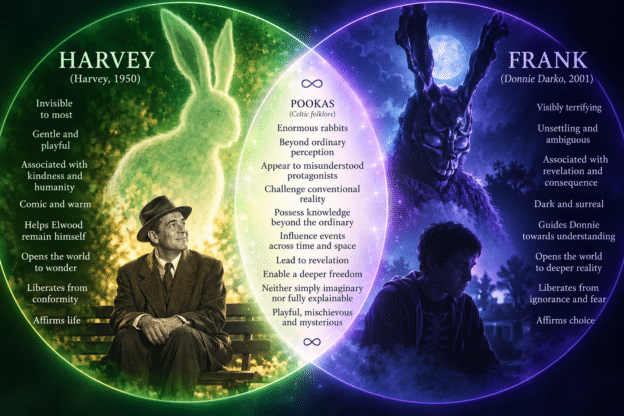
On imaginary rabbits, Celtic folklore, the ambiguity of madness, and why Donnie Darko might be the spiritual sequel to Harvey. A brief follow-up piece to my whimsical article comparing Bulgakov’s Behemoth from Master & the Margarita, and Derpy Tiger from Netflix’s KPop Demon Hunters.
Contents
- Contents
- 1. Introduction
- 2. Harvey: The Benevolent Pooka
- 3. Frank: The Postmodern, Unsettling Pooka?
- 4. Two Rabbits, Two Understandings of Reality
- 5. The Problem of Sanity
- 6. Time, Fate and the Supernatural Companion
- 7. From Acceptance to Sacrifice
- 8. Revelation, Liberation and the Benevolent Pooka
- 9. The Same Pooka in a Different Age?
- 10. The Pooka Beyond Time, Space and Death
- 11. How Far Does the Sequel Hypothesis Work?
- 12. Conclusion: The Same Rabbit?
1. Introduction
There is something rather wonderful about the possibility that Donnie Darko (2001), Richard Kelly’s unsettling meditation on adolescence, mental illness, time travel, and existential dread, might be understood as a thematic sequel to Harvey (1950), Henry Koster’s gentle comedy about an amiable eccentric whose best friend happens to be an invisible six-foot rabbit. The films are separated by half a century, belong to apparently incompatible genres, and approach their supernatural protagonists from almost opposite directions. Nevertheless, both revolve around a youngish man whose relationship with an enormous rabbit puts him at odds with conventional reality, questions whether his protagonist is mentally unwell or unusually perceptive, and suggests the rabbit may possess powers far beyond those of an ordinary imaginary companion.
The comparison becomes more intriguing when we consider that Harvey is explicitly identified as a pooka, a supernatural creature from Irish folklore capable of assuming animal form, influencing human affairs, and behaving with an unpredictable mixture of mischief and benevolence. Frank, the sinister rabbit figure in Donnie Darko, is never described as a pooka, but his appearance, behaviour, and relationship with Donnie invite precisely that interpretation. If Harvey represents the benign, playful manifestation of the pooka, Frank might be understood as its darker, more fatalistic counterpart.
I would suggest that Donnie Darko can therefore be read as a thematic sequel to Harvey, not because the filmmakers necessarily intended any such connection, but because the later film revisits many of the earlier film’s central questions and arrives at radically different conclusions.
2. Harvey: The Benevolent Pooka
In Harvey, James Stewart plays Elwood P. Dowd, an unfailingly courteous, generous, and apparently untroubled man whose closest companion is Harvey, an invisible rabbit standing six feet three and a half inches tall. Elwood introduces Harvey to acquaintances, reserves him a place in bars, and treats his presence as an ordinary part of daily life. His sister Veta, concerned about the family’s reputation and Elwood’s apparent delusions, attempts to have him committed to a psychiatric institution, setting in motion a comedy of mistaken identities, institutional incompetence, and increasingly uncertain distinctions between sanity and madness.
The film’s central conceit is that Elwood may not be delusional at all. Harvey is identified as a pooka, a creature from Celtic folklore, and various incidents suggest he exists independently of Elwood’s imagination. His apparent ability to manipulate circumstances, influence other characters, and move beyond ordinary spatial and temporal constraints gradually undermines the psychiatric explanations offered by those who consider Elwood unwell.
Harvey is particularly interesting because his supernatural qualities are inseparable from Elwood’s philosophy of kindness. Elwood’s eccentricity is not accompanied by aggression, bitterness, or alienation. He is almost extravagantly pleasant, treating strangers as friends and approaching the world with a generosity that frequently exposes the impatience and self-importance of supposedly sensible people. Harvey’s presence seems less a symptom of withdrawal from reality than an expression of Elwood’s refusal to accept that reality must be organised around suspicion, conformity, and social respectability.
The film’s conclusion reinforces this interpretation. When Veta realises that psychiatric treatment might eliminate not only Harvey but also the qualities that make Elwood himself, she abandons the attempt to make him conventionally normal. The possibility that Harvey is real remains important, but the bigger question is whether a society that values conformity over kindness has any authority to determine what counts as sanity.
3. Frank: The Postmodern, Unsettling Pooka?
Frank, the enormous rabbit who appears to Donnie Darko, is a considerably less reassuring figure. Where Harvey is invisible to most people and associated with Elwood’s gentle eccentricity, Frank appears as a grotesque humanoid rabbit wearing a disturbing metallic mask, with a voice that seems to emerge from somewhere beyond ordinary human experience. He tells Donnie the world will end in twenty-eight days, six hours, forty-two minutes, and twelve seconds, then directs him toward a series of increasingly consequential actions.
Donnie’s relationship with Frank initially resembles the familiar cinematic representation of psychological disturbance. Donnie experiences hallucination-like encounters, undergoes psychiatric treatment, and struggles with emotional and behavioural difficulties. Yet the film steadily complicates any straightforward interpretation of Frank as a product of mental illness. His predictions align with events in the narrative, his interventions seem tied to disturbances in time and causality, and his identity ultimately becomes entangled with the film’s elaborate metaphysics of tangent universes, manipulated individuals, and temporal correction.
Frank is therefore not simply an imaginary rabbit, just as Harvey cannot be comfortably dismissed as one. Both figures occupy the uncertain territory between subjective experience and supernatural reality, though the films use that uncertainty for different ends.
The pooka interpretation is particularly suggestive because Frank possesses several qualities traditionally associated with such beings. He adopts an animal form, appears selectively to a human companion, communicates knowledge unavailable through ordinary means, and influences events according to motives that are initially difficult to understand. His behaviour is also morally ambiguous: he encourages destructive actions, but they contribute to a sequence of events through which Donnie eventually comes to understand his own role in restoring the proper course of time.
Strictly speaking, Frank is not a pooka within the film’s stated mythology. The story identifies him through its own temporal framework, and the rabbit costume belongs to a human character whose fate becomes central to the narrative. Nevertheless, the folkloric interpretation remains useful because it illuminates the older imaginative structure beneath the film’s science-fiction machinery.
Harvey is a pooka who makes the world more hospitable to his human companion. Frank is a pooka-like figure who makes his companion confront the possibility that the world itself is fundamentally unstable.
4. Two Rabbits, Two Understandings of Reality
The most striking connection between the films is not simply that both feature enormous rabbits, but that both use those rabbits to challenge the authority of conventional explanations.
In Harvey, the conflict is between Elwood’s private experience and the assumptions of his family, psychiatrists, and wider society. The institutions that claim to understand reality repeatedly demonstrate their own limitations, while the supposedly irrational protagonist remains remarkably consistent, perceptive, and humane. Harvey’s existence suggests that reality may be more expansive than the rationalist categories used to describe it.
Donnie Darko begins with a similar conflict but develops it in a much darker direction. Donnie’s experiences are treated as symptoms of psychological disturbance, yet the narrative increasingly suggests that his perception of reality may be more accurate than that of the people attempting to explain or correct him. The difference is that Donnie’s privileged understanding brings him neither happiness nor social acceptance. Instead, it confronts him with a terrifying responsibility.
Both protagonists are outsiders whose relationships with supernatural rabbits distinguish them from the communities around them. Elwood’s difference is expressed through eccentric kindness, while Donnie’s emerges through alienation, anger, intelligence, and an often painful awareness of hypocrisy. Both encounter institutions that misunderstand them, and both are ultimately vindicated in ways that undermine conventional judgements about their mental states.
But where Harvey suggests that accepting an unconventional reality might make life more pleasant, Donnie Darko asks what happens when that reality demands something unbearable.
This is where the thematic-sequel argument begins to acquire substance.
| Dimension | Harvey (Harvey, 1950) | Shared Characteristics | Frank (Donnie Darko, 2001) |
|---|---|---|---|
| Appearance | Enormous, apparently invisible white rabbit | Extraordinary rabbit figures | Enormous, visibly unsettling figure in a metallic rabbit mask |
| Folkloric identity | Explicitly identified as a pooka | Can be interpreted through the pooka archetype | Not identified as a pooka, but invites a folkloric reading |
| Personality | Gentle, playful, companionable | Mysterious, disruptive, unconventional | Intense, enigmatic, unsettling |
| Human companion | Elwood P. Dowd | Appear to misunderstood outsiders | Donnie Darko |
| Perception | Invisible to most people | Exist beyond ordinary perception | Appears to Donnie in extraordinary circumstances |
| Relationship with reality | Opens everyday life to wonder | Challenge conventional explanations of reality | Reveals an unstable universe governed by unfamiliar laws |
| Knowledge | Associated with powers beyond ordinary time and space | Possess or convey extraordinary knowledge | Reveals events and possibilities beyond Donnie’s immediate understanding |
| Influence | Helps Elwood remain himself | Guide their companions towards understanding | Guides Donnie through events culminating in revelation |
| Humour and playfulness | Warm, comic, mischievous | Disrupt expectations and conventional seriousness | Darkly surreal, provocative, occasionally mischievous |
| Sanity | Elwood’s belief in Harvey is treated as evidence of delusion | Challenge society’s assumptions about mental illness and perception | Donnie’s encounters with Frank are initially understood through psychiatric explanations |
| Moral character | Benevolent and reassuring | Neither adequately understood through appearance alone | Frightening in presentation, but ultimately revelatory rather than malevolent |
| Freedom | Liberates Elwood from social conformity | Enable their companions to exercise personal freedom | Liberates Donnie from ignorance and enables an informed choice |
| Narrative function | Affirms kindness, individuality and acceptance | Supernatural intermediaries who reveal deeper possibilities | Affirms understanding, love and self-sacrifice |
| Thematic significance | The freedom to live authentically | Revelation as a path to liberation | The freedom to choose knowingly |
5. The Problem of Sanity
Both films also examine the relationship between psychiatric authority and experiences that conventional models of reality cannot accommodate.
In Harvey, psychiatry is treated primarily as a comic institution. The sanatorium’s doctors and administrators are often confused, self-important, and susceptible to the very misunderstandings they claim to diagnose. Elwood’s supposed madness contrasts with his extraordinary composure and kindness, inviting the audience to question whether the attempt to cure him represents a more serious failure of judgement than his belief in Harvey.
Donnie Darko presents psychiatric treatment with considerably greater complexity. Donnie’s therapist, Dr Thurman, is neither simply incompetent nor malicious, and his psychological difficulties are not reducible to the question of whether Frank exists. Nevertheless, the film similarly resists the assumption that experiences classified as hallucinations must therefore be devoid of external significance.
This distinction matters because neither film needs to establish that psychiatric medicine is inherently misguided. Their shared concern is the philosophical problem of determining reality when an individual’s experience contradicts everyone else’s assumptions.
Elwood and Donnie are both unreliable witnesses to their own lives, yet each has access to information the surrounding characters cannot readily explain. The rabbit becomes a symbol of the limits of socially sanctioned knowledge, suggesting that what appears irrational from one perspective may be entirely coherent from another.
The difference lies in the consequences of that knowledge. Elwood’s understanding enables him to live generously and without apparent fear. Donnie’s eventually forces him to confront mortality, sacrifice, and the possibility that his continued existence threatens the world’s stability.
6. Time, Fate and the Supernatural Companion
Time provides one of the more intriguing connections between Harvey and Donnie Darko, although the films approach it with very different intentions. In Harvey, the pooka’s extraordinary relationship with time and space is treated almost as an incidental curiosity. Harvey seems capable of operating beyond the ordinary restrictions of physical existence, but the film is more interested in the effect his presence has on Elwood and those around him than in explaining how his abilities work.
In Donnie Darko, time becomes the narrative’s organising principle. Frank’s countdown establishes an apparently unavoidable future, while the subsequent events reveal a world in which causality is unstable and the relationship between past, present and future is far less straightforward than Donnie initially understands. Where Elwood accepts the extraordinary without requiring an explanation, Donnie must discover the rules governing his circumstances before he can understand what is happening to him.
The key distinction is not necessarily between a playful supernatural being and an oppressive one, but between their human companions’ experiences. Elwood inhabits a world where Harvey’s disregard for ordinary time creates a sense of possibility and freedom. Donnie encounters similar violations of temporal order, but with frightening, potentially catastrophic consequences. Yet Frank’s knowledge ultimately enables Donnie to act rather than merely submit to events. What initially appears to be an inescapable fate becomes, through revelation, an opportunity for meaningful choice.
Both films therefore associate their extraordinary rabbits with a reality in which human assumptions about time prove inadequate. The significance of that discovery depends upon the person making it: for Elwood, it enlarges an already generous understanding of existence; for Donnie, it provides the knowledge necessary to confront the consequences of his own actions.
7. From Acceptance to Sacrifice
The endings of Harvey and Donnie Darko reveal how two films can resolve a similar supernatural proposition in different ways. Both protagonists are misunderstood by those around them, and both develop relationships with extraordinary rabbits whose existence challenges conventional explanations. Yet the freedom each protagonist ultimately achieves takes a very different form.
Harvey concludes by affirming Elwood’s right to remain himself. His sister Veta recognises that the treatment intended to make him conventionally normal might also deprive him of the kindness, generosity and eccentric individuality that make him who he is. The film’s resolution is therefore one of acceptance: Elwood does not need to abandon Harvey or surrender his understanding of reality to satisfy others’ expectations.
Donnie Darko reaches a more tragic conclusion. Donnie comes to understand the consequences of the temporal disturbance and recognises that restoring the proper course of events requires him to relinquish the future he has experienced. His decision to remain in bed as the aircraft engine falls is not simply a surrender to fate, but an act informed by knowledge he could not have possessed without Frank’s intervention. The circumstances are terrible, yet the choice is his.
The difference reflects the films’ contrasting emotional worlds. Harvey lets its protagonist keep living by his own values, while Donnie Darko asks its protagonist to express those values through sacrifice. Elwood’s kindness shows in how he lives; Donnie’s love for others becomes inseparable from his willingness to give up his own life. In both cases, the supernatural companion helps reveal something essential about the person he accompanies, even though one story ends in reconciliation and the other in loss.
8. Revelation, Liberation and the Benevolent Pooka
The apparent opposition between Harvey’s benevolence and Frank’s unsettling appearance may ultimately be misleading. Both creatures intervene in the lives of individuals whose experiences others misunderstand, and both help their companions achieve forms of freedom that would otherwise remain inaccessible. Harvey’s companionship lets Elwood live without sacrificing his generosity and individuality to social expectations. Frank’s interventions, though far more disturbing, give Donnie the knowledge he needs to understand his circumstances and make a meaningful choice. Neither rabbit simply offers an escape from reality; each reveals possibilities that ordinary experience has concealed.
This interpretation is consistent with the ambiguity of the pooka in Irish folklore. Such beings may be mischievous, unpredictable or frightening without necessarily being malicious, and their intentions cannot always be inferred from their appearance or behaviour. Frank’s grotesque mask and cryptic pronouncements initially make the audience see him as threatening, yet his role in Donnie’s eventual understanding suggests something closer to guidance than hostility. His methods are alarming, but their ultimate significance is revelatory.
What joins Harvey and Frank, then, is not merely their supernatural knowledge but how that knowledge changes their companions’ lives. Elwood is free to remain himself, while Donnie becomes capable of choosing knowingly in circumstances that initially seem incomprehensible. Their experiences are hardly equivalent, but both suggest that genuine freedom may depend upon recognising possibilities beyond conventional understandings of reality. Harvey and Frank can therefore be understood as benevolent intermediaries, whose contrasting appearances and methods reflect the different needs of the people they accompany.
9. The Same Pooka in a Different Age?
There is a difference between recognising similarities in two films and suggesting that one might function as a sequel to the other. The first requires only a comparison of characters, themes, and narrative structures; the second implies some form of continuity, even if that continuity exists primarily in the viewer’s imagination. Donnie Darko is plainly not a conventional sequel to Harvey. Its characters inhabit different fictional worlds, its mythology follows different rules, and the films share no established narrative connection. Nevertheless, the possibility becomes more interesting when the figure connecting them is a supernatural being whose nature already places him outside ordinary time and physical reality.
Harvey’s identity as a pooka provides an unusually convenient starting point. A creature capable of changing form, appearing selectively, influencing circumstances and moving beyond ordinary temporal constraints need not be confined to a single appearance or human relationship. Nothing in Harvey requires its supernatural protagonist to exist solely for Elwood’s benefit, or to remain forever in the form in which we encounter him. If we imagine Harvey with a history beyond the film’s events, a later encounter with another human companion would hardly contradict his folkloric origins.
This is where Frank becomes an intriguing candidate. Half a century after Harvey’s cinematic appearance, another enormous rabbit enters the life of a socially misunderstood individual, communicates knowledge unavailable to those around him, and helps him navigate a reality considerably stranger than conventional explanations allow. His appearance has changed, as have his methods and his companion’s circumstances, but his essential narrative purpose remains recognisable. A pooka who once appeared to an eccentric middle-aged man in post-war America might, in a different era, approach a troubled adolescent through the imagery of horror, science fiction and psychological uncertainty.
There is something appealing about the idea that the supernatural being adapts to the person who needs him. Elwood is already remarkably comfortable with himself and the world; he needs companionship and, perhaps, protection from those who would correct his eccentricity. Donnie is neither comfortable nor reconciled to his circumstances. He needs to discover what is happening to him, why the world appears to be coming apart, and whether he can exercise meaningful agency within it. Harvey’s gentle presence suits Elwood’s temperament, while Frank’s alarming appearance and cryptic instructions suit a story in which understanding must emerge through fear, confusion and resistance. The pooka, on this reading, has not changed his purpose so much as his approach.
The chronological distance between the films adds another dimension to the comparison. Harvey appeared in 1950, when Hollywood could present the supernatural as gentle comic eccentricity and use it to challenge social conformity without disturbing comedy’s reassuring conventions. Donnie Darko, released in 2001 but set in 1988, belongs to a cinematic culture more comfortable with fractured chronology, unreliable perception, adolescent alienation and unresolved metaphysical questions. Read as a sequel, the later film might be understood as revisiting the earlier one’s supernatural proposition through the anxieties and storytelling conventions of another generation. The rabbit has survived, but the world around him has found new ways of imagining uncertainty.
10. The Pooka Beyond Time, Space and Death
The apparent incompatibility between the supernatural worlds of Harvey and Donnie Darko may be less substantial than it first appears. Harvey presents its extraordinary events through the language of Celtic folklore, while Donnie Darko approaches comparable phenomena through the speculative vocabulary of temporal anomalies, alternative universes and the manipulation of causality. Yet these may describe the same underlying reality in different terms. The pooka’s ability to appear and disappear, assume different forms, influence events, and move beyond ordinary temporal constraints is not necessarily distinct from the capabilities attributed to beings that operate outside our familiar dimensions of space and time.
Suppose, for the sake of the argument, that a pooka is an n-dimensional being, capable of perceiving and navigating aspects of reality inaccessible to ordinary human consciousness. Such a creature might appear to move instantaneously between locations, know events that have not yet occurred, or manipulate circumstances in ways that seem impossible to those who experience time as a single, irreversible sequence. From a human perspective, people would naturally interpret these abilities as magic. From another perspective, they might simply represent faculties unavailable to beings confined to fewer dimensions.
This is not to suggest that Donnie Darko offers a scientifically rigorous account of higher-dimensional physics, or that string theory provides an established explanation for the film’s events. Instead, the speculative analogy lets the folkloric pooka’s supernatural powers and Donnie Darko’s temporal phenomena coexist within the same imaginative framework. While Elwood accepts it without demanding an explanation, Donnie must struggle to understand it through the elaborate metaphysics of the tangent universe. The difference may lie as much in the observers and their circumstances as in the nature of the beings themselves.
Frank’s status as a dead man introduces a further possibility. In Donnie Darko, the rabbit figure is connected to Frank Anderson, whose death and subsequent appearances are tied to the film’s temporal disturbance. At first glance, this appears to distinguish him decisively from Harvey, an independently existing supernatural creature. But that distinction weakens when we consider the relationship between the pooka, the Otherworld, and the wider traditions of Irish fairy folklore.
The Aos Sí, the supernatural people associated with the Irish Otherworld, belong to a body of tradition in which the boundaries between ordinary human existence and other realms are often permeable. Fairy beings, spirits, the dead, and inhabitants of the Otherworld are not always understood as identical, but the traditions surrounding them repeatedly explore encounters across boundaries that humans ordinarily cannot cross. Time may behave differently in the Otherworld, familiar landscapes may conceal entrances to other realms, and those who pass between them may experience profound changes in their relationship with mortal existence. The pooka belongs to this broader imaginative landscape, even if its particular folkloric identity should not simply be equated with every other supernatural being within it.
Frank’s death can therefore be interpreted as part of his transformation rather than an objection to his supernatural significance. The figure who appears to Donnie may be understood as a spirit operating beyond the ordinary constraints of mortality, a being whose relationship with the living is no longer governed by the same temporal sequence they experience. In the film’s mythology, the Manipulated Dead explain this. In folkloric terms, this evokes the possibility of an intermediary between the mortal world and an Otherworld in which time, identity, and physical existence operate differently.
Indeed, the film’s unusual chronology makes the distinction between being alive and being dead particularly unstable. Frank can appear to Donnie before the events that bring about his death, because the narrative’s temporal structure does not require causes and consequences to unfold in their ordinary order. For a creature capable of perceiving or traversing time beyond the human perspective, such a paradox might not be paradoxical at all. What appears to Donnie as an impossible encounter with a dead man might, within the pooka hypothesis, be another manifestation of a being whose existence is not confined to a single human lifetime or linear sequence of events.
This does not establish that Frank Anderson is secretly Harvey, nor does it erase the explanation supplied by Donnie Darko. Frank might be imagined as a human spirit acting through powers associated with the Otherworld, as a pooka adopting a form already significant within the temporal disturbance, or simply as a cinematic expression of the same supernatural archetype. These possibilities are not equivalent, but each shows how readily the film’s science-fiction imagery can enter into conversation with much older traditions of supernatural encounters.
11. How Far Does the Sequel Hypothesis Work?
The difficulty with imagining Donnie Darko as a literal continuation of Harvey is that the later film already has its own elaborate mythology. Frank is not simply an unexplained supernatural rabbit. He is also Frank Anderson, a human whose rabbit costume, death, and subsequent role in the film’s temporal events are integral to the plot. The film’s account of tangent universes and manipulated individuals explains his appearances without requiring a folkloric pooka to intervene. Imagining such an intervention is possible, but it remains an additional interpretation rather than something the narrative establishes.
Nor is there an established basis for claiming that Richard Kelly consciously constructed Donnie Darko as a continuation of Harvey. Similarity is not proof of influence, and the enormous rabbit, the misunderstood protagonist and the questioning of ordinary reality do not establish an intentional relationship between the productions. A historical argument about influence would require evidence from the filmmakers, scripts or production history that the thematic comparison alone cannot provide.
The most useful distinction, then, is between a literal sequel, a deliberate thematic successor and a retrospective thematic sequel. Donnie Darko cannot reasonably be presented as the first, and the second remains unestablished. The third, however, offers a way of reading the films together without requiring either to acknowledge the relationship. It treats the later work as though it were continuing an imaginative conversation begun by the earlier one, allowing the possibilities introduced in Harvey to be explored under radically different circumstances.
This reading matters because each film changes how we see the other. Harvey lends Frank a measure of warmth and benevolence that his frightening appearance might otherwise obscure, while Donnie Darko draws attention to the extraordinary metaphysical implications of Harvey’s powers, which the earlier comedy treats with such charming casualness. Harvey becomes a little more mysterious, Frank a little less threatening, and the similarities between their interventions become more significant than their differences in appearance.
The interpretation works best when it remains playful rather than doctrinaire. You don’t need to establish a secret cinematic universe, invent an elaborate account of the pooka’s movements between 1950 and 1988, or explain away every contradiction between the films’ respective mythologies. Their differences are part of the pleasure of the comparison. Whether the rabbit is literally the same creature matters rather less than what becomes visible when we entertain the possibility that he might be.
12. Conclusion: The Same Rabbit?
I find Donnie Darko’s role as a thematic sequel to Harvey appealing because it lets two seemingly unrelated films illuminate one another. The earlier work presents a supernatural rabbit whose existence challenges conventional reality and whose companionship enables an eccentric man to live according to his own generous principles. The later film takes a comparable premise and explores its implications through a very different set of cultural anxieties, turning the supernatural companion into an intermediary between human consciousness and an unstable universe. The films’ contrasting moods need not imply any fundamental difference in the benevolence of their extraordinary rabbits.
The possibility that a pooka might be a higher-dimensional being, capable of moving between different manifestations of reality, makes the comparison even more entertaining. Harvey’s casually extraordinary powers and Frank’s involvement with time, death, and alternative universes begin to look less like incompatible mythologies and more like different expressions of a shared supernatural possibility. There is no particular reason to insist that the films belong to the same fictional universe, but equally no need to dismiss the imaginative pleasure of wondering whether their rabbits might be more closely related than either film acknowledges.
I love both characters, and perhaps that is ultimately why the comparison appeals to me. Harvey’s gentle humour and Frank’s unsettling intensity express the same underlying possibility: that the strange figure standing just beyond the limits of our understanding may not be something to fear, but someone who has come to help us see more clearly. If Harvey and Frank are indeed manifestations of the same pooka, then his transformation across half a century of cinema seems less a change in his essential nature than a change of costume, appropriate to the needs of a different companion and a different age.