On Bulgakov, KPop Demon Hunters, supernatural familiars, and the remarkable persistence of the ridiculous feline. A short comparative piece to amuse my children, who won’t read this for years, if at all.
Contents
1. Introduction
There is something wonderfully incongruous about discovering that Behemoth, the enormous, vodka-drinking, chess-playing, gun-wielding black cat from Mikhail Bulgakov’s The Master and Margarita, has what amounts to a contemporary counterpart in Derpy, the blue tiger from Netflix’s KPop Demon Hunters. The resemblance is not immediately obvious, given that one belongs to a Russian novel written under Stalin and the other to a Korean-inspired animated musical released in 2025, but once noticed it becomes increasingly difficult to ignore. Both are supernatural felines associated with demonic figures, both provide comic relief in narratives concerned with the relationship between humanity and the supernatural, and both derive much of their appeal from behaving in ways that are fundamentally at odds with their supposed metaphysical significance.
I would go further and suggest they are essentially the same character, or at least manifestations of the same archetype, separated by almost a century of cultural development and adapted for different audiences.
For my babies, Pixie, Leo, and Bella, who adore KPop Demon Hunters, which I watched again tonight, and for Bill and me, who share a love of The Master and Margarita. This one’s for all of us.
2. The Case for a Shared Archetype
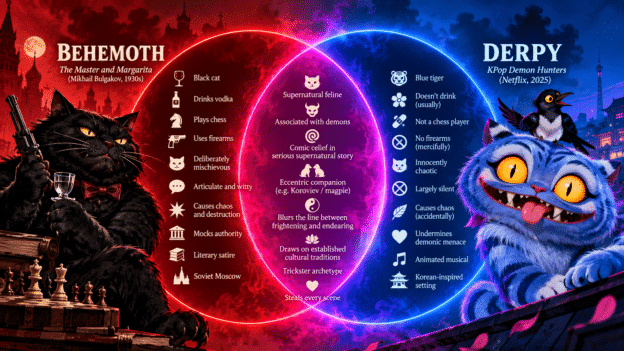
Behemoth is part of Woland’s entourage, a group of supernatural miscreants who descend upon Moscow in The Master and Margarita and expose the hypocrisies and absurdities of Soviet society. Although outwardly an enormous black cat, Behemoth walks upright, speaks fluently, plays chess, drinks vodka, and demonstrates an alarming familiarity with firearms. His antics are among the novel’s most memorable, especially when he and Koroviev embark on their various campaigns of disruption, culminating in confrontations that blend slapstick, satire, and considerable property damage.
Derpy, by comparison, is a large blue supernatural tiger associated with Jinu, the conflicted demon who leads the Saja Boys in KPop Demon Hunters. Where Behemoth is articulate, calculating, and frequently malicious, Derpy is largely silent, apparently innocent, and spectacularly incompetent. His enormous eyes and perpetually bewildered expression suggest a creature whose understanding of the world is considerably less sophisticated than his supernatural origins might imply. Yet both characters achieve a similar effect, introducing a distinctly feline absurdity into circumstances that might otherwise be dominated by demonic menace.
The contrast between their personalities is perhaps the most interesting aspect of the comparison. Behemoth is deliberately ridiculous, an accomplished performer who understands precisely how to manipulate a situation for comic effect. Derpy’s ridiculousness appears entirely involuntary. He isn’t trying to undermine anyone’s dignity, though he often succeeds. Where Behemoth employs wit and theatricality, Derpy relies upon the visual comedy of an animal behaving with complete disregard for the expectations placed upon it. These differences reflect both their respective mediums and their characters: Bulgakov’s satirical novel requires a creature capable of elaborate verbal exchanges, whereas an animated musical can convey the same essential incongruity through movement, expression, and timing.
3. Supernatural Companions and Cultural Origins
There is also an interesting parallel in their relationships with other supernatural characters. Behemoth frequently operates alongside Koroviev, whose elaborate deceptions and theatrical behaviour complement the cat’s enthusiasm for mischief. Derpy has his own companion in the form of a magpie, with whom he forms an equally distinctive comic pairing. This relationship matters because it draws on an established Korean artistic tradition. In hojakdo, or tiger-and-magpie paintings, the tiger is frequently represented as comically ungainly or foolish, sometimes interpreted as a satire of pompous authority, while the magpie occupies a contrasting position. Derpy is therefore not simply a modern invention for comic relief, but a contemporary interpretation of a recognisable motif from Korean folk art.
Behemoth’s ancestry is rather different, although no less interesting. European folklore has long associated cats with witchcraft, demonic familiars, and supernatural intermediaries, while the name Behemoth itself carries biblical and demonological associations. Bulgakov combines these traditions with the conventions of literary satire, producing a creature whose demonic identity is expressed less through conventional horror than through a sustained assault upon social respectability. The result is a character who belongs to both the supernatural and the absurd, an ambiguity Derpy reproduces in a gentler form.
| Dimension | Behemoth | Shared characteristics | Derpy |
|---|---|---|---|
| Appearance | Enormous black cat | Supernatural felines | Enormous blue tiger |
| Origin | The Master and Margarita | Rooted in established cultural traditions | KPop Demon Hunters |
| Supernatural association | Woland’s demonic entourage | Connected to demonic figures | Companion of Jinu |
| Personality | Intelligent, cynical, theatrical | Eccentric and unpredictable | Innocent, bewildered, affectionate |
| Humour | Verbal satire and deliberate mischief | Comic disruption of supernatural seriousness | Visual comedy and accidental chaos |
| Behaviour | Chess, vodka, firearms and destruction | Disregard for ordinary expectations | Curiosity, clumsiness and distraction |
| Companions | Koroviev | Distinctive comic partnerships | Magpie |
| Cultural influences | European demonology and literary satire | Folkloric supernatural animal traditions | Korean tiger-and-magpie folk art |
| Moral character | Dangerous and occasionally cruel | Complicate conventional ideas of good and evil | Primarily benign and sympathetic |
| Narrative function | Exposes hypocrisy and undermines authority | Makes supernatural power both strange and familiar | Humanises the demonic and encourages sympathy |
| Archetype | Deliberate supernatural trickster | Feline familiar and agent of comic disruption | Innocent supernatural companion with trickster-like effects |
4. Tricksters, Familiars and Moral Ambiguity
This brings us to the broader tradition of the trickster, a figure found in mythologies and storytelling traditions worldwide. Tricksters are characterised by their disregard for established boundaries, their ability to disrupt social expectations, and their ambiguous relationship with conventional morality. Behemoth fits comfortably within this tradition, although his behaviour is more calculated and frequently more destructive than that of the typical comic animal companion. Derpy is less obviously a trickster in the strict mythological sense, since he lacks the deliberate cunning usually associated with the role, but he shares the trickster’s capacity to destabilise expectations. His presence complicates the distinction between demonic and benign, making the supernatural world appear considerably less threatening than its inhabitants might intend.
The moral dimension is particularly important. In Bulgakov’s novel, Woland and his companions are agents of supernatural power whose actions repeatedly expose the corruption, greed, and hypocrisy of ostensibly respectable human beings. Behemoth is hardly virtuous, but his outrageous conduct forms part of a larger philosophical challenge to simplistic distinctions between good and evil. In KPop Demon Hunters, the same ambiguity emerges through Jinu’s divided loyalties and the possibility of redemption. Derpy’s affectionate, harmless-seeming behaviour encourages the audience to see the demon world as more complicated than an undifferentiated source of evil. In both cases, the animal companion makes moral ambiguity accessible, though Bulgakov does so through satire and the film through sympathy.
5. Two Characters, Two Cultural Traditions
The differences between the two characters are not minor. Behemoth is dangerous, manipulative, and occasionally cruel, whereas Derpy is primarily an object of affection. Nor is there any established evidence of direct creative influence between Bulgakov’s novel and the filmmakers responsible for KPop Demon Hunters. The resemblance is better understood through the persistence of shared narrative structures and the adaptation of older folkloric material to new artistic contexts. The comparison is worthwhile precisely because two works emerging from such different circumstances arrive at recognisably similar solutions to the problem of representing supernatural power without letting it become oppressively solemn.
There is a further irony in the cultural distance between them. Bulgakov was writing in a society whose official ideology rejected the supernatural, yet he employed Satan and his entourage to expose the absurdities of its supposedly rational institutions. KPop Demon Hunters, by contrast, belongs to a global popular culture in which supernatural mythology can be incorporated quite naturally into a musical about celebrity, identity, and belonging. Behemoth’s comedy is directed outward, against the institutions and individuals he encounters; Derpy’s is largely intrinsic to his character and his relationship with the other creatures around him. Nevertheless, both serve the same underlying purpose: to make the supernatural simultaneously strange and familiar.
6. The Feline Archetype
Perhaps the strongest argument for their equivalence lies in the choice of animal itself. Cats have long occupied an unusual position in the human imagination, combining domestic familiarity with independence, unpredictability, and an apparent indifference to the rules that govern everyone else. Their behaviour already lends itself to supernatural interpretation, and the transformation into a demonic familiar requires remarkably little adjustment. Behemoth exaggerates the intelligence, arrogance, and destructive potential that humans sometimes attribute to cats, while Derpy exaggerates their curiosity, eccentricity, and capacity for apparently inexplicable behaviour. Both are recognisable because, in different ways, they are recognisably feline.
This ambiguity has produced a remarkable variety of feline archetypes across mythology, folklore, and literature. Bastet, the cat-headed Egyptian goddess, embodies protection and domestic harmony, while the lioness-headed Sekhmet represents the considerably less reassuring qualities of divine wrath and destruction. Japanese folklore offers the bakeneko and nekomata, cats capable of transformation, speech, deception, and occasionally malevolent supernatural behaviour. European folklore contributes the witch’s familiar and the Cait Sìth of Scottish Gaelic tradition, a mysterious black fairy cat, while literature gives us the Cheshire Cat from Lewis Carroll’s Alice’s Adventures in Wonderland, whose enigmatic pronouncements and disregard for ordinary logic anticipate something of Behemoth’s theatrical absurdity, and Puss in Boots, whose intelligence, cunning, and social manipulation make him a particularly accomplished feline trickster. Across these traditions, felines repeatedly occupy the boundary between the domestic and the supernatural, wisdom and foolishness, benevolence and danger, making Behemoth and Derpy less isolated inventions than contemporary expressions of a remarkably persistent cultural fascination.
7. Conclusion: The Same Cat?
Ultimately, I think the case for treating Behemoth and Derpy as versions of the same character is rather stronger than their superficial differences might suggest. They occupy comparable positions in their respective narratives, draw upon overlapping traditions of supernatural animal companionship, and employ feline absurdity to complicate the audience’s relationship with demonic power. Their contrasting temperaments best reflect adaptations to different genres and cultural expectations than fundamental differences in their narrative identities.
Behemoth is what happens when the supernatural cat is placed in the service of literary satire, armed with a revolver, and given several decades’ worth of accumulated cynicism. Derpy is what happens when the same essential creature is reimagined through Korean folk-art traditions and contemporary animation, with the malice replaced by bewilderment and the destructive tendencies reduced to manageable proportions.
I cannot prove that they are the same cat, and I certainly wouldn’t suggest that Bulgakov anticipated the arrival of a blue tiger in a K-pop musical. But as expressions of the same enduring imaginative idea, they are remarkably close relatives. Behemoth would undoubtedly regard Derpy as an embarrassment to the profession, while Derpy would probably be delighted to make his acquaintance, which may be the most compelling evidence of their shared feline nature.