The Iliad, Odyssey, and Aeneid are not a trilogy, but together they form an extraordinary narrative arc from the Trojan War to the legendary origins of Rome. Achilles embodies the tragedy of war, Odysseus the struggle to return home, and Aeneas the search for a new one. Following their stories reveals how Virgil inherited, reworked, and ultimately Romanised Homer’s world.
Contents
- Contents
- 1. Introduction
- 2. The Trojan War as the Common Centre
- 3. A Short Chronology: From Troy to Rome
- 4. The Geography of the Three Epics
- 5. The Iliad: Achilles, Hector, and the Cost of War
- 6. What Happens Between the Iliad and the Fall of Troy?
- 7. The Odyssey: What Happens After Victory?
- 8. Penelope, Telemachus, and the Home Odysseus Has Lost
- 9. Turning the Story Around: From Greek Victor to Trojan Survivor
- 10. Aeneas Already Exists in Homer
- 11. Aeneas Carrying Troy Out of Troy
- 12. Virgil Deliberately Rebuilds Homer
- 13. Carthage and Dido
- 14. Aeneas and Odysseus Travel Through the Same Mythological World
- 15. The Underworld: Odysseus Looks Back, Aeneas Looks Forward
- 16. Aeneas Does Not Found Rome
- 17. The War in Italy
- 18. Pallas, Turnus, and the Return of Achilles
- 19. From Greek Defeat of Troy to Roman Conquest of Greece
- 20. Achilles, Odysseus, and Aeneas as Three Models of Heroism
- 21. The Most Important Contrast: Homecoming and Foundation
- 22. Are the Three Epics a Trilogy?
- 23. The Missing Epic Between the Iliad and the Odyssey
- 24. The Three Epics as One Enormous Narrative
- 25. Reading the Epics
- 26. Conclusion: From Troy to Rome
1. Introduction
The Iliad, the Odyssey, and the Aeneid are often encountered as three separate monuments of classical literature: two Greek epics attributed to Homer and, several centuries later, a Roman epic by Virgil. They were not conceived as a trilogy; they do not belong to the same historical period, and the Aeneid was written in a different language, culture, and political world from the Homeric poems. Yet they fit together with extraordinary neatness because all three are anchored to the same legendary event: the Trojan War.
The simplest way to understand their relationship is that the Iliad takes place during the war itself, the Odyssey follows one of the victorious Greeks attempting to return home after Troy has fallen, and the Aeneid follows one of the defeated Trojans attempting to find a new homeland after his own has been destroyed. Homer gives us the Greek assault on Troy and the consequences for one of the men who helped win that war; Virgil turns the perspective around and asks what happened to those who survived on the losing side. Read consecutively, the three poems produce a vast narrative movement from war, through destruction and displacement, to homecoming on one side and the legendary origins of Rome on the other.
That relationship is worth examining carefully, because the usual shorthand, “The Iliad is about the Trojan War, The Odyssey is about Odysseus going home, and The Aeneid is about the founding of Rome”, is useful but misleading in several important respects. The Iliad does not tell the whole story of the Trojan War. The Odyssey is not simply an adventure story about monsters. Aeneas does not actually found Rome. The Trojan Horse is not in the Iliad. And Virgil is doing something much more sophisticated than merely writing a Roman sequel to Homer.
What connects the three works is not just plot, but a developing argument about heroism, civilisation, memory, duty, violence, and what happens after a world has been destroyed.
2. The Trojan War as the Common Centre
The legendary Trojan War begins with a collection of events that lie outside the narrative of the Iliad itself. According to the broader mythological tradition, Paris, a prince of Troy, becomes involved in the famous Judgement of Paris, in which he is asked to decide which of the goddesses Hera, Athena, and Aphrodite is the most beautiful. Aphrodite promises him the most beautiful woman in the world, Helen, who is already married to Menelaus, king of Sparta. Paris takes Helen to Troy, whether as a seducer, an abductor, or something more ambiguous, depending on the version, and Menelaus appeals to the other Greek rulers for assistance.
A vast Greek expedition consequently sails to Troy under the overall leadership of Menelaus’ brother Agamemnon, king of Mycenae. Among its heroes are Achilles, Ajax, Diomedes, Nestor, and Odysseus. The Greeks besieged Troy for ten years.
It is only near the end of those ten years that the Iliad begins.
This is the first major misconception to clear away. The Iliad is not an epic history of the Trojan War from beginning to end. It describes only a relatively brief episode in the tenth year of the conflict. It neither begins with Helen and Paris nor ends with the destruction of Troy. The Trojan Horse does not appear in it, and Troy is still standing when the poem finishes.
Homer tells us exactly what the real subject is in the opening of the poem: the anger, or wrath, of Achilles.
“Rage—Goddess, sing the rage of Peleus’ son Achilles.”
— Homer, The Iliad, I.1, trans. Robert Fagles
3. A Short Chronology: From Troy to Rome
Before going further, it is useful to establish the sequence of events, particularly because the order in which the stories take place is very different from the order in which the surviving works were composed. In mythological chronology, the broad sequence runs as follows:
| Sequence | Event | Principal Source or Tradition |
|---|---|---|
| 1 | Judgement of Paris and Paris’ relationship with Helen | Wider Greek myth and Epic Cycle |
| 2 | Greek expedition against Troy | Wider Trojan War tradition |
| 3 | Nine years of warfare | Wider Trojan War tradition |
| 4 | Achilles’ quarrel with Agamemnon, the death of Patroclus, and Achilles’ killing of Hector | The Iliad |
| 5 | Hector’s funeral; the Iliad ends while Troy is still standing | The Iliad |
| 6 | Death of Achilles and the final stages of the war | Wider Trojan War tradition and Epic Cycle |
| 7 | Trojan Horse and the sack of Troy | Wider Trojan tradition and Epic Cycle; subsequently narrated at length in The Aeneid |
| 8A — Greek aftermath | Odysseus leaves the fallen city and begins his attempt to return to Ithaca | The Odyssey |
| 8B — Trojan aftermath | Aeneas escapes the fallen city and begins his search for a new homeland | The Aeneid |
| 9A — Greek aftermath | Odysseus’ wanderings eventually bring him home to Ithaca | The Odyssey |
| 9B — Trojan aftermath | Aeneas’ wanderings eventually bring him to Latium, where war follows | The Aeneid |
| 10 | Ascanius and the legendary line of Alba Longa | Roman foundation mythology |
| 11 | Romulus and Remus; foundation of Rome | Roman foundation mythology |
From the destruction of Troy onwards, the chronology is better understood as a fork than a straight line. The Odyssey and the Aeneid begin from the same catastrophe but follow opposite sides away from it: one of Troy’s conquerors trying to recover his old home, and one of Troy’s survivors trying to find a new one.
This chronology also exposes the most important gap for a modern reader. The Iliad ends before the most famous event associated with Troy, the Trojan Horse, and the Odyssey begins in a world in which Troy has already been destroyed. The events connecting the two belonged to a much larger body of Trojan mythology that ancient audiences knew but of which only fragments now survive. Virgil later reaches back into that missing territory in Book II of the Aeneid, where Aeneas gives his own account of the final night of Troy.
The literary chronology is quite different. The Iliad and Odyssey emerged from the archaic Greek epic tradition, conventionally dated to around the eighth or early seventh centuries BC, whereas Virgil composed the Aeneid in the first century BC. The apparent narrative sequence from Troy to Ithaca to Rome therefore conceals centuries of literary history. Virgil is not simply continuing Homer: he is deliberately taking possession of an already ancient Greek tradition and reinterpreting it for Rome.
4. The Geography of the Three Epics
Time connects the three epics, but geography separates them just as revealingly. Put their principal locations on the same map, and the different shapes of each poem become immediately visible.
The Iliad is geographically concentrated. Although it constantly refers to places across the Greek and Trojan worlds, particularly when identifying warriors, armies, and their origins, its action is overwhelmingly centred on Troy. This is a poem of siege: two armies occupying the same small piece of ground, with the Greek ships and camp on one side and the city of Troy on the other.
The Odyssey explodes that confined world outwards. Troy becomes the point of departure for a journey through a Mediterranean that is partly geographical and partly mythical. Ithaca is always Odysseus’ destination, but between Troy and home lie islands, strange peoples, monsters, divine territories and places whose locations ancient and modern readers have tried, often inconclusively, to identify with real Mediterranean geography. The uncertainty is part of the poem. Odysseus moves progressively farther from the ordered human world before eventually finding his way back into it.
The Aeneid expands the geography again, but in a different direction. Aeneas begins at Troy and wanders through the eastern and central Mediterranean, including Thrace, Crete, Sicily and Carthage, before reaching Italy. From that point, the geographical scale contracts as the poem becomes increasingly concerned with Latium and the war through which the Trojans will establish themselves there. Virgil’s geography also extends beyond Aeneas’ immediate travels through prophecy, genealogy, and historical allusion, connecting his journey to places that belong to Rome’s future Mediterranean world.
The three patterns are therefore quite different. The Iliad is centred on a battlefield; the Odyssey is centrifugal and wandering, yet always pulled back towards Ithaca; and the Aeneid is directional, carrying its hero from a destroyed city in the east towards a new homeland in the west.
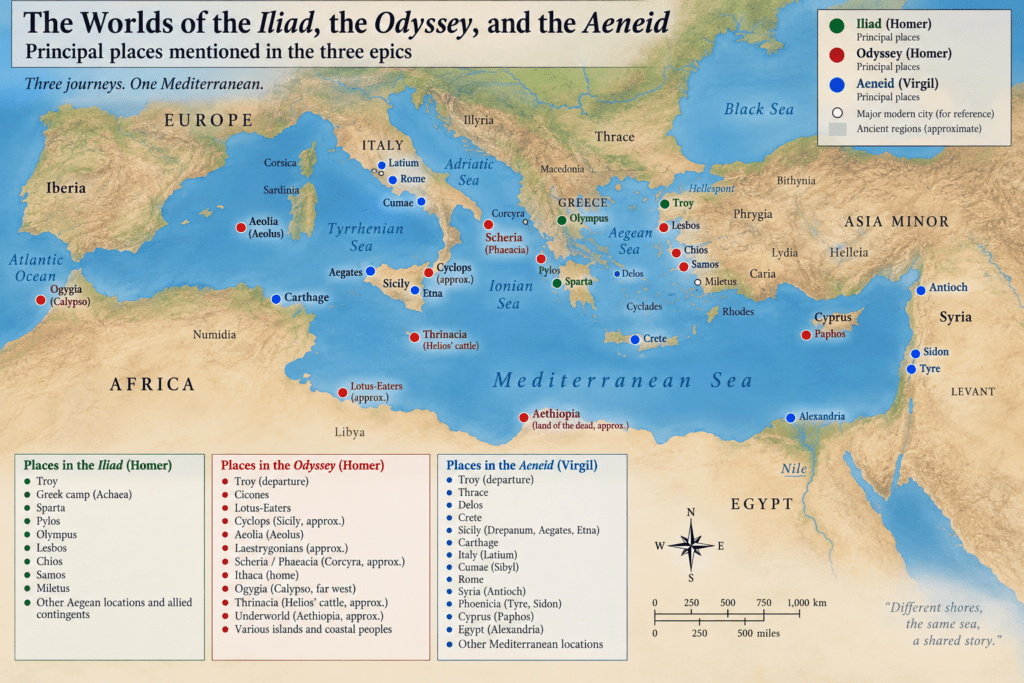
Principal places associated with the Iliad, Odyssey and Aeneid. Green marks the world of the Iliad, red the Odyssey, and blue the Aeneid. Some locations in the Odyssey are mythical or of disputed geographical identification, so their placement should be understood as traditional or approximate rather than certain.
5. The Iliad: Achilles, Hector, and the Cost of War
Achilles is the greatest warrior fighting on the Greek side. He is young, almost superhumanly formidable in battle, and painfully conscious of the relationship between honour, reputation, and mortality. He also knows that his life contains a terrible choice. He can remain away from Troy and live a long but obscure life, or he can fight at Troy, die young, and achieve everlasting fame.
The crisis of the Iliad begins when Achilles quarrels with Agamemnon. Agamemnon takes Briseis, a woman awarded to Achilles as part of the distribution of spoils, and Achilles interprets the act as an intolerable public humiliation. He therefore withdraws from the fighting.
That withdrawal drives much of the poem. Without Achilles, the Greeks suffer badly, while the Trojans, led by their great champion Hector, gain the advantage. Hector is in many respects Achilles’ opposite. Achilles is the exceptional warrior whose sense of identity is deeply bound to personal honour; Hector is the defender of his city, the husband of Andromache, the father of Astyanax, and the son of the ageing Trojan king Priam. His obligations are social and familial as well as purely martial. Through the contrast between the two men, the Iliad examines different kinds of courage and duty while refusing to reduce the conflict to a simple contest between virtuous Greeks and villainous Trojans.
Indeed, one of the remarkable things about the Iliad is the sympathy it extends to both sides. Homer may be composing within a Greek tradition, but the Trojans are not presented as faceless enemies. Hector, in particular, is one of the poem’s most humane figures.
The turning point comes when Achilles’ companion Patroclus enters the battle wearing Achilles’ armour. Patroclus succeeds in driving the Trojans back but is eventually killed by Hector. His death transforms Achilles. The quarrel with Agamemnon becomes almost irrelevant beside his grief and desire for vengeance.
Achilles returns to the battlefield, kills Hector in single combat, and then subjects Hector’s corpse to deliberate humiliation, dragging it behind his chariot. The rage announced in the first line of the poem has reached its terrible conclusion.
Yet the Iliad does not end there.
Instead, Priam, Hector’s elderly father, enters the Greek camp and does the almost unimaginable: he kneels before Achilles and asks for his son’s body. Priam appeals not to Achilles the warrior but to Achilles the son, asking him to think of his own ageing father, Peleus.
The encounter temporarily dissolves the distinction between Greek and Trojan. Priam and Achilles recognise one another primarily as human beings who have experienced grief, ageing, death, and loss. Achilles returns Hector’s body, and the poem ends with the Trojans mourning and burying Hector.
That ending matters enormously when we later reach Virgil. The movement of Achilles from destructive rage towards an act of mercy becomes one of the Iliad‘s final moral gestures, and Virgil will deliberately create an uncomfortable echo of it at the end of the Aeneid.
For the moment, though, Troy still stands.
6. What Happens Between the Iliad and the Fall of Troy?
The fact that the Iliad ends before the end of the Trojan War can make the relationship among the three epics confusing for modern readers. Ancient audiences knew a much larger complex of stories surrounding Troy. The Iliad and Odyssey were part of a broader epic and mythological tradition, sometimes discussed under the heading of the Epic Cycle, that included events before, during, and after the portions narrated by Homer.
Most of the other early Greek epics dealing with these events have been lost, surviving only in fragments, summaries, references, and later retellings. Among them were the Aethiopis, which continued the story beyond Hector’s death; the Little Iliad and Iliou Persis, which dealt with events leading to and including the destruction of Troy; and the Nostoi, which concerned the homecomings of the Greek heroes. The familiar modern version of the Trojan War is therefore assembled from multiple ancient sources rather than from the Iliad alone.
After Hector’s death, the war continues. Achilles himself is eventually killed, traditionally by Paris with the assistance of Apollo. The Greeks still cannot breach Troy’s formidable walls by direct military force, and the conflict is ultimately resolved through deception rather than battlefield superiority.
This is where the Trojan Horse enters the story.
There is an important qualification. The Horse is not in the Iliad, but it is not entirely absent from Homer. In Book VIII of the Odyssey, the bard Demodocus sings of the Wooden Horse and the Greeks concealed inside it, moving Odysseus to tears. What Homer does not give us is a continuous narrative carrying the Iliad from Hector’s funeral through to the sack of Troy.
Odysseus is closely associated in the ancient tradition with the stratagem. The Greeks construct an enormous wooden horse, conceal selected warriors within it, and leave it outside Troy while the rest of the army appears to depart. The Trojans bring the horse inside the city. During the night, the concealed Greeks emerge, open the gates, and allow the returned Greek forces to enter.
Troy is sacked.
Priam is killed. Trojan warriors and civilians are slaughtered. Women of the royal household are enslaved or carried away. The city that Hector died defending is destroyed.
And at this moment the story effectively divides into two directions.
- The Greeks have won, but they must now return home.
- The surviving Trojans have lost everything and must find somewhere else to go.
The Odyssey follows the first direction. The Aeneid, written centuries later, follows the second.
7. The Odyssey: What Happens After Victory?
Odysseus, king of the small island of Ithaca, is one of the most important Greek leaders at Troy. He differs sharply from Achilles. Achilles’ defining qualities are martial excellence, intensity, and heroic glory; Odysseus is famous for intelligence, adaptability, eloquence, deception, and endurance. He is the man of stratagems.
The Greeks have won the Trojan War, and one might imagine that victory would conclude Odysseus’ story. Instead, Troy becomes the starting point of another ordeal.
The war has already kept him away from Ithaca for ten years. His attempted return keeps him away for almost another ten. The Odyssey is therefore fundamentally a poem about nostos, homecoming, and the difficulty of recovering one’s place after a prolonged absence.
Its geography is filled with the episodes that have become some of the best-known stories in classical mythology. Odysseus and his men encounter the Lotus-Eaters, whose food threatens to erase the desire for home. They enter the cave of Polyphemus, the Cyclops, whom Odysseus blinds in order to escape. Odysseus attracts the hostility of Poseidon as a consequence. He encounters the enchantress Circe, who transforms some of his men into swine. He journeys to the realm of the dead and speaks with the shades of the deceased. He passes the Sirens, whose irresistible song destroys sailors, and the monsters Scylla and Charybdis. His companions are eventually lost, and Odysseus himself spends years detained on the island of Calypso.
These episodes are memorable for their fantastical nature, but focusing only on the monsters can obscure what gives the poem its unity. Again and again, Odysseus is offered, or threatened with, alternatives to going home. He could forget Ithaca, remain somewhere else, abandon his identity, or accept a different life.
He refuses: his purpose remains to return.
That gives the Odyssey a very different emotional direction from the Iliad. The Iliad pulls Achilles ever deeper into the world of war, honour, rage, and death. The Odyssey is about escaping that world and restoring the ordinary structures that war has disrupted: household, marriage, inheritance, kingship, fatherhood, and community.
Yet Ithaca has not simply been frozen in time while Odysseus is away. His absence has created a political and domestic crisis.
8. Penelope, Telemachus, and the Home Odysseus Has Lost
Odysseus’ wife Penelope is surrounded by suitors who assume, or claim to assume, that her husband is dead. They occupy his palace, consume his livestock and stores, and pressure Penelope to choose a new husband. Their behaviour is more than discourteous. It represents the disintegration of the proper order of Odysseus’ household and threatens the transfer of his wealth, status, and political authority.
Penelope resists them with an intelligence that deliberately parallels her husband’s. Her famous stratagem is to promise that she will choose a husband after she finishes weaving a burial shroud for Odysseus’ father, Laertes. She weaves during the day and secretly unpicks the work at night, delaying the decision for years.
Meanwhile, Odysseus’ son Telemachus has grown from infancy towards adulthood without his father. A significant portion of the Odyssey focuses on Telemachus’ development and his attempts to discover what happened to Odysseus.
When Odysseus eventually reaches Ithaca, arrival alone does not complete the homecoming. He must establish who he is and restore the order that his absence has destabilised. He returns in disguise, tests the loyalty of those around him, reveals himself selectively, and eventually kills the suitors with the assistance of Telemachus and loyal members of his household.
Only after these acts can he truly return to Penelope.
The famous recognition scene between husband and wife turns on their shared knowledge of their marriage bed, which Odysseus built around a living olive tree. Penelope tests him by suggesting that the bed be moved; Odysseus reacts because he knows it would be impossible without destroying what he had constructed.
“There was a branching olive-tree inside our court,
grown to its full prime, the bole like a column, thickset.”
— Homer, The Odyssey, XXIII, trans. Robert Fagles
The bed is both a piece of furniture and a symbol of rootedness. After decades of war and wandering, Odysseus has finally returned to something fixed.
The Odyssey is therefore not simply “what happened after Troy.” It is an extended meditation on whether someone who has spent twenty years away, ten of them fighting and the rest wandering through extraordinary worlds, can genuinely return to the life he left behind.
Odysseus’ destination is restoration. Aeneas’ destination will be almost exactly the opposite.
9. Turning the Story Around: From Greek Victor to Trojan Survivor
The Homeric poems belong to Greek culture. Whatever sympathy the Iliad extends to the Trojans, the larger legendary tradition culminates in a Greek victory.
Virgil’s great imaginative move in the Aeneid is to turn the camera around.
Instead of asking what happens to a Greek hero after the destruction of Troy, he follows a Trojan who escapes it.
The result is a poem that is simultaneously a continuation of Trojan mythology, a profound engagement with Homer, and a foundational Roman story.
This happens roughly seven centuries after the period in which the Homeric poems are generally thought to have taken shape. Virgil, Publius Vergilius Maro, lived from 70 to 19 BC and composed the Aeneid during the extraordinary political transformation that followed decades of Roman civil war and culminated in the ascendancy of Augustus.
By Virgil’s time Homer was already ancient. The Iliad and Odyssey occupied an enormously prestigious position in Greek education and literary culture, and educated Romans knew them intimately. Roman culture had absorbed Greek literature, philosophy, mythology, art, and intellectual traditions even as Roman political power had extended over Greece and the wider Mediterranean.
Virgil could therefore hardly write a great Roman epic while ignoring Homer. Instead, he chose the more ambitious course of entering into direct competition and conversation with him.
His Roman epic would begin with Troy.
10. Aeneas Already Exists in Homer
Virgil did not invent Aeneas from nothing. Aeneas is a Trojan warrior in the Iliad, the son of the mortal Anchises and the goddess Aphrodite, Venus to the Romans. He belongs to the Trojan royal world but is not simply another version of Hector.
Traditions connecting Aeneas to survival after Troy and to westward migration existed before Virgil. What Virgil did was transform these traditions into a monumental account of Roman destiny.
The Aeneid begins after Troy has fallen, although Aeneas later recounts the city’s destruction in one of the poem’s most famous sections. He has escaped with other survivors and is searching for the land that destiny promised them.
Here, the contrast with Odysseus becomes fundamental.
- Odysseus knows where home is. The problem is reaching it.
- Aeneas’ home has been burned to the ground. There is nothing to return to.
Odysseus’ journey points backwards towards restoration. Aeneas’ journey points forwards towards foundation. Odysseus wants to recover the life that existed before Troy. Aeneas has to create a future beyond Troy.
That is perhaps the single most useful distinction for understanding the relationship between the Odyssey and the Aeneid.
11. Aeneas Carrying Troy Out of Troy
Virgil gives us one of the defining images of Western literature when Aeneas escapes from the burning city.
He carries his elderly father, Anchises, on his shoulders. His young son Ascanius, also called Iulus, accompanies him. His wife, Creusa, attempts to follow but is lost in the chaos and dies.
The image has become famous because it condenses the entire logic of Aeneas’ mission. He literally bears the older generation on his body while leading the younger generation towards the future. The religious objects and traditions of Troy are also carried away by the refugees.
Aeneas is therefore preserving continuity through catastrophe. He cannot save the city, but he can carry something of the city beyond its destruction.
This is closely connected with the Roman quality Virgil repeatedly associates with him: pietas. Translating pietas simply as “piety” is inadequate because the Latin concept encompasses a network of obligations: duty to the gods, family, ancestors, community, and the larger order to which an individual belongs.
Aeneas is repeatedly called “pius Aeneas”, dutiful Aeneas.
This does not make him emotionally cold or mechanically obedient. Much of the tragedy of his character comes precisely from the fact that duty requires him to suppress or sacrifice things he personally wants.
Where Achilles is consumed by the claims of individual honour, and Odysseus is defined by resourcefulness in pursuit of his own homecoming, Aeneas is defined by the burden of responsibility towards a future extending beyond his own lifetime.
That is one reason why the three heroes make such an interesting sequence.
- Achilles is concerned with glory and mortality.
- Odysseus is concerned with identity and homecoming.
- Aeneas is concerned with inheritance and destiny.
12. Virgil Deliberately Rebuilds Homer
The relationship between the Aeneid and the Homeric poems is not merely a matter of shared characters and mythology. Virgil builds his poem in deliberate dialogue with the structures of both the Odyssey and the Iliad.
The Aeneid consists of twelve books. Its first six books are dominated by travel, wandering, prophecy, storms, divine intervention, strange peoples, memory, and an eventual descent into the Underworld. They therefore invite comparison with the Odyssey.
Its final six books concern Aeneas’ arrival in Italy and the war that follows. They are filled with armies, alliances, battle scenes, heroic deaths, duels, grief, revenge, and contests over honour. They consequently invite comparison with the Iliad.
The common formulation that the first half of the Aeneid is Virgil’s Odyssey and the second half his Iliad is necessarily an oversimplification, but it captures something real about the poem’s architecture.
Virgil has, in effect, reversed the Homeric order. Homer gives us war in the Iliad and then wandering in the Odyssey. Virgil gives us wandering first and then war.
That reversal makes sense because Odysseus and Aeneas are moving towards different ends. Odysseus leaves the war behind in order to reach home. Aeneas’ wandering leads him toward a new conflict because the foundation of his people’s future cannot be laid peacefully.
The Aeneid thus absorbs both Homeric epics while transforming their direction.
13. Carthage and Dido
One of the most important episodes in Aeneas’ wandering brings him to Carthage, a city whose significance would have been impossible for Virgil’s Roman audience to miss.
Carthage was Rome’s great western Mediterranean rival. The two powers fought the Punic Wars, and Hannibal’s invasion of Italy during the Second Punic War had become one of the most traumatic episodes in Roman historical memory. Rome eventually defeated and destroyed Carthage in 146 BC.
Virgil projects this historical hostility backwards into the legendary age.
At Carthage, Aeneas encounters Queen Dido, herself a refugee and founder. This makes their meeting particularly charged: both have experienced displacement, and both are engaged, in different ways, in creating political communities after catastrophe.
Dido falls passionately in love with Aeneas. The precise role of the gods, particularly Venus and Juno, complicates the question of agency, but emotionally the relationship becomes real enough. For a time, Aeneas appears to settle into life at Carthage.
Yet Carthage is not his destination. The god Mercury is sent to remind him of his mission and of the future awaiting his descendants in Italy. Aeneas decides to leave.
For Dido, this is catastrophic. She denounces him and eventually kills herself, calling for enduring hostility between her people and his.
Virgil’s audience knows what comes later. Carthage and Rome will become mortal enemies. Hannibal will cross the Alps. Rome will eventually destroy Carthage.
The personal tragedy of Aeneas and Dido is therefore placed against the backdrop of future history. Mythology becomes a means of imagining why two peoples separated by centuries of subsequent history are destined to hate one another.
The episode also exposes the cost of Aeneas’ pietas. His obedience to destiny is not benign. Other people suffer because of it.
Aeneas does what he is supposed to do, and Dido dies. That moral discomfort is central to the Aeneid.
14. Aeneas and Odysseus Travel Through the Same Mythological World
Virgil makes his relationship with Homer explicit in numerous smaller ways. Aeneas encounters landscapes, monsters, and stories familiar from the Odyssey, but their meaning changes when viewed from the Trojan side.
One particularly revealing example is Achaemenides.
In Virgil’s poem, Achaemenides is a Greek who accompanied Odysseus during the episode with the Cyclops Polyphemus but was accidentally left behind when the Greeks fled. He does not appear as such in Homer’s Odyssey; Virgil effectively inserts him retrospectively into one of Homer’s most famous adventures.
Aeneas’ Trojan party encounters this stranded Greek and rescues him.
The scene is almost playfully intertextual. Virgil creates a character abandoned at the edge of a Homeric episode and lets his own protagonist pick him up afterwards.
It also reverses the expected relationship between Greek and Trojan. A Greek associated with Odysseus is rescued by Trojans whose city the Greeks have just destroyed.
Virgil is not simply borrowing Homeric material. He is re-viewing it through another civilisation’s eyes.
15. The Underworld: Odysseus Looks Back, Aeneas Looks Forward
Both Odysseus and Aeneas descend into the world of the dead, and the comparison between the two episodes is especially revealing.
In the Odyssey, Odysseus encounters figures associated with his past and with the Trojan War. He speaks to the dead prophet Tiresias, sees his mother, and meets fallen heroes including Agamemnon and Achilles.
The episode is deeply concerned with memory, death, and the consequences of the world Odysseus is trying to leave behind.
Aeneas’ descent in Book VI of the Aeneid does something different.
He meets his dead father Anchises, who reveals to him a procession of future Roman figures. Aeneas is shown as a descendant and national hero who, from his perspective, has not yet been born but whom Virgil’s audience recognises from Roman history.
This difference neatly expresses the opposing temporal direction of the two poems.
- Odysseus goes among the dead and encounters the past.
- Aeneas goes among the dead and is shown the future.
His journey is no longer merely the survival story of a Trojan refugee. It has been connected directly with Roman history.
16. Aeneas Does Not Found Rome
It is often said casually that Aeneas “founds Rome”, but that compresses centuries of legendary chronology.
Aeneas’ destination is Latium in Italy. His son Ascanius, or Iulus, becomes associated with the foundation of Alba Longa. A line of Alban kings follows. Many generations later, the twins Romulus and Remus are born. Romulus eventually becomes the legendary founder of Rome.
The mythological sequence is therefore roughly:
- Troy
- Aeneas
- Latium
- Ascanius
- Alba Longa
- Generations of Kings
- Romulus and Remus
- Rome
Aeneas is not Rome’s founder but its Trojan ancestor.
That distinction actually makes Virgil’s project more interesting. Aeneas does not get to see the final civilisation his sacrifices supposedly make possible. He acts on behalf of an imagined future lying far beyond his own life.
The connection with Ascanius also carried contemporary political significance because the Julian family, to which Julius Caesar and Augustus belonged, claimed descent from Aeneas through Iulus and therefore ultimately from Venus.
Virgil’s mythological genealogy consequently links the destruction of Troy, the Trojan hero Aeneas, Roman origins, and Augustus’s political order.
The Aeneid operates simultaneously on mythological, literary, historical, and political levels.
17. The War in Italy
Aeneas’ arrival in Italy does not end his problems. In structural terms, it begins the second half of the poem and shifts the Aeneid from its broadly Odyssean mode of wandering into a broadly Iliadic mode of warfare.
Aeneas and the Trojans become entangled in conflict involving the local peoples of Italy. Central to this struggle is Lavinia, daughter of King Latinus. Aeneas is destined to marry her, but she has already been associated with Turnus, ruler of the Rutulians.
Turnus becomes Aeneas’ principal martial opponent.
Once again, the gods are involved, particularly Juno, whose hostility towards the Trojans runs throughout the poem. War erupts.
The irony is considerable. Aeneas has escaped one destroyed city only to become involved in another war over the creation of a new settlement. The man whose people were victims at Troy must now participate in the violence through which a new political order will be established in Italy.
Virgil, therefore, refuses to make the foundation clean.
Rome’s legendary ancestry does not emerge from a peaceful destiny unfolding automatically. It emerges from migration, conflict, compromise, bloodshed, and death.
18. Pallas, Turnus, and the Return of Achilles
The final movement of the Aeneid deliberately calls the Iliad back into view.
A young warrior named Pallas becomes associated with Aeneas. He is the son of Evander, an Arcadian ruler who allies himself with the Trojan cause. Aeneas assumes a degree of responsibility for the young man.
- Turnus kills Pallas in battle and takes his sword-belt as a trophy.
- The emotional structure now begins to resemble the relationship between Achilles, Patroclus, and Hector.
- Patroclus dies at Hector’s hands, provoking Achilles into vengeful fury.
- Pallas dies at Turnus’ hands, intensifying Aeneas’ desire for vengeance.
- Eventually, Aeneas and Turnus meet in single combat.
- Aeneas defeats him.
- Turnus, wounded and helpless, asks for mercy.
“Go no further down the road of hatred.”
— Virgil, The Aeneid, Book XII, trans. Robert Fagles
- For a moment, Aeneas appears ready to spare him.
- Then he notices the belt of Pallas on Turnus.
- His anger returns.
- Aeneas kills him.
- And there the Aeneid ends.
The abruptness of this conclusion has generated debate for two thousand years, but whatever interpretation one favours, Virgil’s choice is extraordinary.
The Iliad ended with Achilles, a man almost consumed by rage, responding to Priam’s appeal and returning Hector’s body.
The Aeneid ends with Aeneas, the hero supposedly characterised by duty and order, allowing the memory of Pallas to overcome his hesitation and kill Turnus.
The parallel is not exact, and Virgil does not offer us an easy verdict. Turnus is responsible for Pallas’ death and has stripped his body. Aeneas has reasons for vengeance that would have been intelligible within ancient heroic ethics.
Nevertheless, the ending refuses comfortable triumphalism.
The poem about the legendary origins of Roman greatness concludes with an act of killing.
It leaves open the disturbing question of whether the violence required to create political order can ever be neatly separated from the rage that destroys it.
19. From Greek Defeat of Troy to Roman Conquest of Greece
Once the Aeneid is placed beside the Homeric poems, another striking historical irony emerges.
In the legendary Trojan War, the Greeks won.
They destroy Troy and scatter its survivors.
But according to Roman myth, one of those survivors reaches Italy, and his descendants eventually become part of Rome’s ancestral story.
Rome then expands throughout Italy and across the Mediterranean.
By Virgil’s lifetime, the Greek world itself was under Roman power.
The cultural relationship is more complicated than a simple reversal because Rome absorbed Greek culture on an enormous scale. Horace’s famous observation that captive Greece captured her fierce conqueror expresses precisely this paradox: Rome conquered Greece militarily while Greek civilisation profoundly reshaped Rome culturally.
Nevertheless, from the perspective created by Virgil’s mythology, there is an irresistible long historical arc.
The Greeks destroy Troy. A Trojan escapes. His descendants are associated with Rome. Rome eventually conquers the Greek world.
The losers of the Trojan War become, mythologically, ancestors of the dominant Mediterranean power of Virgil’s age.
It is difficult to imagine a more audacious act of cultural appropriation in the best literary sense. Virgil takes the foundational epic tradition of Greece and makes the defeat of Homer’s Trojans the first stage in Rome’s own legendary history.
Troy loses the war but acquires an extraordinary afterlife.
20. Achilles, Odysseus, and Aeneas as Three Models of Heroism
Reading the three poems together also reveals three different conceptions of the hero.
Achilles is the hero of exceptional individual excellence. His central concerns are honour, glory, mortality, and the terrible intensity of heroic identity. His strength is incomparable, but his anger is destructive to both his companions and enemies.
Odysseus represents a different ideal. He survives through intelligence, language, deception, improvisation, patience, and endurance. If Achilles overwhelms obstacles, Odysseus finds ways around them. His objective is not immortal fame on the battlefield but the restoration of his particular place in the world.
Aeneas represents yet another model. His defining virtue is not simply strength or cleverness, although he possesses both. His distinctive burden is obligation. He must repeatedly subordinate his immediate desires to responsibilities imposed by family, gods, community, and destiny.
These three models can be expressed too neatly, and all three characters are vastly more complicated than a single defining quality, but the contrast remains illuminating.
- Achilles asks what a mortal life is worth if stripped of honour and glory.
- Odysseus asks how a person can preserve identity and return home after extraordinary disruption.
- Aeneas asks what must be sacrificed in order to create a future for others.
The movement from one hero to the next is therefore not merely chronological. It reflects changing ideas about what heroism can mean.
21. The Most Important Contrast: Homecoming and Foundation
Of all the connections between the three poems, the contrast between Odysseus and Aeneas may be the most useful.
- Both are veterans of Troy.
- Both cross the Mediterranean.
- Both suffer because of divine hostility.
- Both experience storms, supernatural encounters, temptations, loss, and journeys involving the dead.
- Both are seeking a place where they and their people belong.
Yet their journeys point in opposite temporal directions.
- Odysseus wants to restore something.
- Aeneas has to create something.
Odysseus travels towards memory. His destination existed before the war. Penelope, Telemachus, Ithaca, his palace, his marriage, and his kingship are all parts of a world he is trying to recover.
Aeneas travels towards possibility. His city has been destroyed, his wife is dead, his father dies during the journey, and the political world that defined him no longer exists. His destination is a future he has never seen.
- Odysseus, therefore, struggles to become the person he was again.
- Aeneas has to become the ancestor of people who do not yet exist.
This is why it is so useful to think of the Odyssey as a poem of homecoming and the Aeneid as a poem of foundation.
- The former asks whether you can truly return after catastrophe.
- The latter asks what you can build when return is impossible.
22. Are the Three Epics a Trilogy?
Historically and literarily, no.
The Iliad and Odyssey emerge from the archaic Greek epic tradition and are traditionally attributed to Homer. Their precise composition histories remain complex and debated, particularly because of their relationship with oral poetic traditions.
The Aeneid is a consciously authored Latin literary epic from the first century BC, composed in a Roman world very different from that in which the Homeric poems arose.
Virgil is writing hundreds of years later, with Homer available as an established literary inheritance.
So calling the three works a trilogy would be seriously misleading.
Yet as a reading sequence, Iliad → Odyssey → Aeneid is enormously rewarding because Virgil intentionally makes his poem intelligible in relation to Homer.
The Aeneid does not merely happen to follow events from Trojan mythology. It repeatedly invokes, imitates, reverses, and challenges the Homeric epics.
Readers familiar with Homer are expected to notice the echoes.
In that sense, the Aeneid behaves rather like a sequel written by someone who is simultaneously a devoted admirer, a critic, an inheritor, and a competitor.
Virgil does not simply continue Homer.
He rewrites what Homer means from a Roman perspective.
23. The Missing Epic Between the Iliad and the Odyssey
If these works really were a trilogy, there would be a glaring narrative gap between the first and second instalments.
- The Iliad finishes with Hector’s burial.
- The Odyssey assumes that Troy has already fallen.
Between those two points lie some of the most famous events in the entire Trojan legend: the death of Achilles, the contest over his armour, the final stages of the siege, the Trojan Horse, and the sack of Troy.
Ancient audiences possessed a much broader narrative tradition connecting these events, including the now largely lost poems of the Epic Cycle discussed earlier. We possess fragments and summaries, but not those works in anything like the complete form in which the Iliad and Odyssey survive.
The survival of the Iliad and Odyssey in complete form has distorted the modern picture because they tower over a surrounding landscape of largely lost archaic Greek epic.
Virgil, however, could draw upon that broader mythological inheritance. Indeed, one of the most powerful sections of the Aeneid is Aeneas’ own narration of the fall of Troy in Book II.
This means that, oddly enough, one of our greatest surviving literary accounts of the Trojan Horse and the destruction of Troy appears not in Homer but in the Roman Aeneid, written centuries later from the perspective of a Trojan survivor.
That is a useful corrective to the assumption that Homer contains the entire Trojan story.
He does not.
24. The Three Epics as One Enormous Narrative
If we temporarily put aside the centuries separating their composition and simply follow the mythological chronology, the relationship becomes wonderfully clear.
The Greeks and Trojans fight a ten-year war.
During its final year, Achilles quarrels with Agamemnon, Patroclus dies, Achilles kills Hector, and the Iliad ends with Hector’s funeral.
The war continues. Achilles dies. The Greeks use the Trojan Horse. Troy falls. From the ruins, two great journeys begin.
- Odysseus sails west, trying to return to Ithaca and restore the household and identity he possessed before the war.
- Aeneas leaves the same destroyed city, knowing that restoration is impossible. His route eventually leads to Italy, where Trojan survival becomes part of the legendary ancestry of Rome.
And so:
- Odysseus’ story ends with home recovered.
- Aeneas’ story ends with the violent beginning of a new political order.
- Generations after Aeneas, Roman legend gives us Romulus and the foundation of Rome.
Seen from this perspective, the three works form an extraordinary arc from destruction to reconstruction.
- The Iliad asks what war costs.
- The Odyssey asks whether a man can return from it.
- The Aeneid asks what those who cannot return might build instead.
25. Reading the Epics
If you want to follow the relationship for yourself, read the Iliad, the Odyssey, and then the Aeneid. The gap between the first two has already been described; what matters here is that reading them in this order allows you to encounter Homer before seeing what Virgil does with him.
That gap makes Book II of the Aeneid particularly worth reading closely. Virgil has Aeneas recount the destruction of Troy from the Trojan side, including the Horse and the final night of the city. So one of the oddities of the surviving tradition is that the most famous literary account of Troy’s fall comes not from Homer, but from a Roman poet writing centuries later.
Reading the Aeneid after both Homeric poems also makes Virgil’s game much easier to see. You recognise the Odyssey behind Aeneas’ wanderings and the Iliad behind the war in Italy, while noticing all the places where Virgil deliberately changes what he has inherited.
26. Conclusion: From Troy to Rome
That is how the Iliad, the Odyssey, and the Aeneid fit together.
The Iliad takes us into the Trojan War, not to narrate the entire conflict but to explore Achilles’ rage and the human consequences of heroic warfare. It ends before Troy falls, with a temporary restoration of humanity between bitter enemies.
The wider Trojan tradition then supplies the events that Homer does not narrate directly in the Iliad: Achilles dies, the Greeks employ the Trojan Horse, and Troy is destroyed.
The Odyssey follows one of those Greek victors away from the ruins. Odysseus spends years trying to return to Ithaca, where he must recover a household, marriage, kingship, and identity threatened by his twenty-year absence.
Centuries later, Virgil takes one of the survivors from the opposite side and sends him out of the same catastrophe. Aeneas cannot restore what he had because Troy no longer exists. His journey must therefore lead towards a new homeland, a new political order, and ultimately the mythological genealogy through which Rome connects itself to Troy.
This gives the three poems their remarkable symmetry.
Odysseus leaves Troy because the war is finished and he wants his old life back.
Aeneas leaves Troy because his old life has been annihilated, and he must create something new.
Achilles stands at the centre of the destruction itself, confronting glory, rage, grief, mortality, and the terrible logic of heroic war.
Read together, the three epics therefore describe much more than a sequence of adventures involving Greeks and Trojans. They offer three answers to the question of what human beings do in the presence of and in the aftermath of catastrophe.
- One fights.
- One returns.
- One rebuilds.
The Iliad looks into the furnace of Troy. The Odyssey follows a survivor towards home. The Aeneid takes another survivor beyond the possibility of home and towards a future he will never see completed.
And through Virgil’s extraordinary act of literary inheritance, the city destroyed by the Greeks becomes part of the legendary ancestry of the civilisation that would eventually rule the Greek world itself.
The road connecting the three epics is therefore not simply the Iliad, then the Odyssey, then the Aeneid.
It is the much larger road from Troy, through war and exile, to Rome.
For The Ages