The problem is not that endurance failed. The problem is that it worked. I can teach students how to be successful. I cannot, apparently, teach them how to be happy. The same system produced a career, a large house, freedom, and children strong enough to leave. What it cannot manufacture is home, because home requires another free person, and another free person cannot be built. This is an essay about what comes after survival, when getting up was supposed to be the beginning of something, and turned out to be the thing I knew how to do.
There is a family joke among the Horkans that we are incredibly hard to kill: like tardigrades, or cockroaches even. Not in appearance, obvs, although genetics is an unpredictable business, but in the sense that we survive. Drop a nuclear weapon on us and, once the dust has settled, some Horkan will crawl out from underneath a fridge, brush the radioactive ash off his coat and ask whether anybody has put the kettle on. Left to ordinary biological processes, the men in the family seem perfectly capable of going on well into their eighties; when we have managed to die considerably younger it has sometimes involved our own intervention, directly or indirectly, through suicide, risk, stupidity, bad decisions, or that peculiarly male conviction that consequences are mainly things that happen to other people.
The Horkan family motto is “Honor et Virtus“; literally honour and virtuous courage; to us, “Honour and Duty”. The men in our family tend to drill this into the youngsters; I guess they’ve been doing it for generations.
I have said versions of this to my children for years. We’re Horkans. We endure. Whatever happens, get up.
Endurance is a strange word because it contains both the achievement and the price. A thing endures because it continues to exist. A person endures something because it hurts. Family mythologies tend to emphasise the first meaning. Look what we survived. They are less interested in asking what the survivor carried out of the rubble.
I learned that lesson early. My relationship with Dad was complicated and, at times, much harsher than most people who knew us would probably imagine. There was love in it too, because people and families are inconveniently complicated and love does not necessarily make people gentle. I have no interest in turning him into a monster so that I can make myself the hero of whatever came afterwards. But one of the lessons I carried out of childhood was brutally simple: get up. Get up when it hurts, get up when you are frightened, get up when you do not understand what has happened, and if getting up seems to make no rational difference, get up anyway.
I became extremely good at it.
Later the instruction acquired more respectable clothing. If Mum was falling apart, do what needed to be done. If something was broken, understand it and fix it, like rewiring the dry joints on the telly when I was seven. If people depended on you, provide. If there wasn’t enough money, earn more. If the organisation was failing, work harder. If somebody needed something, become useful. If there was a problem nobody wanted, pick it up. If the family was breaking, hold it together. If a relationship was failing, try harder.
The boy who got up became a man who fixed things.
And fixing things works.
Money matters. Security matters. Competence matters. Freedom matters. Being able to provide for your children matters. Doing interesting work matters. I have had opportunities most people do not get, and I have created my own. I have been astonishingly lucky in some respects and catastrophically unlucky in others, and pretending either side cancels the other would be dishonest.
I have intelligence. Capability. Money. A very good house. A good car. Freedom. Children I love. Work I still find interesting. I have run large organisations, built things, written things, taught people, solved difficult problems and spent a substantial portion of my life being the person somebody calls when the answer is not obvious.
I am grateful for all of that.
The problem is not that endurance failed. The problem is that it worked.
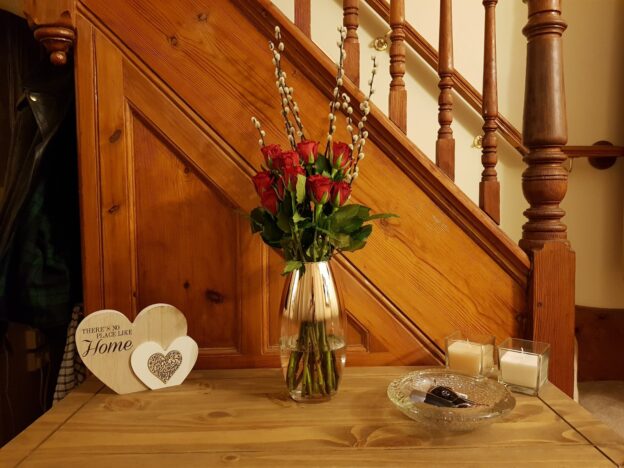
I live in a million-pound house with something like twenty rooms, and I have ended up, most nights, asleep on the settee in the living room. The heating is on. The roof does not leak. Nobody is coming down the stairs. The house is doing exactly what a house is supposed to do. I am in it the way a traveller is in a room he can leave in the morning.
There’s your prize, pal.
Almost nothing in that story represents failure. The house exists. The money exists. The freedom exists. The career happened. Things were built. Problems were solved. Children grew up. The system produced results remarkably close to those it was designed to produce.
Now what?
I say something when I give talks at universities that students usually take as a joke. Typically the first thing after introductions.
“I can teach you how to be successful. I can’t teach you how to be happy.”
The brighter ones sometimes understand why that isn’t a boast. The others immediately want the success bit.
“How?”
There isn’t a trick. Get up at six. Work until ten. Work when other people aren’t working. Read. Learn. Stay humble enough to discover that somebody else knows more than you. Take responsibility. Do the difficult thing first. Sacrifice things you would rather not sacrifice. When you fail, get up and do it again. Do that not for three weeks because you’ve bought a new notebook and watched an inspirational video, but for years.
They think I’m taking the piss.
I’m not.
Luck matters. Where you were born matters. Health matters. Intelligence matters. Other people matter. The world is full of people who worked brutally hard and did not receive the rewards their effort deserved. I am not offering the revolting little morality tale in which wealth proves virtue and poverty indicates insufficient hustle. Within the part of the world I can control, I know how to increase the probability of success. Work. Learn. Persist. Sacrifice. Become good enough at something useful that other people value your ability to do it. Stay in the problem after somebody else has decided it cannot be solved.
I know how to teach that because I have done it.
I don’t know how to teach happiness because I haven’t successfully achieved that.
This gets even stranger when I look at my children. For roughly ten years I had Andy, Joe, and Bill three weekends a month, and I put an enormous amount into them. Not because children are projects, and certainly not because my job was to manufacture three miniature Waynes, but because I have always thought one of my responsibilities as a father was to make sure my children became strong enough to meet the world without requiring the world to become gentle first. Strong, capable, fit, healthy, able to think, able to look after themselves and other people, able to get knocked down without assuming that the floor was where they now belonged.
Resilient.
Perhaps as resilient as I am, although I hope at rather less cost.
And they are. They’re all right, Jack. Which is wonderful and, from the narrow perspective of the lonely father, slightly inconvenient, because the successful conclusion of raising strong and capable children is that they develop lives of their own. They fuck off. They have relationships, work, friends, ambitions, homes, plans, arguments, journeys and Tuesday evenings which quite properly do not involve their father. I did not spend ten years helping them become independent, so that they could spend the following forty keeping me company. That would be a peculiar definition of successful parenting.
I love my children enormously, and I am close to them. But their job is not to cure their father’s loneliness, and their love is not a substitute for a partner’s love. These things are not interchangeable. Friendship is not parenthood. Parenthood is not erotic love. A son or daughter cannot reasonably be asked to occupy the same human space as somebody you want beside you; somebody you go to the cinema with, talk complete shit with, eat with, sleep with, argue with, laugh with, fuck, forgive and occasionally wish would stop leaving the bloody cupboard door open.
A man can be loved and still be lonely.
My children being all right is evidence that something worked. It does not tell me what I am supposed to do with Tuesday.
The King and the Land
Excalibur is my second favourite film after Doctor Zhivago, and it belongs to that category of things I encountered early enough that I no longer know precisely where the work ends and I begin. Arthurian legend was part of the imaginative furniture of my childhood: Arthur, Merlin, the sword, the Grail, the wounded king and the Waste Land; that collision of Celtic mythology, Christianity, sex, kingship, fertility, betrayal and redemption in which the condition of the ruler and the condition of the world refuse to remain separate. Grandad Bill was a big fan of the Grail mythology, and my early memories and books on the subject were gifts of his, from his collection.
There is a moment in John Boorman’s Excalibur which has stayed with me for decades. Arthur is alive, but the kingdom is barren. Camelot still exists. The king still exists. Survival has not solved the problem.
The Grail figure asks Perceval, “Have you found the secret that I have lost?”
“Yes. You and the land are one.”
In my memory, it long ago concatenated itself into the simpler formulation: the king and the land are one, and has always made me cry.
The external existence of a kingdom does not mean the kingdom is alive. The material existence of a house does not mean somebody has made a home in it.
And there is an immediate danger in that idea for somebody raised as I was, because if the king and the land are one, and the land is barren, the king has failed.
That is exactly how the boy who learned to get up thinks. If Mum is falling apart, fix it. If the company is failing, fix it. If the family is breaking, fix it. If somebody you love is unhappy, make her happy. If the relationship is failing, love harder. If the house does not feel like home, perhaps you have not yet done enough to deserve one.
No.
The king is not God.
Responsibility is not sovereignty.
I spent about a year giving Leiann everything I knew how to give. Attention, time, loyalty, thought, persistence; trying to understand, trying to repair, trying not to give up. Some of that was loving. Some of it, I suspect, was the fixing instinct doing what it always does: identifying a desired state and searching for the sequence of actions that will produce it. There is a point at which trying to repair another person’s experience can become oppressive, however loving the intention, because the person being repaired has not necessarily agreed that your preferred state is the state to which anything should return.
I know what I thought I was building. I cannot know for sure what Leiann believed she was inhabiting. I can describe my side of the room. I cannot occupy hers retrospectively.
Eventually I ran out of additional things to try.
I couldn’t love her into loving me back.
Almost every other important part of my life has taught me that sustained effort changes outcomes. Work harder, learn more, solve better, stay in the problem longer than everybody else, and eventually the graph usually moves. I have built a life on the proposition that there is nearly always another move.
Love has the rather infuriating property of containing another person.
You cannot survive hard enough for somebody to eventually have to love you. You cannot be useful enough that belonging becomes compulsory. You cannot optimise another human being’s desire.
It is evidence that the other person is a person.
My favourite book is The Master and Margarita. Not my favourite Russian novel, or my favourite twentieth-century novel. My favourite book. And Chapter Two, “Pontius Pilate”, may be my favourite piece of written work.
Bulgakov’s Pilate possesses enormous worldly power and begins the chapter in almost pathetic physical misery. He has hemicrania. Light hurts. Smell hurts. The scent of rose oil is intolerable. His head hurts so badly that power itself becomes ridiculous beside the immediate desire for darkness, relief and Banga, his dog.
Pilate understands the machinery by which the world he inhabits operates: authority, Caesar, fear, accusation, political danger, violence, reputation, consequences. He knows that words can kill. He understands what happens when truth collides with power because he is one of the people through whom power operates.
Then Yeshua walks in.
What I love about Bulgakov’s Yeshua is something I have never been able to name satisfactorily except as the innocence of all the good. Not stupidity. Not weakness. Innocence. He enters the scene calling Pilate “Good man!”, which Pilate immediately corrects: the rumour in Jerusalem is that he is a raving monster, and he assures Yeshua that the rumour is entirely correct. Later Pilate pushes the point harder. What about Mark Ratkiller, who has beaten him? What about the men who are going to be executed alongside him? What about Judas, who betrayed him? Are they all good men?
“Yes,” answers Yeshua.
There is something extraordinary in that answer which I have never been able to get away from. Yeshua is not stupid about what people do; he has arrived before Pilate, beaten, bound and facing death. But he does not organise reality according to the categories through which Pilate survives it. Somehow, the violence committed by a human being does not exhaust Yeshua’s account of who that human being is. He calls people good. He notices suffering. Where everyone else sees the Procurator of Judea, Yeshua sees a man whose head hurts and who wants his dog.
Pilate knows how to operate the world.
Yeshua sees the person trapped inside the operator.
That destroys me.
I have spent much of my life becoming extremely good at operating the world. Read the room. Understand the hierarchy. Predict the threat. Become useful. Solve the problem. Make yourself difficult to discard. Get up. Learn the system faster than the system can hurt you.
It works.
Pilate survives. Pilate commands. Pilate has authority over whether others survive.
And Pilate is miserable.
Power cannot make existence inhabitable.
That does not make power worthless. It means a tool can be extraordinarily effective at the task for which it was designed and completely useless for another. A screwdriver is an excellent tool. The discovery that it cannot cook dinner is not an indictment of screwdrivers.
I have perhaps been trying to cook dinner with a fucking screwdriver.
I have written before about usefulness, and about constructing meaning when meaning is not conveniently supplied. I still believe in that. If the universe does not hand you a job description, write one. If an institution measures human beings badly, refuse its measurement. If the life you have inherited is incoherent, take some responsibility for constructing something you can inhabit.
But there is a boundary condition I had not properly understood.
Some meaning can be constructed. Some meaning can only be made together.
I can write an essay without anybody’s permission. I can build a company. I can make money. I can buy a house. I can decide that somebody else’s judgement of me does not have final editorial authority over who I become.
I cannot construct reciprocity by myself.
And if I could, it would not be reciprocity.
I wrote about this earlier, before this series had a name, in “No Comfort Here: Muriel Spark, Catholicism, and the Problem of Control versus Self Control“; the more completely you try to author the outcome, the closer the work gets to ending the conditions under which anything can still be made.
How do I make room for something I cannot make happen?
A House Is Not a Motel
I do not simply want somebody physically present. There are straightforward commercial solutions to physical presence, and none of them is what I mean by home. I want someone free. Free to leave, and therefore capable of choosing to stay. Her freedom is not an unfortunate defect in the desired relationship. Her freedom is precisely what makes her staying mean anything.
The freedom that makes love possible also makes loneliness possible.
There is no engineering solution to that.
The title of this essay comes from Love’s Forever Changes. “A House Is Not a Motel” suggests three things that look superficially similar but are nothing alike: structure, occupancy, and belonging. A house is a physical thing. A motel is a physical thing too, but its architecture assumes departure. Somebody arrives, occupies a room, sleeps and leaves. There is nothing inherently false about that.
Home contains something else: return, expectation, repetition, the accumulation of ordinary knowledge so banal nobody thinks to record it. Which cup she uses. What she sounds like coming up the stairs. The stupid television programme she watches. Her smell on a pillow. The warmth of another body beside you. The cupboard door she always leaves open despite apparently possessing all the motor skills necessary to close the fucking thing. Looking at somebody you have seen a thousand times and, for no useful reason whatsoever, still wanting to touch her.
Belonging is not an administrative arrangement. Desire is stupidly particular. There can be ten perfectly lovely people in a room and one person whose arrival changes your physiology. We do not desire categories. We desire people.
And this is why two people can inhabit what appears externally to be the same relationship while living somewhere else. One may think home. The other may think something else entirely: motel, refuge, habit, obligation, prison, a place she once loved and no longer does, or something for which I do not possess the correct metaphor because it was never mine to name.
Same room. Different ontology.
What I want now is almost embarrassingly ordinary. I have enough grand narrative. I have enough fucking drama. I want somebody to come home to. Somebody who tells me something boring about her day and assumes I know who all the people are despite having introduced none of them. Somebody I listen to and occasionally fail to listen to properly. Somebody whose footsteps I recognise. Somebody I look at while she’s doing something utterly mundane and think, Christ, she’s beautiful. Somebody who irritates me. Somebody who thinks I’m being a pompous cunt and tells me. Food. Sex. Arguments about things which do not matter. Laughter. Falling asleep. Her stuff appearing in places. My stuff annoying her. Going to the cinema. Sitting in the same room doing completely different things.
Tuesday.
Nothing impressive.
That is what makes it so difficult. I know how to do impressive. I don’t know how to manufacture Tuesday.
Usefulness can build companies. It can build careers. It can provide for children. It can buy the house.
It cannot make a home.
In And This Is Sid, I said that Dave did not need an operating model. He liked me being there.
That is still the distinction.
There is a Taoist idea I have returned to repeatedly: that the usefulness of a vessel lies partly in its emptiness, that we build walls but inhabit the space between them.
I am less relaxed about emptiness than I once was.
There is generative emptiness: the blank page, the room waiting to be inhabited, the pause into which something unexpected can enter. And there is absence: the chair after somebody dies, the bedroom after somebody leaves, the space beside you where another body is not.
Architecturally, empty is empty.
Humanly, these are entirely different conditions.
What if the empty space fucking hurts?
I cannot fill it by treating another person as material. I can make room. I cannot make somebody enter it.
And I do not know whether anyone will.
What frightens me is simpler: what if there is more emptiness? What if I continue doing what Horkans do, getting up, carrying on, making things, loving people, trying to become less of an arsehole, and discover only more of this?
I am Catholic. I believe the Lord sees me. I try to be grateful for the gifts I have been given, including the bloody-minded capacity to endure. I also believe a Cross is a Cross. Faith does not require me to rename pain as something pleasant simply because I believe it can be borne. Gratitude and suffering are perfectly capable of occupying the same human being at the same time.
The question remains stubbornly human.
What do you do after survival has worked?
No Ithaca
Odysseus spends ten years trying to return to the home he already knows. Ithaca exists. Penelope exists. The household has been disrupted, and the task is to restore it.
Aeneas has the nastier problem.
Troy is gone.
He cannot go home because home has been destroyed. His movement therefore has to be forwards, towards foundation, towards a future city he himself will never see completed. For a long time after something changes, I think we become Odysseus. We want to get back. Restore the old configuration. As I wrote in Tears in Rain, find Ithaca. Find the person she was. Find the person I was. Find the room as it used to be.
Sometimes there is no Ithaca.
Build.
And God knows I know how to build.
You can build the city and still not know how to live in it.
That may be where I am. The house is built. The professional life is built. The intellectual life is very fucking built. The children are grown and capable.
They’re all right, Jack.
The question is no longer whether I can get home or build another one.
It is whether I know how to inhabit what has been built.
I don’t think the answer is another programme. Optimise social contact, improve routines, expand networks, date more, date better, define objectives, measure outcomes. Fucking KPIs for intimacy.
No.
That road is extraordinarily good at producing outcomes which can be produced.
What I am trying to understand may require something closer to participation than to construction. Not dominating everything. Not fixing everybody. Not making myself useful before anybody has asked me to be useful. Not retreating either.
Participating.
I am not entirely sure what I mean by that yet.
Perhaps that is important.
Can Wayne survive?
Yes.
At this point the experimental evidence is embarrassingly strong. If the bomb comes, find a Horkan. We’ll probably have tins.
I get up.
My children get up too. I wanted strong children and got strong adults who quite properly do not need to organise their lives around me. The father succeeds partly by becoming less necessary.
Maybe usefulness contains its own ending.
That may be why I can teach success and not happiness.
Success has procedures.
Happiness has always struck me as a much less obedient bastard.
I can tell a room full of students what sacrifice does. I cannot stand at the front of the room and say, “Do these things, and you will be loved.” Or do these things, and you will feel at home. Or even do these things, and you will be happy.
I have run the experiment. Those are not the outputs.
That does not mean the inputs were wasted. I would still teach my children resilience. I would still tell the students to work. I would still tell the frightened boy to get up. I cannot condemn the thing that carried me here merely because here has problems of its own.
The survival system worked. It made me capable. It made me useful. It helped make me successful. It helped me raise children who can stand on their own feet. It helped build a life I am, in many respects, extraordinarily fortunate to have.
And now the life it built is asking a question the system cannot answer.
I would like to tell the boy something besides get up.
I just don’t know what it is.
And that, I think, is the question underneath the house. Not whether endurance is good. It is. Not whether success matters. It does. Not whether I am loved. I am. Not whether I should be grateful. I am.
The question is what any of those things can tell me about how to live in the life they successfully produced.
I have survived into wealth, competence, independence and children strong enough to leave me alone.
Well done.
There’s your fucking prize, pal.
I am proud of them. I am proud of things I have built. I like the house. I like my life in many ways. There are moments of pleasure, stupidity, laughter, and beauty inside it.
But neither does gratitude require me to pretend the absence isn’t there.
I want home.
Not property. Not dependency. Not somebody whose freedom has been slowly engineered out of the relationship until staying no longer means anything.
A woman who could leave and doesn’t.
Tuesday.
I don’t know how to make that happen.
Perhaps the most significant thing I can do is finally stop pretending that I do.
I know how to survive. I know how to work. I know how to sacrifice. I know how to make myself useful. I know how to build things. I know how to get up.
The experiment no longer needs repeating.
What I do not know is what comes after I endure.
The house is here. The children are all right. I am grateful. I am loved. I am lonely. The Lord sees me. I still want home.
None of those truths cancels any of the others.
I don’t know what comes next.
For now, that is where I am.