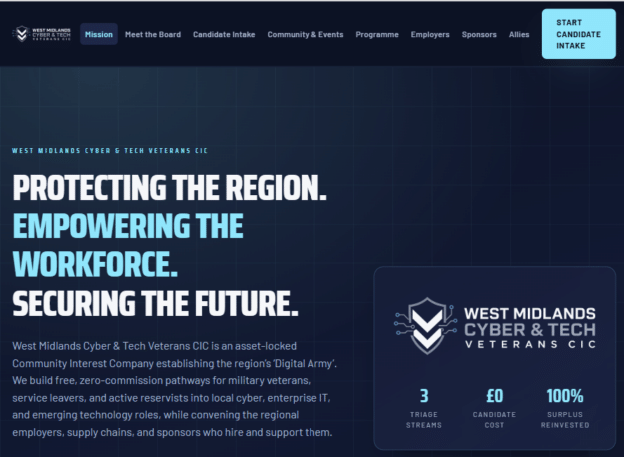
The Cyber Veterans Alliance began with Ryan Jones’s idea for an enduring veteran-led cyber community. I subsequently helped develop that concept into a structured, independent operating model. The later West Midlands Cyber & Tech Veterans CIC proposition contains recognisable elements of that earlier work, along with substantial subsequent development. This article celebrates that evolution, examines the documented contributions along the way, and makes a simple case for collaboration and fair attribution.
Contents
- Contents
- 1. Introduction
- 2. Ryan’s Original Insight Was A Good One
- 3. From Insight To Operating Model
- 4. Independence Was Also Designed Into The Model
- 5. From Practitioner Network To Something Considerably Bigger
- 6. From A Veterans Community To An Institution With A Veterans Community
- 7. One Particularly Revealing Change Is Recruitment
- 8. The Same Thing Happened With Institutional Authority
- 9. Three Models Can Therefore Be Seen In The Documentary History
- 10. Collaboration Doesn’t Diminish Authorship
- 11. And The Final Model Deserves To Be Celebrated
1. Introduction
A genuinely good idea lies at the heart of the West Midlands Cyber & Tech Veterans CIC.
Veterans and serving personnel possess an extraordinary concentration of technical experience, operational judgement, leadership and hard-won institutional knowledge. Yet when people leave service, much of the infrastructure surrounding that expertise disappears with them. Training and transition programmes can help people cross the boundary into civilian employment, but they do not necessarily provide the enduring professional community that exists afterwards.
That was the insight behind the original Cyber Veterans Alliance (CVA) proposal.
What is particularly interesting, looking back at the documentary trail, is how that relatively simple proposition developed. It went through several stages: from Ryan Jones’s initial concept, through the work I subsequently did to formalise and elaborate the model, and ultimately to the considerably broader proposition now publicly presented as West Midlands Cyber & Tech Veterans CIC.
I think the resulting organisation contains some excellent ideas. I also think its evolution illustrates something important about collaboration: ideas rarely emerge fully formed. Different people contribute different layers, and recognising those contributions does not diminish the person who had the original idea. It usually makes the story better.
What matters to me in telling that story is not simply who wrote which document. When Ryan brought the idea to me, I wanted to encourage him. I thought there was something genuinely worthwhile in what he was trying to create, and I was happy to give him my time, support and experience to help develop it.
2. Ryan’s Original Insight Was A Good One
Ryan’s initial WhatsApp proposal was refreshingly straightforward.
His idea was for a non-profit community for veterans and serving armed forces personnel working in cyber. The gap he identified was equally straightforward: organisations such as TechVets addressed training and routes into jobs, but there was space for an ongoing network focused on knowledge sharing, defence expertise and professional relationships.
The original proposal envisaged people networking organically, sharing real-world technical knowledge and opportunities, supporting one another through the military-to-civilian transition, and eventually creating a sufficiently authoritative community that MOD, NCSC, government, and industry might consult.
The West Midlands Cyber Hub was proposed as its initial home. LinkedIn and Discord would support the online community. Events would begin small. The target was just 50 active veteran members in six months and regular events attracting perhaps 10–20 people.
The long-term ambition was much bigger: potentially a dedicated platform, described memorably as essentially a LinkedIn for cyber security in MOD and defence, incorporating talent matching, recruitment opportunities and secure professional collaboration.
That is a strong founding idea.
And it is important to say that plainly.
3. From Insight To Operating Model
When I subsequently developed Ryan’s initial material, I deliberately retained its central proposition.
The resulting CVA overview described an organisation intended to “retain, develop, and connect cyber expertise from across the UK armed forces” and explicitly positioned it in the gap between transition programmes and a lasting professional community.
The distinction mattered.
CVA was not another training provider. It was a practitioner network.
In the subsequent CVA material, I developed Ryan’s proposition into three clearer functions: a knowledge and practice network; community and continuity after service; and, eventually, defence-informed insight capable of contributing to best-practice discussions and perhaps consultation.
That introduced an important concept into the model: sequencing.
Authority would not simply be declared. It would be earned.
First build the community. Then demonstrate participation. Then accumulate useful knowledge. Then establish credibility. Only after that should the organisation begin exploring advisory or institutional roles.
The development plan therefore became:
community → activity → knowledge → reputation → partnerships → advisory capability
rather than trying to launch all of those things simultaneously.
4. Independence Was Also Designed Into The Model
One concern in Ryan’s original message was particularly important: although the West Midlands Cyber Hub could provide an excellent home, CVA needed to remain an independent, veteran-led organisation.
I turned that concern into a more explicit organisational principle.
Under the proposed “Early-Stage Home Model”, WMCH would provide a credible physical anchor, events infrastructure and access to the regional ecosystem, allowing CVA to get started without unnecessary overhead. But CVA would retain ownership of its governance, brand, direction and network.
The distinction was expressed particularly clearly:
Physically hosted at WMCH, but independently governed and veteran-led.
And although born in Birmingham, the proposed organisation was explicitly designed for national scope from day one. WMCH would remain its founding hub rather than becoming a geographical constraint.
I still think that is a particularly useful model.
It provides the advantages of institutional support without requiring institutional ownership: a credible place to meet, ecosystem connections, reduced startup friction, and immediate visibility, while protecting the independence that made Ryan’s original idea attractive in the first place.
5. From Practitioner Network To Something Considerably Bigger
What makes the subsequent West Midlands Cyber & Tech Veterans proposition fascinating is how much further the concept has travelled.
The submitted/public-facing material retains recognisable elements of the earlier thinking: veteran talent, cyber and technology, a CIC structure, community building, events, defence expertise, industry engagement and an eventual physical hub.
But around those elements now sits a considerably larger institutional proposition.
The original CVA was principally a community of practitioners.
The subsequent model encompasses:
| Dimension | Ryan’s original concept | My elaborated CVA model | Subsequent WMC&TV proposition |
|---|---|---|---|
| Central purpose | Veteran cyber community | Structured veteran practitioner network | Regional workforce and technology ecosystem |
| Geography | WM base, wider defence relevance | Explicit UK-wide scope | Explicit West Midlands mission |
| Primary value | Peer connection and knowledge | Community, knowledge and retained expertise | Talent, employers, SMEs, procurement and regional impact |
| WMCH | Main base | Founding host, not controlling institution | Broader regional ecosystem model |
| Employment | Transition support | Community supporting transition | Candidate/employer introductions |
| Recruitment | Future platform possibility | Future talent visibility | Operational candidate intake and introduction |
| Knowledge sharing | Core purpose | Core organisational pillar | One component of a broader programme |
| Events | Small community events | 10–20-person practitioner sessions | Job fairs, panels, workshops, expos and summits |
| Consultancy | Eventual possibility | Only after credibility develops | Explicit advisory revenue opportunity |
| SMEs | Peripheral | Potential partners | Major beneficiary group |
| Procurement | Not stated in the original material | Not a founding purpose | Significant organisational pillar |
| Social value | Not stated in the original material | Not central | PPN 06/20 advisory proposition |
| Funding | Low-cost/community approach | Lean incubation | Sponsorship, retainers and grants |
| Digital product | Future defence-cyber LinkedIn | Conditional on demonstrated demand | Operational platform/portal |
| Economic development | Not a stated objective | Ecosystem benefit | Retaining technology expenditure in the region |
| Governance | Founders/community | Independent veteran-majority governance | CEO plus multi-domain steering structure |
| Growth logic | Network → community | Community → credibility → partnerships | Launch → ecosystem → regional scale → grants/hub |
In several respects, it is an impressive expansion.
Helping regional SMEs become more capable suppliers, improving cyber readiness, connecting veteran expertise with industry, supporting CNI, bringing organisations together and retaining high-value technical activity in the West Midlands are all potentially valuable objectives.
My reading of the documentary progression is that this is no longer only the original proposition.
It represents a substantial evolution.
6. From A Veterans Community To An Institution With A Veterans Community
There is another way of understanding this evolution.
The original CVA was fundamentally a veterans community with an organisational structure around it. The community was the point. Governance, events, digital tools and institutional relationships existed to support the practitioner network.
The subsequent proposition appears to reverse that emphasis. It increasingly resembles a broader institution within which the veterans community is one important component, alongside employers, SMEs, procurement, supply-chain activity, social value, sponsorship, grants and regional economic-development objectives.
That is a significant change in organisational architecture. It does not make the subsequent model better or worse. It makes it different, broader and considerably more ambitious.
Put another way, the original proposition was a veterans community that might, through its knowledge, activity and reputation, eventually acquire wider institutional relevance. The subsequent proposition is much closer to an institution with a veterans community at its heart.
7. One Particularly Revealing Change Is Recruitment
The chronology here is useful.
Ryan originally envisioned recruitment and talent matching as part of the long-term vision: once the community existed, it could perhaps develop into a dedicated professional platform connecting defence organisations, MOD, CISOs, and cyber professionals.
My elaboration retained that ambition but deliberately made it conditional. A specialist digital platform might follow if demand supported it, after the practitioner community had demonstrated value.
In the subsequent proposition, talent intermediation has moved much closer to the centre of operations: candidate intake, triage, verification and employer introductions.
Helping veterans and service leavers into meaningful civilian employment is an excellent objective, and any credible route that helps translate military experience into careers in cyber and technology deserves support. If this model gets more veterans into good jobs, that is something to celebrate.
What is interesting is the evolution of the proposition: CVA began by identifying the gap beyond “training-to-jobs”, an enduring professional community for knowledge-sharing and defence expertise, whereas employment pathways and talent intermediation now sit much closer to the centre of the subsequent model.
In other words, an idea that began near the end of the original maturity curve has moved towards the beginning of the new one.
That is substantive model development.
8. The Same Thing Happened With Institutional Authority
Ryan’s ambition was that CVA might eventually become a place where MOD, NCSC, government, and industry sought expertise.
I thought the word eventually was important.
Consequently, my elaboration placed defence-informed advisory activity explicitly in the longer-term category: aggregate expertise first, establish credibility, contribute to best-practice discussions, and develop consultation capability “as credibility develops”.
The subsequent proposition places those activities considerably earlier in the organisational model.
That also changes the nature of the proposition. A practitioner community aspiring to become influential as its membership, knowledge and reputation grow is different from an organisation presenting functions across supply chains, procurement, CNI, security standards and regional economic development much earlier in its development.
Defence supply chains, CNI, DCPP, Cyber Essentials Plus, AI governance, security-clearance pathways, public procurement, social-value obligations and collaborative tendering all appear much closer to launch.
9. Three Models Can Therefore Be Seen In The Documentary History
Reading the three sets of material chronologically, I think three distinct models emerge.
Ryan’s original model could be represented as:
Veterans → Community → Knowledge → Reputation → Institutional relevance
My elaboration developed that into:
Veterans → Practitioner network → Regular activity → Knowledge base → Demonstrated credibility → Partnerships → Advisory capability → Potential specialist platform
The subsequent model looks considerably more like:
Veteran talent → Regional platform → Employers + SMEs → Supply-chain capability → Procurement + social value → Sponsorship + grants → Regional economic impact
All three have merit.
They are also clearly not identical.
And that is precisely why attribution need not be adversarial.
10. Collaboration Doesn’t Diminish Authorship
Ryan deserves recognition for identifying the original opportunity.
There was a human dimension to that collaboration too. Ryan brought me an idea he cared about and asked for my input and guidance. I encouraged him to pursue it and tried to help turn that initial idea into something that could work in practice. Supporting people in developing worthwhile ideas has always been part of how I have approached building companies and working with colleagues. Whatever subsequently changed, I remain pleased that I supported Ryan at that formative stage and that the underlying idea has continued to develop.
At the time, Ryan was employed by Cyber Tzar, the company I founded, and our work on the proposition arose naturally in that context. It was exactly the sort of initiative I wanted people around Cyber Tzar and the West Midlands Cyber Hub to feel able to bring forward and develop.
I remain pleased to have played a part in that formative work. Neither Cyber Tzar nor I seek to detract from what Ryan has subsequently done. Quite the opposite: I wish him every success with West Midlands Cyber & Tech Veterans and in his role at CyberQ Group.
That goodwill is also why I think the distinction between origination and contribution is worth making carefully. Ryan originated the proposition. My contribution was to help develop it into a more structured organisational and operating model.
In the CVA working documents that followed Ryan’s original note, the proposition was developed into a more explicit practitioner-network architecture: immediate activity separated from longer-term ambition, a staged growth model, formal independence, a defined WMCH incubation relationship, measurable early success criteria, and national scope from the start.
Those were substantive contributions to the organisational model, while the originating idea remained Ryan’s.
This account is based on our March 2026 WhatsApp exchanges (extracted into “Original Cyber Veterans Alliance Overview“), the CVA working documents that followed (“Cyber Veterans Alliance – Initial Overview – draft v0.1” and “CVA at the WM Cyber Hub – draft v0.1“), and the later publicly circulated WMCTV material (saved in “WMCTV Overview“). My comparison is chronological and based on what those materials actually say, rather than on assumptions about anyone’s private intentions.
11. And The Final Model Deserves To Be Celebrated
What has subsequently emerged is not simply a larger version of the proposition with which we started. It is a different kind of organisational proposition: broader, more institutional and considerably more ambitious.
It attempts to connect veteran transition with regional cyber resilience, SMEs, defence supply chains, procurement, CNI, social value, employers and economic development.
If successfully delivered, that could create meaningful opportunities for veterans while strengthening the West Midlands technology ecosystem.
I hope it succeeds.
Indeed, seeing an idea gain momentum, attract people, and become something larger is exactly what those of us who build things want.
But success and provenance aren’t mutually exclusive.
The story has room for the person who first said, “there should be a veteran cyber community.”
There is room for the person who helped turn that idea into a structured organisational and operating model.
And there is room for those who subsequently expanded it into something considerably broader.
None needs to diminish the others.
Fair attribution costs very little. Collaboration deserves to be part of the story, not edited out.
And perhaps that is particularly appropriate for an organisation whose founding premise was that people achieve more when expertise is retained, shared and built upon.