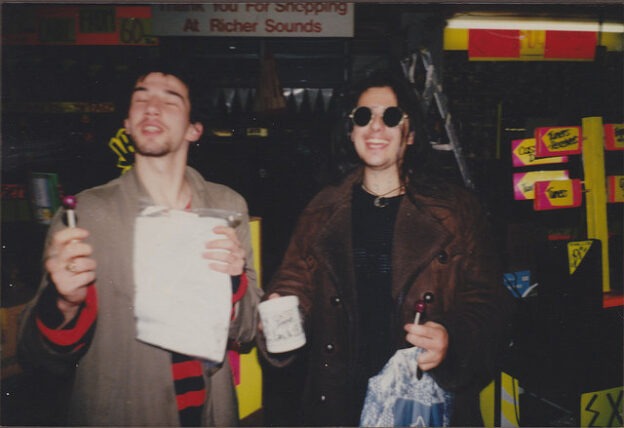
Call Me Womble said I am the baker, and my life is the bread. Then Ian pointed out the obvious problem: there are other people in the bakery. This is an essay about my friend Dave, who stole my stories, helped produce them, blamed me when he died, and kept editing afterwards. Personality happens between people. Being seen is not a passive event. Usefulness asks what I can do for you; witness asks whether I am here. We make one another. We do not own one another.
In Call Me Womble I ended up with Dave Sim’s line, “You are the baker and your life is the bread.” I make the work, the work changes me, and the changed me makes whatever comes next. You make a decision and afterwards have to become the person who made it. You write something and discover that the act of writing has changed what you think. You love somebody and cannot, afterwards, return completely to the person who did not love them. The baker makes the bread, but baking also changes the baker.
There is an obvious problem with this, which my friend Ian Dunmore spotted almost immediately.
There are other people in the bakery.
They don’t merely admire the bread. They eat it. They digest it. They tell other people about it. They forget where it came from. They make their own. Somebody else eats that. Eventually, something comes back that contains a trace of the original but has travelled through so many people that talking about ownership starts to sound faintly ridiculous. Ian’s point was that a work does not simply create another version of its artist. It can produce “other works, other artists, other audiences, other structures and other conditions for its own reproduction.” Once you admit the audience into the loop, the loop stops being a loop. It branches.
Which brings me to Dave.
And this is Sid
Dave stole my stories.
Dave was a voracious consumer of other people’s stories with an unusually relaxed attitude towards provenance. Something would happen to me, usually something ridiculous enough to be worth retelling, and it would enter the Dave ecosystem. Months or years later somebody would say, “Did you hear about the time Dave…?” and I would listen for a while before eventually having to say, “That was me.”
The little fuck.
He did it to everybody. I think Dave absorbed stories almost as a form of affection. He liked people, he liked their mythology, and when something entertained him sufficiently it became incorporated into whatever Dave was. I probably supplied rather more raw material than most because I have spent a significant proportion of my life generating unnecessary incidents. The thing I understand differently now is that Dave wasn’t merely stealing the finished product. Quite often he had helped produce it.
There were things I did partly because Dave was there.
Not because I was pretending to be somebody else, but because Dave brought out a particular somebody in me. There is a pleasure in doing something magnificent, stupid, dangerous or merely very funny and turning towards the person whose reaction you already know you want. The raised eyebrow. The laugh. The expression that says you’re an absolute fucking idiot. The event has happened, but part of its meaning arrives when it lands in another person.
Dave was an audience, certainly, but “audience” makes him sound too passive. He was part of the performance. And I was part of his.
“We all impersonate personality.”
I’ve attributed that to Sartre for years. I am no longer confident Sartre actually said it, at least not in that form, and there is something so pleasing about a quotation concerning the impersonation of personality, having spent years impersonating Jean-Paul Sartre, that I am reluctant to interfere with it too much.
I don’t really believe there is a Wayne-Wayne.
There may be some inner continuity we can reasonably call Wayne: temperament, memory, appetites, fears, habits, ways of thinking which have been recognisably mine for most of my life. But I don’t think there is an archaeological Wayne buried underneath all my interactions, waiting for the social sediment to be brushed away so that some authentic factory-original personality can finally be displayed in a museum.
Wayne-with-Andy is genuinely Wayne-with-Andy. Wayne-at-work is Wayne interacting with colleagues, expectations, responsibility and quite a lot of deliberate autistic masking. Wayne-with-Dave was something else. Wayne with somebody I love is something else again.
Miles Davis playing with Coltrane is still Miles Davis, but he isn’t producing exactly the music he would have produced with somebody else. A conversation is partly made by the person opposite you. A joke changes according to its audience. Even the way we think alone is crowded with other people: imagined arguments, remembered voices, things our parents said, the person we wish were there to see what has just happened.
Personality, at least some of it, seems to happen between people.
That takes me further than Womble. I can make myself, but I cannot independently make the Wayne who exists between you and me.
The Wayne Between Us
If another person changes what I produce, and what I produce changes them, and the changed person then produces something else, we are no longer dealing with individual artists firing completed works at passive audiences. We are dealing with propagation.
Art does this visibly. Culture does it constantly. The web does it at absurd speed. An idea moves from a public page into a WhatsApp group, gets paraphrased in a conversation, appears without attribution in somebody else’s post, changes somebody’s opinion, becomes part of another piece of work and perhaps returns years later wearing a hat and insisting it has never met you before. Provenance disappears long before consequence does.
Human beings do this to one another all the time.
I discovered another example of this only much later. Dave converted to Catholicism, and apparently I had something to do with it. The odd thing is that I never tried to convert him. I don’t remember talking to him about Catholicism in any serious attempt to persuade him of anything. He simply knew I was Catholic, and, as I later understood it, he wanted to be like me. I find that rather astonishing. You imagine influence happening through the things you deliberately say and do, while apparently somebody else may be quietly incorporating something you regarded simply as part of being yourself. The sod was nicking more than my stories.
Dave was simply an analogue version of the unbundled web with catastrophically poor attribution controls.
If other people participate in making us, then being seen by somebody is not a passive event. A witness changes what is witnessed.
I have spent a lot of my life being useful. I learned early that usefulness is a reliable way of establishing a place in the world: fix the problem, understand the system, carry the thing nobody else wants to carry, make yourself difficult to dispense with. It works extraordinarily well, right up until you confuse being needed with belonging.
Dave did not need me because I could optimise anything for him. He did not require a strategic plan, a transformation programme or a fucking operating model. He liked me being there.
That is different.
Usefulness asks what I can do for you. Witness asks whether I am here, and whether the fact that I am here matters.
Perhaps the opposite of usefulness is not uselessness.
Perhaps it is belonging.
Friendship is one of the places where that distinction becomes obvious, because friendship at its best contains an enormous quantity of purposeless presence. Talking shit. Repeating stories. Sitting around. Laughing at things that become less funny every time you attempt to explain them to somebody outside the friendship. There is no deliverable. Nothing has been optimised. Yet something is being made.
The people involved are being made.
Co-authorship is not ownership
If other people participate in making us, how much authority do they acquire over what they have helped make?
My father killed himself when I was twenty-one and left a note blaming me. For more than twenty years I carried that judgement with an authority that is difficult to explain unless you have experienced the peculiar power the dead can acquire over the living. You can argue with the living. You can tell them they’re wrong. You can demand an explanation. You can tell them they’re talking bollocks and make them defend themselves.
The dead have finished speaking.
Their last words can therefore acquire a permanence they do not necessarily deserve.
Then Dave killed himself, and Dave blamed me too.
Except by then I was older. And I knew he was wrong. I hadn’t killed the daft cunt.
I don’t mean I had successfully repeated this isn’t your fault into a mirror until I believed it. I mean I understood something at forty-something that I had not understood at twenty-one: another person’s despair can involve me without being authored by me. I can matter profoundly to somebody without possessing sovereign control over whether they live or die. Intimacy does not confer omnipotence.
And once I knew Dave was wrong, something happened that I had not expected.
If Dave could be wrong about me, perhaps Dad could have been wrong too.
Death does not confer omniscience. A suicide note is written by a suffering human being, not dictated by God. There is an enormous difference between knowing that intellectually and having it enter deeply enough to rearrange something you have carried for decades.
I sometimes think of this as the last gift Dave gave me, and I have to be careful with that phrase because his death was not a gift. His accusation was not a gift. I refuse the revolting little moral transaction in which suffering becomes worthwhile because somebody eventually extracts wisdom from it. The gift was the unexpected consequence: knowing with certainty that Dave had been wrong allowed me finally to entertain, emotionally rather than merely logically, the possibility that Dad had been wrong as well.
Dave changed me after he died. He was still editing. But editing isn’t ownership.
Parents help make us, but they don’t own the finished meaning. Lovers help make us, but they don’t get to decide what we are in the end. Friends can see things in us that we cannot see ourselves and still be wrong about us. Other people leave brushstrokes, scars, corrections, marginalia and great fucking holes in the work, but participation does not confer sovereignty.
We make one another, but we do not own one another.
When the witness dies
After Dave died, I became obsessed for a while with the fact that some memories which had previously existed in two people now existed only in me. There were things for which Dave and I were the witnesses, and suddenly I was carrying both ends of the memory. It happened. I know it happened. Something has nevertheless been lost when there is no longer another human being to whom I can say, “Do you remember?” and watch recognition arrive. The same feeling came back hard when Richard Martin died.
For a while I rang Dave.
I knew perfectly well he was dead. Something would happen, and the part of me which had spent years knowing this is a thing I tell Dave would reach towards him before the rest of me caught up.
Internally, Dave still had an address.
Externally, nobody answered.
The body disappears faster than all the selves organised around that body can reorganise themselves. Dave was gone, but Wayne-with-Dave had not yet understood that there would be no further performances.
There is a line in Cerebus which has haunted me for years. The Judge tells Cerebus that he will die:
“Alone, unmourned and unloved.”
Alone is one thing. There are kinds of aloneness I enjoy. Unmourned and unloved suggest something different: that your existence failed to become consequential in anybody else, that when you disappear, no corresponding absence appears in the world.
Dave’s funeral was fucking packed.
And somewhere in the middle of looking at all those people who had come because this ridiculous, infuriating, funny man mattered to them, I had a thought I wasn’t especially proud of:
Would this many people come for me?
Dave had other witnesses, of course. He had been part of The Tenants, a tasty Birmingham punk band with its own mythology, and there were whole versions of Dave belonging to people and places in which I had no part at all. Many were built on other people’s stories, I later learned.
I don’t think the question below mine was really about funeral attendance. It was whether my absence would matter.
Would somebody possess a story whose other witness had disappeared? Would somebody find themselves reaching for the phone? Would somebody hear themselves using one of my phrases years later and think, Christ, that’s Wayne? Would there be a Wayne-shaped absence somewhere other than inside Wayne?
Somebody tells your joke. Somebody adopts one of your expressions. Somebody changes a decision because of an argument you had twenty years earlier. Somebody remembers exactly how you looked when something happened which nobody photographed. Somebody tells one of your stories and, eventually, forgets it was yours.
Dave would certainly approve of that last one.
To witness another person is not merely to observe them. It is to allow something of them to enter you, where it may remain, change, combine with other things and eventually emerge somewhere neither of you could have predicted.
I am Catholic, so I believe there is another witness behind all of this. I believe the Lord sees us. I believe Dave was seen and that I am seen. The Lord seeing Dave does not mean I can ring him. God does not fill the empty chair by making the chair philosophically unnecessary. Particular bodies matter. Particular people matter. Christ weeps for Lazarus despite knowing perfectly well what happens next. Faith does not require us to pretend absence is not absence.
I still make myself. I still believe that the authority is mine because the authorship is mine. But authorship has become a much stranger and more promiscuous business. Parents, children, friends, lovers, enemies, books, songs, work, faith, jokes, arguments and accidents all get into the material. Some people vandalise the work. Some repair things without knowing they were broken. Some paint over things we later excavate. Some leave marks we spend decades trying to remove, and others leave marks we would now give anything to preserve.
None of them makes us completely.
Neither do we.
Individuality is not freedom from influence. It is the particular, irreproducible way in which a human being absorbs, resists, transforms and carries everything that has touched them.
And somewhere in that mess is Dave.
Just Dave: funny, infuriating, loved, sometimes wrong, eventually dead, still present in consequences he could never have predicted.
There are things about him which now exist only because I remember them. There are things about me which existed only because he was there to see them. That particular collaboration has ended, and I cannot reconstruct it by myself because it was never mine by myself.
What remains is the changed artist.
Ian was right. The bread gets eaten. The eater becomes a baker. The recipe changes. Provenance disappears. Something travels onwards.
And Dave, naturally, nicked some of mine on the way.
I could probably insist on correcting the record.
But I think I’ll let him have a few.
After all, he got into my work, and I got into his.
And this is Sid.
FIN
…I miss you more than all the others
And I salute you, brother…