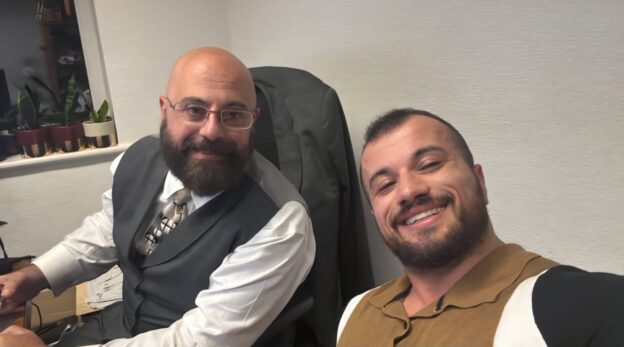
Writing about Charles Jordan MBE, preparing for his funeral, and just after taking stock of everything we have built around the West Midlands Cyber Hub, made me think about founders and stewardship. The Hub and Cluster are entering a new phase. Andrew Horkan will take the lead, and I am going to concentrate more of my time on Cyber Tzar, Psyber Inc. and WARP Labs, and the exciting future that awaits.
Contents
Introduction
A couple of days ago, I published a short piece remembering Charles Jordan MBE, founder of Servol, “Thank You, Charles: Remembering Charles Jordan MBE“. Writing it made me think about founders, institutions, and what happens when something you create develops a life beyond you.
I also had lunch with my friend Martin Hockly, who led Street UK. I worked directly with Martin as Street UK grew into what became the UK’s largest charitable lending platform, and I saw firsthand just how much of an organisation can reside in the drive, knowledge and relationships of the person leading it. Martin eventually stepped away and handed Street UK on; ultimately, after a number of years and a changing ecosystem, the organisation dissolved.
Those are two very different stories, and I don’t pretend there is a simple lesson connecting them. Charles made me think about how a founder’s contribution can gradually fade from an institution’s memory. Martin’s experience reminds me of the opposite risk: that stepping away from something you have built does not, by itself, guarantee that it will continue to flourish.
These thoughts came immediately after publishing “West Midlands Cyber Hub Diaries: I Went Quiet. The Work Didn’t.“, which forced me to look at just three months’ worth of activity in one place. Reading it back, I realised quite how much I have been trying to do simultaneously across the West Midlands Cyber Hub, West Midlands Cyber Cluster, Cyber Tzar, Psyber Inc. and WARP Labs. The last time I found myself carrying this much at once was at Sun Microsystems, when I realised one day that I was working a hundred hours a week while my marriage was collapsing. I should probably have learned something from that.
The conclusion is fairly obvious: I am doing too much, and something needs to change.
The Hub No Longer Needs To Depend On Me
When we started the West Midlands Cyber Hub, it required an enormous amount of founder energy just to get it off the ground. We had an idea, some Cyber Local funding and a conviction that the West Midlands needed stronger cyber coordination, a physical home for the community and much better support for the businesses and people already here.
That is no longer where we are.
The Hub now has a five-year home at Millennium Point, a growing community of cyber businesses, an expanding education and skills programme, an established events calendar and a National Cyber Awards nomination. Companies that met through the Hub are collaborating and bidding together, students are building their own community, and the emerging West Midlands Cyber Cluster provides a structure for tackling longer-term economic development work.
The Hub has always been intended to be funded by and for its community, rather than dependent on any single company or individual. In practice, in its earliest stages, a significant portion of the cost has been covered by Cyber Tzar’s revenues, alongside funding and support we have received from others. That was necessary to get it built, but it should not be the long-term model. If the Hub is genuinely valuable to the region, it needs to develop its own sustainable footing, supported by the community and partners it serves.
Most importantly, increasingly, these things happen without me having to make them happen.
That is success, not a problem.
Andrew Will Lead The Next Phase
As the West Midlands Cyber Hub and West Midlands Cyber Cluster transition to their new CIC structures, Andrew Horkan will lead their next phase of development. I will not become a director of either CIC and will step back from their day-to-day operational leadership. I will undoubtedly continue to have strong opinions about Cyber in the West Midlands and how we can help it grow, but Andrew will have the space and authority to lead. Andrew’s first job will be to build the leadership team to make both the Cluster and the Hub successful, as he, in turn, refocuses on our growing commercial interests.
This needs to be a genuine transition. Andrew is my son, but he is also an accomplished business leader in his own right. Andrew has his own relationships, judgement, and leadership style, and if the Hub and Cluster are to become sustainable regional institutions, they need proper governance and leadership that extend beyond their founder.
For me, it also creates space to focus on my commercial and research interests: Cyber Tzar, Psyber Inc., and WARP Labs. Nothing changes with those businesses, and there is an enormous amount happening across all three that I want to give considerably more attention.
Stewardship Is Not Ownership
Writing about Charles helped me articulate something I had probably understood without putting it into words.
Founding something gives you a particular relationship with it, but it does not give you permanent ownership of its future. There are times when stewardship means pushing relentlessly because something will not exist otherwise, and other times when good stewardship means creating enough space for others to take responsibility for what comes next.
I am enormously proud of having conceived the Hub, fought for it, secured the original funding and helped build the community around it. I am equally excited about what the Cluster can become. I am not walking away from either of them, but I no longer need to be standing in the middle of everything they do.
Part of that stewardship is also financial. Having helped underwrite the Hub as it established itself, I want to see it become increasingly self-sustaining, with a broader base of community, partner, and institutional support. Independence should mean financial resilience as well as leadership and governance.
Perhaps that is one of the better tests of whether we have actually succeeded.
I founded the Hub because I believed the West Midlands needed it. My responsibility now is not simply to step away and hope for the best, but to help make the transition work: preserving what mattered at the beginning while giving Andrew and the people around him the authority to make what comes next their own.
Perhaps that is the harder part of stewardship: knowing when to drive, knowing when to let others lead, and caring enough about what you built to understand the difference.
What I Am Stepping Towards
Stepping back from the operational leadership of the Hub and Cluster should not be confused with slowing down. In many respects, it is the opposite.
Cyber Tzar is preparing to launch what we intend to become a universal cyber risk score: beginning in the UK, expanding into other countries, and ultimately building towards genuinely global coverage. Behind that sits an aggressive roadmap for cyber risk intelligence, with the ambition to create intelligence exceptional in both scale and richness: a common foundation for understanding cyber risk across organisations, sectors and, ultimately, borders.
At Psyber Inc., we are bringing behavioural psychology directly into the next phase of the platform, particularly around post-cyber recoverability: understanding not simply how organisations protect systems, but how people and organisations behave, respond and recover when things go wrong.
And through WARP Labs, a research developer is joining us to take forward my research into online behaviour, cyber psychology, and human factors: how people are influenced in digital environments, for better and for worse; how those mechanisms can be understood; and what we can build to better protect people from them.
These are not side projects. They are substantial research, technology and commercial programmes in their own right, with the potential to operate at both national and international scale.
There is also a pattern emerging in how Andrew and I work together.
My particular strength has always been at the difficult, uncertain end of technology: finding problems that interest me, researching them, developing the intellectual property, building the technology and proving that something which did not exist before can actually work. But invention and commercialisation are different disciplines.
Cyber Tzar has taught us something about that. I built much of the underlying technology and proposition; as it matured, Andrew was increasingly able to take what we had built and drive its commercial development. I want to become much more deliberate about that model.
My job with Psyber Inc., WARP Labs, and whatever comes after them is therefore not simply to have ideas. It is to prepare the ground: undertake the research, develop the intellectual property, build and test the technology, establish the proposition and take these businesses to the point where they are genuinely ready to scale. Andrew can then increasingly step into businesses with proven foundations and concentrate on turning technological potential into commercial success.
Inventor-Led Technology Businesses
There is a broader principle behind this, which I talk about a lot: I want us to build inventor-led technology businesses.
Inventors have a peculiar relationship with organisations. They create intellectual property, technologies and possibilities that did not previously exist, but that does not necessarily mean they should spend the next twenty years managing every operational aspect of the organisations that grow around those inventions.
Too often, however, we have treated those as the only two choices: either the inventor remains at the centre of everything indefinitely, or professionalisation eventually means separating the inventor from what they created.
I don’t think either is a particularly good model for innovation.
I sometimes describe this, rather irreverently, as “the Barnes Wallis problem.” How do you create an environment in which inventors can keep inventing, retain a meaningful relationship with what they create and participate in its success, while giving other people the authority and freedom to turn those inventions into properly managed, commercially successful organisations?
That matters because inventors are human beings. Lives change. People experience illness, loss, family problems, exhaustion and periods when they cannot or should not carry the operational weight of an entire organisation. Relationships change too. None of those things should automatically mean losing the connection to years of intellectual work or being engineered out of the value you created.
Equally, protecting the inventor cannot mean making an organisation permanently dependent upon them.
The answer, I think, is to separate invention from operational control without separating the inventor from the value of their invention.
That is the model I increasingly want us to build.
These should be inventor-led technology businesses: organisations where invention is protected and valued; where researchers and technologists have the freedom to pursue difficult ideas; where strong commercial leadership can turn proven technology into sustainable businesses; and where success creates the resources and freedom to invent again.
That is also why the relationship Andrew and I are developing matters. My role is increasingly to originate, research, invent, build and prove. His is increasingly commercialising, operating, and scaling.
Neither role is subordinate to the other. At their best, they form a cycle.
Invent. Prove. Commercialise. Scale. Reinvest. Invent again.
So this is not retirement, withdrawal or a loss of ambition. It is about becoming much more deliberate about where I can create the greatest value (technology, research, engineering, and turning difficult ideas into things that work), while building the structures and businesses that enable others to take those ideas further than I could alone.
The objective isn’t to build businesses that depend permanently upon their inventor.
Nor is it to build businesses that eventually dispense with them.
It is to build businesses capable of scaling beyond their inventor without leaving their inventor behind.