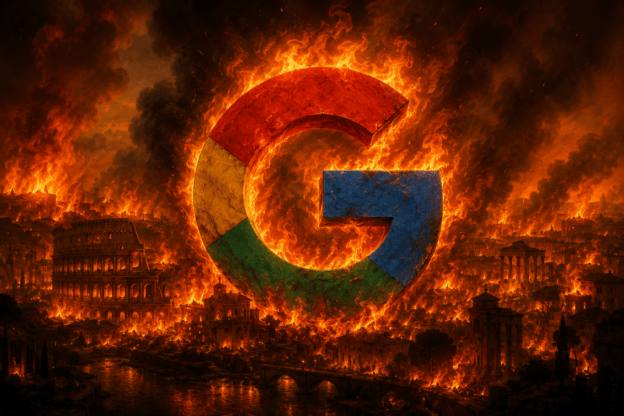
Guardian gets it wrong again: the real story isn’t “creator journalism”, it’s Google cutting its own throat. The real threat to journalism is not YouTubers, Substack writers, or “creator journalism”, but Google quietly destroying the economic engine of the web it depends upon. By replacing outbound traffic with AI-generated summaries, Google is breaking the reciprocal model that sustained publishers, independent experts, and the open internet for 25 years. The result is not merely media disruption, but the slow collapse of the knowledge ecosystem AI itself requires to function.
Contents
- Contents
- 1. Introduction
- 2. The BBC Thinks Joe Rogan Is The Problem
- 3. Google was never supposed to be the destination
- 4. Google Has Started Extracting Value Instead of Circulating It
- 5. The Entire Web Was Quietly Built On Cross-Subsidy
- 6. Google Is Strip-Mining The Internet
- 7. The Real Threat Is Cognitive Infrastructure Collapse
- 8. Creator Journalism Is A Symptom, Not The Cause
- 9. Google May Be Building A Suicide Machine
- 10. Conclusion: The Internet As We Know It Is Quietly Ending
1. Introduction
Deborah Turness thinks the crisis facing journalism is “creator journalism.”
It isn’t.
In a recent Guardian interview, former BBC News boss Deborah Turness argued that “creator journalism” represents an existential threat to traditional broadcasters. (Guardian article)
The irony is extraordinary.
While the BBC and Guardian frame the collapse of journalism as a cultural problem driven by YouTubers, podcasters, and Substack writers, a widely circulated X thread from the very “creator economy” they are criticising identified something far more important: that Google may be quietly destroying the economic foundations of the open web itself. (X thread)
That analysis is much closer to the truth.
The former BBC News boss warned that personality-led media on YouTube, TikTok and Substack represents an “existential threat” to traditional broadcasters. In her framing, audiences are abandoning polished institutional journalism in favour of direct parasocial relationships with creators.
That analysis is comforting for legacy media because it implies the problem is cultural.
It isn’t cultural.
It’s infrastructural.
The real existential threat to journalism — and increasingly to the web itself — is that Google has broken the economic contract that made the internet function for the past quarter century.
And in doing so, Google may have begun destroying the very information ecosystem its AI products depend on to survive.
1.1 A Note on This Series
This article forms part of a broader exploration of how the web is changing, not just in terms of platforms or technology, but in how information, attention, and thinking itself are structured: The Web Unbundled series.
Across this series:
- Is the Blogosphere Dead, or Am I Just Standing on an Island? examines the unbundling of the web as a visible, interconnected system, and why publishing now feels like isolation.
- While The BBC And Guardian Fiddle As Rome Burns, Google Is Quietly Destroying The Web It Depends On looks at the economic layer, and how extraction by dominant platforms is breaking the model that sustained the open web.
- All Noise and No Signal: The Future of Online Spaces explores what happens to conversation itself when it moves into environments that cannot retain structure or meaning.
- The Persistence Layer: Cognitive Continuity Under Conditions of Flow Dominance explores the growing importance of durable, owner-controlled continuity systems operating beneath increasingly transient and behaviourally mediated environments.
- Signal Under Conditions of Flow: The Architecture of Public Cognition After the Open Web examines the constraints under which cumulative public cognition can still stabilise within systems increasingly optimised for flow, visibility, and governability.
The companion The Age-Gated Internet series explores a related transition: the migration of governance, trust, and behavioural regulation into infrastructure and identity systems themselves.
Taken together, these are not isolated trends.
They describe a broader transition: from a web that enabled visible, accumulative, and relatively open public cognition toward environments increasingly defined by fragmentation, opacity, behavioural mediation, and infrastructural governance.
This piece focuses on one part of that transition.
2. The BBC Thinks Joe Rogan Is The Problem
This is classic institutional misdiagnosis.
The Guardian article frames the crisis as audiences preferring “personality-led journalism” over “traditional broadcasters.” But that explanation mistakes distribution changes for economic causation.
People did not suddenly wake up and decide they hate journalism.
The web’s incentive structure changed.
Historically, the internet worked because of a relatively stable bargain:
- Publishers created content
- Search engines indexed it
- Search engines sent traffic
- Advertising monetised the traffic
That loop funded investigative journalism, niche expertise, forums, reviews, technical writing, music criticism, local reporting, and millions of independent websites.
Google was not merely a search engine. It was the central routing layer of the open web.
But AI search summaries break the loop.
Google now increasingly answers queries without sending users anywhere at all.
The publisher pays the cost of creating information.
Google captures the value.
Traffic disappears.
Revenue collapses.
And the organisations producing the underlying knowledge begin to die.
That is the story.
Not Tucker Carlson.
Not Substack.
Not “creator journalism.”
3. Google was never supposed to be the destination
There is a crucial difference between Google and platforms like Facebook, Instagram, LinkedIn, or TikTok.
Those platforms were always designed to keep users inside their own ecosystems. They are destinations. Closed environments. Digital shopping malls engineered around engagement retention.
Google was different.
Google became dominant precisely because it acted as a gateway rather than a destination. Its role in the web ecosystem was to route users outward toward the broader internet.
That distinction matters enormously.
When Facebook keeps users on Facebook, it is behaving according to its native economic model. But when Google keeps users inside Google, it is undermining the very function that justified its dominance in the first place.
Google’s legitimacy came from being infrastructure.
From helping users leave Google efficiently and discover the wider web.
AI summaries invert that relationship. The gateway is becoming the endpoint. The router is becoming the owner of the traffic. And once that happens, the economic logic underpinning the open web starts to collapse.
4. Google Has Started Extracting Value Instead of Circulating It
The terrifying thing about AI summaries is not that they are inaccurate.
It is that they are economically parasitic.
Google’s old model was symbiotic. The new one is extractive.
When Google indexed your page and sent you visitors, there was at least a mutually beneficial exchange happening. You received attention, authority, subscribers, ad impressions, sales, or influence in exchange for allowing Google to crawl your work.
AI summaries sever that reciprocity.
Now Google ingests the work, synthesises the answer, and keeps the user inside Google’s own interface.
The click never happens.
The publisher receives nothing.
And because Google controls search distribution at planetary scale, opting out is functionally impossible. Refuse inclusion and you effectively disappear from discoverability altogether.
That is not a marketplace.
That is infrastructure leverage.
5. The Entire Web Was Quietly Built On Cross-Subsidy
This is the part almost nobody in mainstream media seems willing to say out loud:
Most of the internet was never directly profitable.
Investigative journalism wasn’t profitable.
Open source documentation wasn’t profitable.
Forums weren’t profitable.
Niche expertise wasn’t profitable.
Music criticism wasn’t profitable.
Academic explainers weren’t profitable.
They survived because search traffic indirectly subsidised them.
A weird technical blog could survive because Google sent readers.
A specialist publication could survive because search created discoverability.
A local paper could survive because articles still generated visits.
Search was the circulation system of the web economy.
AI summaries convert circulation into extraction.
And once you understand that, you realise why this crisis is much larger than “traditional media versus creators.”
This is potentially the beginning of web ecosystem collapse.
6. Google Is Strip-Mining The Internet
What Google is doing increasingly resembles industrial resource extraction.
The company is harvesting decades of human-created knowledge, compressing it into AI-generated responses, monetising those responses, and starving the originating ecosystem of oxygen.
This works brilliantly in the short term.
Quarterly revenue looks fantastic.
Users stay inside Google properties longer.
Ad inventory improves.
Operational costs fall.
But the long-term dynamics are catastrophic.
Because AI systems do not create primary knowledge.
They remix it.
Large language models are downstream of civilisation.
They are not upstream of it.
The raw material still has to come from somewhere:
- Journalists conducting investigations
- Engineers documenting discoveries
- Researchers publishing papers
- Enthusiasts writing tutorials
- Experts arguing in public
- Communities refining information collaboratively
If the economic substrate supporting those activities collapses, AI eventually begins feeding on historical residue rather than living knowledge production.
At that point the system starts recursively consuming itself.
The outputs become stale.
Then derivative.
Then wrong.
Then polluted by synthetic content generated from prior synthetic content.
You end up with informational inbreeding.
And we are already seeing early signs of this degradation across the web.
7. The Real Threat Is Cognitive Infrastructure Collapse
This is the level the Guardian piece completely misses.
The issue is not whether audiences prefer charismatic individuals over broadcasters.
The issue is whether society is dismantling the economic machinery required to produce reliable public knowledge at all.
Google search was never just a website.
It became civilisation-scale cognitive infrastructure.
It determined how knowledge propagated.
How expertise surfaced.
How discoverability functioned.
How institutions reached the public.
How independent creators built audiences.
How technical information circulated.
Now AI threatens to centralise that entire process into a handful of proprietary interfaces owned by trillion-dollar firms.
And unlike the old web, where traffic flowed outward toward creators, the new model increasingly traps value at the centre.
This is not decentralisation.
It is enclosure.
8. Creator Journalism Is A Symptom, Not The Cause
Ironically, the rise of creator journalism is itself partly a reaction to the collapse of institutional distribution economics.
Journalists moved to Substack because legacy media business models are imploding.
Experts moved to YouTube because platform algorithms replaced homepage editors.
Analysts moved to podcasts because search and social fractured audiences.
The creator economy did not kill traditional media.
Platform monopolies destabilised the economic foundations underneath all media.
Independent creators simply adapted faster.
The BBC still thinks in terms of broadcasts.
Google thinks in terms of owning the entire information layer.
Those are very different games.
9. Google May Be Building A Suicide Machine
The truly astonishing part is that Google appears willing to cannibalise the open web despite depending on it existentially.
This is the paradox.
Google’s AI products only remain useful if the external knowledge ecosystem continues generating high-quality information.
But Google’s current incentives reward maximum extraction from that ecosystem right now.
That is classic late-stage platform behaviour:
- monopolise access
- internalise value
- externalise costs
- degrade the ecosystem
- consume the substrate sustaining you
We have seen this pattern before in finance, media, manufacturing, and social platforms.
But this time the substrate being consumed is human knowledge production itself.
And unlike oil fields or factories, once expertise ecosystems collapse, rebuilding them can take decades.
10. Conclusion: The Internet As We Know It Is Quietly Ending
What we are watching may ultimately be larger than the decline of journalism.
It may be the slow death of the open web as a viable economic system.
Not because people stopped creating.
Not because audiences abandoned quality.
But because the dominant gateway to information discovered it could monetise the outputs without sustaining the producers.
The Guardian thinks the story is that broadcasters need to become more like creators.
The real story is that Google may have broken the underlying metabolism of the internet itself.
And if that continues, eventually there will be nothing left worth summarising.