
Enterprise architecture is not the maintenance of modelling tools or diagram repositories; it is the cognitive ownership of structural intent. An enterprise architect must be able to articulate, from memory, the organisation’s core domains, identity flows, state ownership, and integration topology. When architecture lives primarily in tools rather than in the architect’s internal model, complexity is documented rather than reduced, and structural drift becomes institutionalised.
Executive Summary
Enterprise architecture is not the maintenance of documentation platforms. It is the ownership of structural intent.
An enterprise architect must be able to articulate — without opening a repository — the fundamental topology of the enterprise: core domains, systems of record, identity flows, trust boundaries, and integration patterns. This is not about memorising inventory. It is about holding a structural model.
When architecture lives primarily inside tools rather than inside architects, organisations substitute documentation for comprehension. That substitution stabilises complexity rather than reducing it.
Architecture is not the curation of diagrams. It is cognitive accountability for structure.
Contents
1. Introduction
Enterprise architecture is supposed to provide structural clarity.
It should explain how domains are bounded, where state is owned, how identity propagates, how systems integrate, and where change is constrained. It should reduce enterprise complexity into a comprehensible topology.
But in many organisations, architecture has drifted from structural ownership toward repository management. The diagrams exist. The modelling tool is populated. The governance workflow is active.
Yet the structure is not internalised. And if the structure is not internalised, it is not being shaped.
In the preceding discussion of re-legacy, the problem was structural topology preserved beneath modern infrastructure. But topology does not maintain itself. It is either consciously shaped or passively inherited. When architects do not hold an internalised model of domain boundaries, state ownership, and integration flows, structural debt ceases to be visible. Re-legacy becomes not just a technical condition, but a cognitive one.
1.1 Quadraphenia: Four Architecture Articles Together
A critique of superficial modernisation and a defence of structural discipline in enterprise systems: Enterprise modernisation fails when intervention occurs below the level of causality. This four-part series examines transformation through a structural lens:
- Data Is a Symptom of Function: Migrating RDBMS Estates Is Not Transformation
Why starting at the data layer mistakes persistence for capability. - Re-Legacy: The Debt of Deferred Structure
How infrastructure modernisation compounds structural debt when topology remains unchanged. - If Your Enterprise Architect Cannot Draw Your Core Architecture From Memory, What Are They?
Why structural ownership must exist cognitively, not just in tooling. - Stop Making Sense: Semantic Collapse in the Enterprise
How semantic drift erodes architectural reasoning itself.
Across the series, one principle holds:
- Structure determines behaviour.
- Behaviour determines state.
- State produces data.
- Infrastructure merely hosts it.
If transformation does not intervene at the structural level, it is optimisation, not redesign.
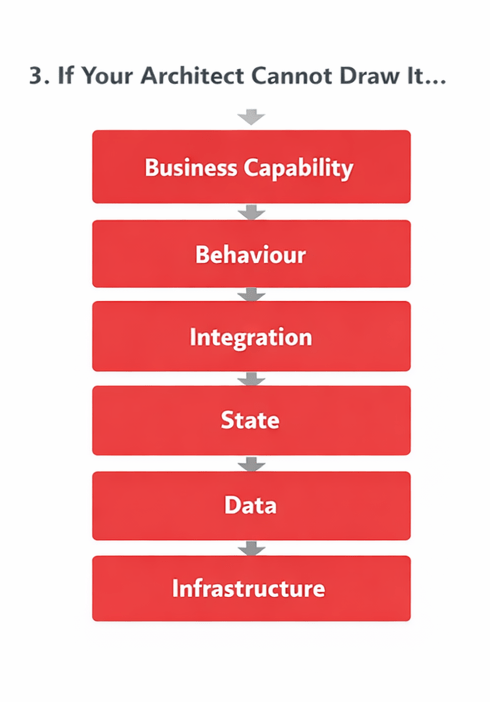
This diagram represents the full structural model of the enterprise. An enterprise architect must be able to articulate how each layer relates to the others: from business capability through to infrastructure.
If the causal relationships between these layers cannot be described coherently from memory, the architecture is not being actively shaped. The diagram is not just a model of systems. It is a model of responsibility.
2. Architecture Is a Compression Problem
Large enterprises are complex by necessity. Hundreds of systems, multiple platforms, regulatory overlays, integration fabrics, identity providers, data stores, and runtime environments.
No one can retain every component in memory. That is not the standard. The standard is structural compression. An enterprise architect should be able to explain, from memory:
- The primary domains of the enterprise.
- The systems of record within each domain.
- Where operational state is owned.
- How identity originates and propagates.
- Where trust boundaries exist.
- How cross-domain integration occurs.
- Where structural coupling constrains change.
This is not recall of detail. It is possession of topology.
If the architecture cannot be coherently drawn on a whiteboard without reference material, then the structural model does not exist in the architect’s mind.
And without an internal structural model, there is no structural agency.
3. The Whiteboard Line
Remove the slides. Close the modelling tool. Step into a room with a whiteboard.
If your enterprise architect cannot draw the core architecture from memory — and describe how identity works, how components interact, where state lives, and how the major feedback loops behave — then the architecture is not being actively designed.
It is being archived.
The ability to draw it is not theatre. It is evidence of structural ownership.
4. The Repository Illusion
Architecture repositories promise coherence. They catalogue applications, interfaces, capabilities, standards, and dependencies. They offer traceability and impact analysis.
They are useful instruments.
But they create a subtle inversion.
The enterprise begins to believe that because the architecture is documented, it is understood.
Repositories accumulate artefacts. Over time they resemble institutional memory. Yet institutional memory is not architectural reasoning.
If answering a structural question requires querying a tool, then architecture has become retrieval-based rather than model-based.
The architect becomes an interpreter of stored artefacts rather than a shaper of structure.
Custodians preserve estates. Architects reshape them.
5. Identity Reveals Structure
If there is one question that reveals whether architecture is internalised, it is identity.
Identity exposes topology more reliably than system inventories.
Where is identity authoritative?
How does it propagate across domains?
Where are policy decisions enforced?
Which systems cache it?
How are machine identities differentiated from human ones?
Where are trust boundaries anchored?
Answering these requires understanding of state ownership, boundary design, and integration flows.
Identity is not a feature. It is a structural backbone.
If the enterprise architect cannot describe identity topology from memory, they do not hold the system model.
6. Architecture as Structural Accountability
Architecture is not the existence of diagrams. It is the responsibility for how the enterprise is shaped.
An enterprise architect should be able to:
- Predict which domains will destabilise if a system of record changes.
- Identify where behavioural coupling blocks decomposition.
- Explain how regulatory memory differs from operational state.
- Anticipate second-order effects of introducing new platforms.
This requires more than governance oversight.
It requires cognitive ownership of the enterprise as a system.
When architecture lives primarily in tools, the architect’s influence narrows to compliance and metadata completeness. Structural change becomes secondary to repository hygiene.
The result is not clarity. It is stagnation.
7. The Dead-End Pattern
Over time, architecture tools risk becoming dead-end systems themselves.
They contain diagrams that are rarely consulted. Capability maps that are aspirational rather than causal. Dependency graphs that lag reality.
They promise a single source of truth but often become a single source of entropy.
When the architecture lives there — rather than in the reasoning capacity of the architect — the enterprise confuses governance throughput with architectural progress.
Documentation grows.
Structure remains.
8. The Uncomfortable Distinction
There is a difference between:
- An enterprise architect who shapes structural intent.
- And an enterprise architect who curates structural residue.
If the architecture cannot be articulated from memory at the level of domains, identity, state ownership, and integration boundaries, then the architect is not holding the enterprise model.
They are maintaining a catalogue of it.
Architecture is not a repository. It is a mental model expressed in structural decisions.
Without that model, the enterprise drifts.
9. Conclusion
Enterprise architecture does not fail because tools are inadequate. It fails when structural responsibility is externalised to those tools.
A repository can store diagrams. It cannot hold intent.
If the enterprise architect cannot draw the architecture from memory and explain how its structural components relate, then the architecture is not under active design.
It is under observation.
And observed systems do not simplify.
They accumulate.