
CYBERUK 2026 defines a clear national cyber strategy, but leaves a critical gap between ambition and execution. This article identifies the “missing layer”: the regional capability infrastructure required to translate policy into scalable organisational resilience. Without it, capability remains uneven, SMEs struggle to progress, and the system evolves by default rather than design, undermining the goal of distributed national resilience.
Executive Summary
CYBERUK 2026 defines a clear direction for UK cyber security.
- Government is moving toward system-level resilience
- Organisations are expected to deliver operational security at scale
- AI is accelerating both threat and defence
But between these two levels lies a critical gap:
the layer that translates strategy into scalable capability
Without this layer:
- SMEs cannot scale
- supply chains cannot stabilise
- resilience cannot distribute
This “missing layer” consists of:
- regional coordination
- capability infrastructure
- ecosystem integration
It is not explicitly defined in policy, but it is implicitly required for the system to function.
Without it, the UK’s cyber strategy cannot scale as intended.
Contents
- Executive Summary
- Contents
- 1. Introduction: The Gap Between Strategy and Execution
- 2. The Assumption Problem
- 3. The Missing Layer Defined
- 4. What Happens Without It
- 5. What the Speeches Implicitly Require
- 6. Characteristics of the Missing Layer
- 7. Why National Approaches Cannot Solve This Alone
- 8. The System Risk
- 9. Reframing the Challenge
- 10. Conclusion: The System Will Default
1. Introduction: The Gap Between Strategy and Execution
Across CYBERUK 2026, a coherent model emerges:
- Government defines the system
- Organisations are expected to operate within it
This reflects a shift from:
building a cyber ecosystem → operating a cyber system
But systems do not execute themselves.
They rely on:
- capability
- coordination
- integration
And these do not emerge automatically from policy.
This article completes the CYBERUK 2026 analysis series, building on the previous pieces on (1) policy transition, (2) operational reality, and (3) system-level tension to examine the missing layer required to make the UK’s cyber strategy function in practice.
1.1 The CYBERUK 2026 Analysis Series
This article forms part four of a five-part analysis of CYBERUK 2026, examining the UK’s evolving cyber strategy from policy through to operational reality and system-level implications:
- CYBERUK 2026: From Policy Ecosystem to Operational Doctrine
Dan Jarvis MBE, UK Security Minister’s, CYBERUK 2026 speech, signals the shift from ecosystem-building to operating a national cyber system - CYBERUK 2026: The Perfect Storm and the Limits of Fundamentals
NCSC CEO Richard Horne’s CYBERUK 2026 keynote discusses the operational reality of cyber security under technological and geopolitical pressure - CYBERUK 2026: System Ambition vs Operational Reality and the Rise of a Two-Speed Cyber Economy
The structural tension between policy ambition and uneven organisational capability - CYBERUK 2026: The Missing Layer Between Strategy and Execution is Regional Capability Infrastructure
The capability infrastructure required to translate the national strategy into distributed resilience - CYBERUK 2026: From Policy to Practice and the System in Between
A synthesis of these perspectives, examining what they imply for how the system behaves in practice and what it means to be able to deliver it
Taken together, these pieces move from:
intent → execution → consequence → constraint → implication
2. The Assumption Problem
At the heart of the current approach is an implicit assumption:
National cyber strategy is being designed as if capability is evenly distributed; regional evidence shows it is not, and without coordination infrastructure, it will not become so.
In practice, capability varies significantly across:
- firm size
- sector
- geography
Policy assumes:
- organisations can uplift
- standards can scale
- resilience can distribute
Reality shows:
- uneven adoption
- uneven capacity
- uneven outcomes
This is not a temporary issue.
It is structural.
The structure of this gap can be understood simply:
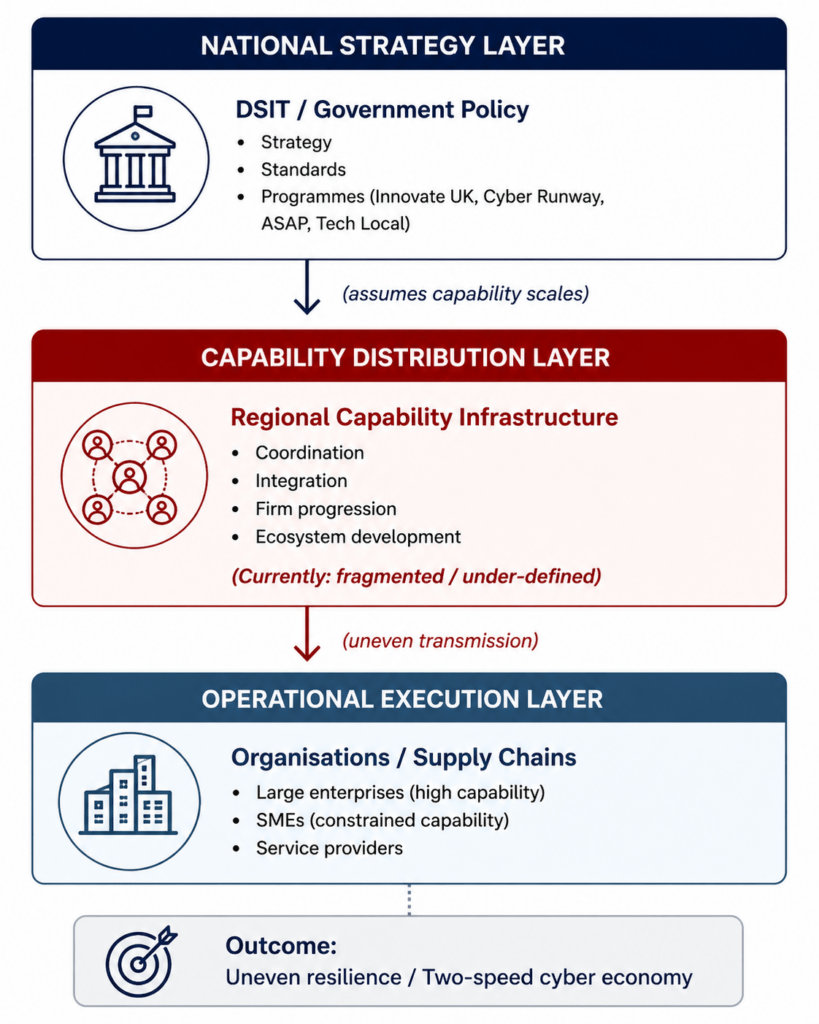
The current model connects national strategy to operational execution through assumption rather than coordinated capability infrastructure.
3. The Missing Layer Defined
As shown above, the gap is not between policy and intent, but between strategy and the infrastructure required to translate it into capability. Here sits a layer that is rarely articulated:
the missing layer
This is the space where:
- strategy is translated into practice
- capability is developed and sustained
- actors are coordinated and aligned
It includes:
- local and regional coordination
- capability development mechanisms
- integration across industry, academia, and government
Critically:
it is not owned by any single organisation
And yet:
it determines whether the system functions.
4. What Happens Without It
If this layer does not exist, or is underdeveloped, the system does not fail immediately.
It fragments.
In practice:
- SMEs struggle to build and sustain capability
- supply chains enforce unevenly
- standards become exclusion mechanisms
- investment does not convert into scalable growth
The result is not collapse.
It is divergence.
The system evolves, but not in the way it was designed to.
Responsibility for cyber strategy sits centrally, and DSIT plays a clear role in shaping policy and enabling delivery through mechanisms such as Innovate UK, Cyber Runway, Cyber ASAP, and Tech Local. These programmes are effective in stimulating innovation and supporting early-stage growth.
But they are not designed to coordinate or sustain capability at the system level. Instead, the model relies on the capability “growing” through a combination of market forces and targeted intervention.
The result is predictable: capability develops unevenly, concentrating where conditions already favour it, rather than being deliberately distributed across the system.
5. What the Speeches Implicitly Require
Both the Security Minister and the NCSC CEO describe a system that assumes:
- organisations can respond to rising expectations
- capability can be increased across the economy
- resilience can be embedded at scale
But for this to happen, something must exist that:
- connects organisations to support
- translates standards into operational practice
- enables progression beyond baseline capability
That mechanism is not explicitly defined.
But it is implicitly required.
6. Characteristics of the Missing Layer
For the system to function as intended, this layer must have specific properties.
It must:
- operate at regional scale, not just national
- reflect local industrial context
- support firm lifecycle progression, not just entry
- connect:
- academia
- industry
- government
- enable:
- adoption
- validation
- scaling
And critically:
it must function continuously, not as a one-off programme or intervention
This is not about isolated initiatives.
It is about sustained capability development.
7. Why National Approaches Cannot Solve This Alone
This gap cannot be closed from either end.
- National policy is:
- necessarily abstract
- designed for coherence, not delivery
- Individual organisations are:
- resource-constrained
- focused on immediate priorities
The problem sits between these levels.
It is a coordination and capability distribution challenge
And that requires a different type of solution.
8. The System Risk
Without this missing layer, the system evolves in a predictable direction:
- resilience concentrates in larger organisations
- SMEs struggle to remain viable
- supply chains narrow
- dependency on a smaller number of actors increases
This creates a system that is:
- more controlled
- more standardised
But also:
- less diverse
- less adaptable
- potentially more fragile at the edges
The system becomes easier to manage, but harder to evolve.
9. Reframing the Challenge
The challenge is often framed as:
- a skills gap
- a funding gap
- an awareness gap
These are real, but incomplete.
The deeper issue is:
a failure to distribute capability effectively across the system
This is not about whether capability exists.
It is about:
where it exists, and whether it can scale.
10. Conclusion: The System Will Default
Cyber strategy is not failing. It is incomplete. The UK has:
- strong institutions
- clear direction
- growing capability
But the mechanisms required to translate that into:
- distributed resilience
- scalable capability
- sustainable growth
are not yet fully in place.
Systems do not fail because strategy is wrong.
They fail because the mechanisms required to deliver that strategy do not exist at the level where execution happens.
If the UK does not build the capability infrastructure required to support its cyber strategy, the system will still evolve, but it will do so unevenly, and by default rather than by design.