
Enterprise transformation relies on shared technical language. When terms like API, normalisation, and microservice are redefined inside an organisation, architectural reasoning degrades, and structural ambiguity increases. Semantic drift creates friction, weakens governance, and slows adaptability. Precision in terminology is not elitism but architectural hygiene. Without a stable vocabulary, even modernised estates become harder to understand, coordinate, and evolve.
Executive Summary
Enterprise architecture depends on shared technical semantics. Terms such as API, normalisation, and microservice carry structural meaning across the industry. When organisations redefine these locally, architectural reasoning becomes unreliable and governance turns performative. Semantic drift introduces friction, slows transformation, and isolates estates from industry practice. Precision in language is not pedantry; it is a prerequisite for structural coherence and sustainable change.
Contents
1. Introduction
Enterprises do not just accumulate systems. They accumulate language. And when language drifts, architecture drifts with it.
In the previous article, I argued that architecture must exist as a coherent structural model in the architect’s mind, not merely in repositories and diagrams. But cognition itself depends on shared vocabulary. If the words used to describe boundaries, services, ownership, and integration lose precision, the mental model degrades. Semantic drift is therefore not cosmetic; it erodes the cognitive foundation required for structural agency.
This is not about pedantry. It is about structural coherence. Architecture depends on shared semantics. When technical terms are quietly redefined inside a local culture, architectural reasoning becomes unreliable. Governance continues. Documentation grows. But the structure beneath it becomes harder to understand and harder to change.
Words are not decorative in architecture. They are structural instruments.
1.1 Quadraphenia: Four Architecture Articles Together
A critique of superficial modernisation and a defence of structural discipline in enterprise systems: Enterprise modernisation fails when intervention occurs below the level of causality. This four-part series examines transformation through a structural lens:
- Data Is a Symptom of Function: Migrating RDBMS Estates Is Not Transformation
Why starting at the data layer mistakes persistence for capability. - Re-Legacy: The Debt of Deferred Structure
How infrastructure modernisation compounds structural debt when topology remains unchanged. - If Your Enterprise Architect Cannot Draw Your Core Architecture From Memory, What Are They?
Why structural ownership must exist cognitively, not just in tooling. - Stop Making Sense: Semantic Collapse in the Enterprise
How semantic drift erodes architectural reasoning itself.
Across the series, one principle holds:
- Structure determines behaviour.
- Behaviour determines state.
- State produces data.
- Infrastructure merely hosts it.
If transformation does not intervene at the structural level, it is optimisation, not redesign.
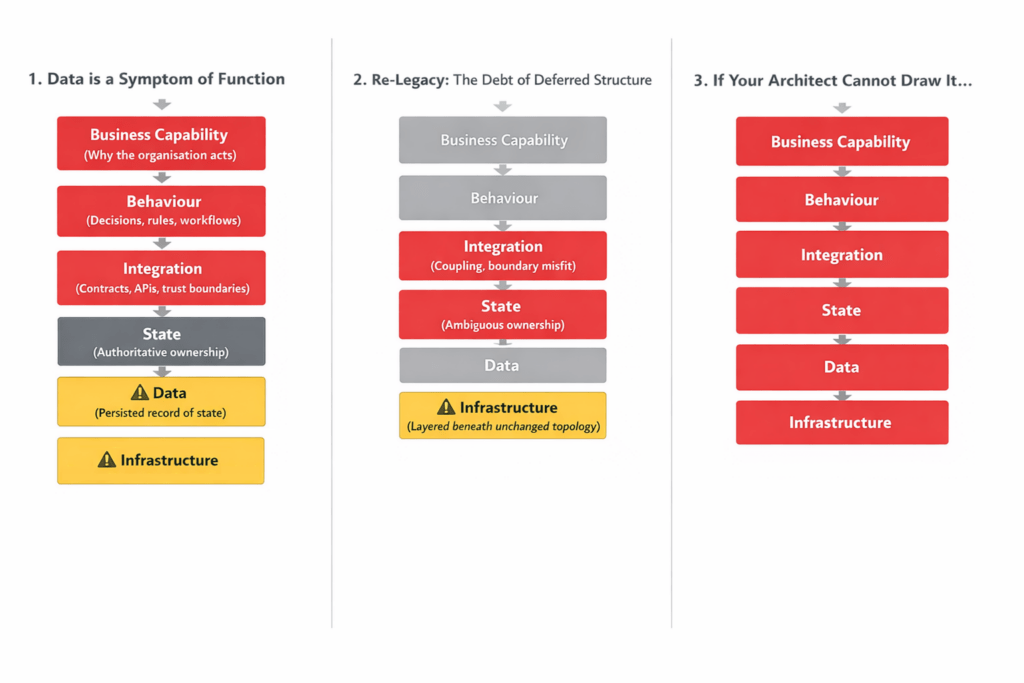
The same structural model applies here. But this article focuses on something more fundamental: the language used to describe each layer.
If terms such as “API”, “microservice”, or “normalisation” are used imprecisely, then the model itself becomes unstable. Semantic drift does not change the diagram: it changes our ability to reason about it.
2. A Harmless Collision
At the Home Office, “API” means Advanced Passenger Information: the passenger data airlines transmit to governments. It is a policy term, and within that context, it is entirely legitimate. The ambiguity is visible. When someone says “API,” clarification is immediate. The collision is obvious and manageable.
That kind of semantic overlap is inconvenient but harmless.
The dangerous cases are different. They occur when technical terms, inside technical environments, drift away from their industry meaning without anyone noticing.
3. When API Stops Meaning Interface
In contemporary practice, “API” overwhelmingly implies a network-addressable interface. It describes a contract that defines how one system interacts with another across a boundary. It implies explicitness, versioning, independence, and a recognisable surface for integration.
Historically, the term could also describe a local library interface. Language evolves, and that evolution is not the problem.
The problem arises when an organisation uses “API” to describe mutable shared code, something that is neither independently deployable nor contractually defined, something that can be changed without coordination and without boundary control. At that point, the word creates the illusion of separation where none exists.
Architecture depends on the difference between a service boundary and a shared dependency. If the language used to describe those two things collapses into one term, then the structural distinction collapses with it. Coupling becomes harder to see because it has been linguistically disguised.
4. When Normalisation Stops Meaning Structure
The same phenomenon appears in more subtle ways. In one estate, “normalised data” did not refer to relational normal forms or structural refinement of schema design. It meant that data had been moved from one place to another.
Normalisation, in the relational model, is about eliminating redundancy and isolating dependencies to preserve structural integrity. It is a specific and rigorous concept. If the same word is used to mean relocation, then architectural inference becomes unreliable.
When someone claims that data has been “normalised,” an architect reasonably assumes structural transformation. If what has occurred is merely movement, then the word no longer describes structure. It performs it.
This is not a linguistic quibble. It is a breakdown of semantic alignment. And semantic alignment is what allows architectural reasoning to move quickly and accurately.
When shared vocabulary loses precision, every discussion slows down. Clarification becomes necessary before analysis. Assumptions become risky. Inference becomes fragile.
And, at scale, architecture is mostly inference.
5. When Microservices Become “Small Bits of Code”
Few terms have travelled as far, or been stretched as thin, as “microservice.”
When Martin Fowler and James Lewis described the style, they anchored it in business capability. When Adrian Cockcroft articulated it in the context of Netflix, he emphasised autonomy, independent deployment, data ownership, and clear network contracts. Fowler later emphasised that microservices require organisational and technical prerequisites (automation, DevOps maturity, and bounded contexts) rather than simply small codebases.
Across those formulations, the consistent thread was not size. It was a boundary.
A microservice was small because it was tightly aligned to a domain responsibility. It owned its state. It could evolve independently. It communicated over explicit interfaces. It did not share a database as a coordination mechanism. It did not depend on internal code mutation as a form of integration.
Yet in some estates, “microservice” now means something far more convenient: a small unit of code running in a cloud runtime. A function. A fragment. Something stateless and lightweight.
But a fragment is not a boundary.
A function running in Azure or AWS is not automatically a service. If it shares a database, depends on implicit contracts, and cannot evolve independently of its neighbours, then it is not a microservice in any architectural sense. It is a distributed implementation detail.
Calling it a microservice may make the estate sound modern. It does not make it decoupled.
When a term that once described structural autonomy is repurposed to describe deployment granularity, the word survives. The structure does not.
6. Why This Drift Matters
At first glance, semantic drift appears trivial. It is easy to dismiss as an inconsistency in terminology, a matter of preference, or a local quirk of culture. It is not.
When an organisation diverges from industry language, it does not simply change how things are described. It changes who can understand them.
Architecture is a collaborative discipline. It depends on shared meaning not just within a team, but across time, roles, and organisational boundaries. When that shared meaning is replaced with a local dialect, the architecture becomes harder to access. New engineers take longer to onboard. External expertise does not simply become less effective. It becomes conditionally usable.
Before any reasoning can occur, translation is required. Before translation, interpretation. And before interpretation, alignment on meaning. The cost of understanding is paid upfront, every time. In practice, this means that people who could help often can’t, not because they lack the capability, but because the system is semantically inaccessible. The result is a form of unintentional isolation.
The organisation builds a walled garden around its own systems. Not because the systems are uniquely complex, but because the language used to describe them no longer aligns with the industry as a whole. Patterns cannot be applied directly. Guidance cannot be trusted at face value. Every interaction carries an additional cognitive cost. This is not inefficiency at the margins. It is a constraint on learning.
When terminology drifts, organisations lose the ability to import capability. They cannot easily adopt established practices because those practices rely on shared definitions. They cannot fully leverage external experience because that experience is grounded in a different semantic model. Even internal governance begins to degrade, as artefacts appear compliant in language while diverging in structure.
The system becomes harder to reason about, not because it is inherently complex, but because its meaning is unstable. Over time, this instability compounds. Friction increases. Change slows. Adaptability declines. What begins as imprecision in language becomes a limitation in capability.
7. The Cost of Semantic Drift
Semantic discipline is therefore not about correctness for its own sake. It is about maintaining permeability between the organisation and the wider ecosystem of knowledge, practice, and expertise. Without that permeability, architecture does not just drift. It becomes insular.
Semantic inconsistency is often tolerated because its cost is indirect. It does not appear in a single failed deployment or a single broken system. Instead, it accumulates across interactions.
- It appears in longer onboarding times, as new engineers must learn a local dialect before they can contribute.
- It appears in misaligned designs, where teams believe they are building decoupled systems while sharing hidden dependencies.
- It appears in governance delays, where artefacts require repeated clarification before they can be assessed.
- It appears in failed reuse, where existing patterns cannot be applied because their underlying assumptions no longer hold.
- It appears in transformation programmes that adopt modern tooling but preserve legacy coupling, because the language used to describe the system obscures its actual structure.
These are not theoretical effects. They are operational costs.
And unlike most technical debt, they are difficult to see directly, because they are embedded in how people think, communicate, and make decisions.
8. Semantics as Infrastructure
We often describe infrastructure as the substrate beneath our systems. Semantics are the substrate beneath our reasoning. They are what allow dozens or hundreds of architects and engineers to coordinate without renegotiating semantics and meaning every time they speak.
When terminology aligns with industry norms, organisations can import talent, patterns, and practices with minimal translation. When terminology drifts locally, the organisation becomes semantically insular. It builds its own dialect, and with it, its own friction. No amount of platform modernisation compensates for that.
Even well-run governance processes, even a disciplined Technical Design Authority, cannot rescue architectural clarity if the vocabulary used in artefacts is unstable. Process assumes shared meaning. It cannot create it after the fact.
9. Conclusion
The Home Office example is benign because everyone knows it is contextual. The ambiguity is visible. The more dangerous examples in this article may appear narrow: API, normalisation, microservices. But they are not isolated issues. They are symptoms of a broader failure. Architecture fails when meaning is unstable.
It fails when causality is misunderstood, when topology is preserved instead of reshaped, when cognition is externalised into tooling, and when language no longer carries its intended structure. These are not separate concerns. They are the same problem expressed at different levels of the system.
Semantic drift is the most subtle of these failures, and therefore the easiest to ignore. It does not break systems directly. It erodes the ability to reason about them.
When words lose their precision, boundaries become harder to see. When boundaries become harder to see, ownership becomes ambiguous. When ownership becomes ambiguous, change becomes risky. And when change becomes risky, transformation slows or stops entirely. This is how modernised estates become static.
The organisation may adopt new platforms, new tooling, and new deployment models. But if the language used to describe the system no longer aligns with its structure, or with the wider industry, then the architecture becomes increasingly difficult to understand, challenge, and evolve.
It becomes isolated. Architecture depends on clarity of meaning before it depends on correctness of implementation. The system must first be understood before it can be changed.
Most organisations recognise technical debt in code. Few recognise it in language. But semantic debt behaves the same way: it compounds silently, and it is paid with interest during change.
Semantic discipline is therefore not a matter of preference or style. It is a prerequisite for architectural integrity, organisational learning, and sustained adaptability.
Without it, even the most sophisticated estate will drift.