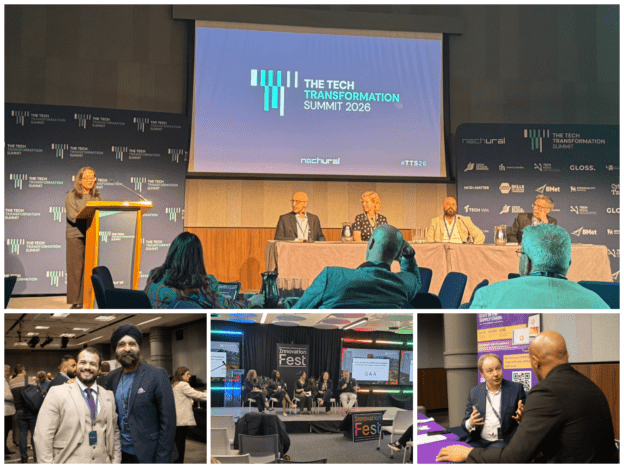
A reflection on a uniquely busy West Midlands cyber and technology day spanning the Tech Transformation Summit, BCU Innovation Fest and the SWBH NHS Charity Quiz Night. Covering cyber resilience, leadership, AI, workforce transformation, industrial resilience, and the growing regional cyber ecosystem, the article explores how operational resilience is increasingly a human, organisational, and economic challenge rather than a purely technical one.
Contents
1. Introduction
Last week was one of those rare Birmingham days when multiple strands of technology, cyber resilience, academia, investment, and civic contribution converged into a much wider conversation about the future of the region.
Cyber Tzar was proud to be a headline sponsor of the Tech Transformation Summit 2026, bringing together leaders from across cyber, technology, investment, academia, and industry to discuss AI, operational resilience, leadership, and the future workforce.
The day opened with a discussion featuring Russ Shaw CBE and Dr Christina Yan Zhang on the UK’s position as a global technology powerhouse, setting the tone for many of the conversations that followed around innovation, resilience, workforce transformation and regional growth.
Thanks also to Ninder Johal DL for his continued support for regional innovation, technology leadership, and the wider West Midlands ecosystem, and to his team. Conversations around cyber resilience, operational transformation and long-term regional growth increasingly benefit from exactly this kind of cross-sector leadership and coordination.
What stood out most throughout the day was that the conversation around cyber security is changing rapidly.
Not long ago, cyber was still widely treated as a technical function handled quietly by IT departments, compliance teams or external specialists somewhere in the background of the organisation. Increasingly, that framing no longer reflects reality.
Modern organisations are now operationally dependent on digital systems, whether they consider themselves technology companies or not.
For manufacturers, logistics providers, healthcare organisations, universities, local government and SMEs alike, cyber resilience is no longer simply about protecting data. It is about continuity, trust, operations and economic resilience. When systems fail, production stops. Supply chains stall. Services degrade. Trust erodes.
Cyber resilience has become operational.
And in industrial regions such as the West Midlands, operational resilience increasingly means economic resilience itself.
2. Leadership, Transformation and Workforce Uncertainty
One of the more striking discussions came during an early leadership session involving Dani Grieveson, Dr Christina Yan Zhang and Russ Shaw CBE, where questions around workforce engagement, future capability and societal change surfaced repeatedly.
One statistic in particular landed heavily.
Only around 12% of the workforce currently reports feeling genuinely engaged in their day-to-day work.
That figure says something important about the moment we are living through.
We are simultaneously experiencing:
- AI acceleration
- economic uncertainty
- information overload
- continuous digital transformation
- and rapidly changing social and operational environments
At the same time, the UK remains globally respected for its technical capability, digital innovation and entrepreneurial talent. Dr Christina Yan Zhang and Russ Shaw CBE both noted that the UK remains one of the world’s strongest digital economies, yet often fails to promote its own strengths confidently enough.
Several examples highlighted this contrast. Despite being the world’s third-largest technology economy, valued at approximately $1.3 trillion, the UK often remains surprisingly modest about its position internationally. The discussion explored how Britain’s strengths extend beyond technology firms themselves, encompassing world-leading universities, international education, research collaboration, financial innovation and global talent networks. In many respects, the challenge is not capability, but confidence in communicating that capability to the wider world.
That tension matters.
The challenge facing organisations is no longer simply technological transformation, but helping people navigate transformation itself.
The discussion also touched upon the role of international talent and knowledge exchange in supporting long-term innovation. The UK continues to attract large numbers of international students, researchers and entrepreneurs, creating networks that extend far beyond domestic markets. As technology becomes increasingly global, these relationships increasingly represent a strategic asset rather than simply an educational or economic one.
Increasingly, inspirational leadership becomes less about charisma or certainty and more about helping people find their feet during periods of rapid change.
Many of these pressures also sit downstream of wider structural changes occurring across the internet and digital society itself. Questions around platform fragmentation, AI-generated environments, identity systems, age verification and the changing nature of the web are increasingly becoming operational, social and governance issues simultaneously. Much of my broader thinking around these shifts can be found across ongoing work around The Web Unbundled, The Age-Gated Internet and wider themes of Societal Evolution.
The leaders who succeed over the next decade are unlikely to be those who simply adopt technology the fastest, but those capable of reducing ambiguity, building trust and helping people navigate continuous transformation without becoming disconnected from it.
3. Cyber Has Become a Leadership and Operational Issue
This wider shift was particularly visible during cyber discussions led by Daljinder Mattu, alongside contributions from John Maguire, Emma Philpott and Prof Zeeshan Pervez.
One of the clearest themes emerging across both government and industry is that boards are increasingly beginning to understand cyber not as discretionary IT spend, but as part of core operational risk.
In the West Midlands, where manufacturing, logistics, aerospace and interconnected supply chains form the backbone of the economy, cyber disruption increasingly means operational disruption.
Production disruption.
Supply chain disruption.
Commercial disruption.
That creates a very different leadership conversation.
The most effective leaders are no longer treating cyber as an annual compliance exercise or awareness campaign. They are beginning to embed resilience into operational culture itself, much like health and safety or quality assurance became embedded over previous decades.
Awareness alone does not create resilience.
Culture does.
And culture is shaped by leadership behaviour far more than policy documents.
Cyber itself is also increasingly socio-technical rather than purely technical. The challenge no longer sits solely within software vulnerabilities or infrastructure, but at the intersection of technology, governance, operations, workforce culture and human behaviour.
Artificial intelligence is only accelerating that shift.
AI is increasing the speed, scale and accessibility of cyber activity on both the defensive and adversarial side. At the same time, organisations are grappling with workforce uncertainty, economic pressure and rapidly evolving operational models.
The result is that cyber resilience is increasingly becoming part of operational continuity itself.
Particular thanks also go to Daljinder Mattu for leading and moderating a thoughtful and grounded discussion around cyber resilience, operational risk and the wider future direction of the sector within the West Midlands.
4. The West Midlands Opportunity
One of the broader themes I discussed throughout the day, and one increasingly reflected in my broader work on Cyber Sectoral Analysis, is that the West Midlands possesses a distinctive cyber opportunity that differs from many other UK regions.
The region’s opportunity may not lie in replicating London’s finance-led ecosystem or Cheltenham’s intelligence-led environment.
Several conversations throughout the day also returned to the wider question of regional growth. While the UK remains one of the world’s leading technology economies, investment, visibility and commercialisation pathways remain heavily concentrated around London and the South East. For regions such as the West Midlands, the challenge is not proving capability but creating the conditions that allow innovation, skills, investment and technology transfer to scale locally.
Instead, the West Midlands is structurally positioned around:
- manufacturing
- logistics
- aerospace
- operational technology
- industrial systems
- and interconnected supply chains
That matters because these sectors increasingly depend upon resilient digital systems, operational continuity and supply-chain assurance.
Cyber disruption within these environments is rarely theoretical.
Production halts.
Logistics fail.
Suppliers disconnect.
Operational continuity breaks down.
In this environment, cyber resilience increasingly becomes part of industrial resilience itself.
That creates a genuine strategic opportunity for the region to establish itself as a nationally recognised centre for industrial cyber resilience and supply-chain security.
A much larger body of work exploring these themes in detail, focused specifically on the emergence of a regional cyber ecosystem and industrial cyber resilience capability in the West Midlands, is due to be published soon.
The long-term success of the UK’s technology sector is unlikely to depend solely upon the continued growth of London. Increasingly, it will depend upon whether regions can develop distinctive specialisms, attract investment, retain talent and create sustainable ecosystems around their own industrial and economic strengths. For the West Midlands, industrial cyber resilience represents one such opportunity.
5. SMEs, Ecosystems and Regional Coordination
Alongside discussions around AI and resilience, there was also a strong emphasis on regional collaboration, practical implementation support and ecosystem coordination.
For many smaller organisations, the barrier is rarely willingness, but bandwidth, trusted guidance and accessible next steps.
Most SMEs do not need a 400-page strategy document.
They need practical implementation support and realistic pathways forward.
This is where organisations such as the West Midlands Cyber Hub, the Cyber Resilience Centre network, Cyber Advisors and wider regional partnerships become increasingly important.
Cyber Essentials was repeatedly discussed as a strong practical starting point for many organisations, while broader frameworks such as ISO27001 represent part of a wider organisational maturity journey rather than competing standards.
Equally important is the growing recognition that supply-chain resilience is now becoming unavoidable.
As the Cyber Security and Resilience Bill evolves, increasing numbers of organisations across data centres, MSPs, critical infrastructure providers, defence supply chains and operational environments will increasingly find themselves drawn into resilience requirements indirectly through the ecosystems around them.
In practice, most organisations can no longer secure themselves independently from their suppliers, partners and wider operational dependencies.
Resilience is becoming collective.
Discussions with Rupert Lyle from the West Midlands Co-Investment Fund also reinforced the growing recognition that cyber startups and resilience-focused SMEs require stronger progression pathways and investment support for the region to scale its capabilities effectively.
6. Workforce, Academia and Cognitive Diversity
The broader relationship among academia, innovation and cyber capability also remained evident throughout the day.
Following the summit, I headed over to BCU Innovation Fest, where discussions with Prof Yussuf Ahmed and colleagues focused on innovation, investment and future workforce development.
Cyber security also remains one of the most neurodiverse professional sectors in the UK, and that diversity increasingly represents a genuine strategic strength. Modern cyber resilience depends heavily upon systems thinking, pattern recognition and the ability to understand interconnected dependencies across technical and human environments.
The future workforce will also depend upon widening participation across women, underrepresented groups and non-traditional career pathways.
Future cyber capability will increasingly depend not simply upon technical tooling, but on interdisciplinary thinking, operational understanding and the ability to navigate complexity across systems, people and organisations simultaneously.
7. Ending the Day
The day concluded at Millennium Point with the Black-Tie Charity Quiz Night in support of Your City & Metropolitan Hospitals Charity, serving Sandwell and West Birmingham NHS Trust, hosted by broadcaster Manish Bhasin.
After a full day discussing resilience, technology, leadership and regional capability, it was a timely reminder that civic infrastructure, healthcare and community resilience ultimately sit downstream of many of the same conversations.
If there was one clear message emerging across the day as a whole, it was this:
resilience is no longer a purely technical capability.
It is becoming a human, organisational and economic one.
And the question facing organisations now is not whether transformation is coming, but whether leaders can build the trust, culture and resilience required to weather it together.
Thanks also go to Abbie Vlahakis, CEO of Millennium Point, Rebecca Delmore and the wider team for organising and supporting the evening, alongside the team from Sandwell College for warmly welcoming us onto their table during the event.
8. Conclusion
If there was one clear message emerging across the day as a whole, it was this: resilience is no longer a purely technical capability. It is becoming a human, organisational and economic one simultaneously.
Across cyber, AI, operational resilience and regional transformation, the same themes surfaced repeatedly: trust, adaptability, culture, coordination and the ability to help people navigate continuous change without becoming disconnected from it.
For the West Midlands in particular, that creates both challenge and opportunity.
The region’s industrial character, manufacturing heritage and interconnected supply chains mean that cyber resilience is increasingly becoming part of economic resilience itself. Equally, the region’s growing ecosystem across academia, SMEs, investment, operational technology and cyber capability creates a genuine opportunity to establish the West Midlands as a nationally recognised centre for industrial cyber resilience and supply-chain security.
The question facing organisations now is not whether transformation is coming, but whether leaders can build the trust, resilience and operational culture required to weather it together.