Ivy Lee shaped the modern world of public relations by mastering narrative control, pioneering a simple yet powerful productivity method, and reframing truth as both tactic and ethic. This article explores Lee’s legacy, from press release orchestration and the “two-way street” philosophy to his morally ambiguous work for industrial giants, ending with a practical guide to applying his enduring techniques today.
Contents
- Contents
- 1. Introduction: The Man Who Sold the Truth
- 2. PR as Narrative Control: From Facts to Framing
- 3. The Two-Way Street (and Its Potholes)
- 4. The Productivity Method: Ivy Lee’s 15-Minute Rule
- 5. Interlude: Truth as Tactic
- 6. Ethical Ambiguity: Propaganda, Not Just PR
- 7. Key Techniques: Ivy Lee’s Playbook
- 8. Final Thoughts: Why Lee Still Matters
1. Introduction: The Man Who Sold the Truth
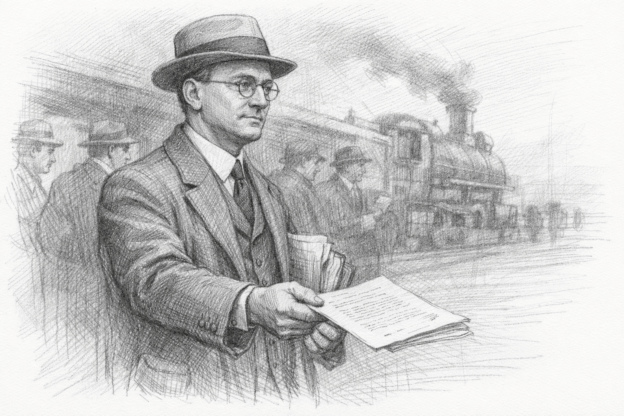
Long before brand strategists wore black turtlenecks and crafted “authenticity,” Ivy Lee stood on a train platform handing out typed statements to journalists. In 1906, following a fatal train crash, the Pennsylvania Railroad didn’t hide behind silence. Lee wrote their account of what happened—clearly, quickly, and with quotable certainty.
It ran verbatim in The New York Times.
This wasn’t transparency. It was choreography. Lee wasn’t just giving them the facts. He was giving them the story.
Lee is remembered as the father of modern public relations. But that’s too narrow. He was a narrative engineer. A productivity theorist. A reputation fixer. And a deeply ambiguous moral figure who understood one thing better than most: truth doesn’t always win—but the first version of it often does.
2. PR as Narrative Control: From Facts to Framing
Ivy Lee was a journalist turned fixer. His first major client, the Pennsylvania Railroad, hired him to manage a press disaster. He invited journalists in, gave them direct information, and reframed the story as one of transparency rather than failure.
That was Lee’s genius: reframing the agenda.
He wrote what he called “statements of fact”, but these were carefully structured narratives. By feeding journalists a complete, quotable, and ready-made story, he took control of what was published. Sound familiar? It’s the foundation of every corporate comms team and government briefing pack today.
“Our plan is to supply the press and public of the United States promptly and accurately with facts…”
— Ivy Lee, 1906
But the devil’s in the structure. Lee understood three key ideas:
- Timeliness beats truth. Speed meant control.
- Tone dictates interpretation. Framing a crisis as a proactive measure (“We have taken immediate steps…”) softens its impact.
- Source equals trust. If you act like the source, people treat you like one.
In effect, Lee built the operating system for modern media relations: get in first, own the frame, appear helpful.
3. The Two-Way Street (and Its Potholes)
Lee didn’t just talk at people, at least, not in theory. One of his key ideas was that public relations should operate on a two-way street: companies should communicate, yes, but they should also listen. Good PR, according to Lee, wasn’t just press management; it was social attunement.
“Publicity is not a bag of tricks,” he argued. “It is a serious profession requiring integrity and an understanding of people.”
In this light, PR becomes a feedback system. Not just a megaphone, but a mirror.
Of course, the record is mixed. While Lee preached responsiveness, many of his most famous interventions involved controlling, shaping, or outright redirecting public attention. Listening sometimes got lost in the performance. But the ideal remains important: the most effective communications strategies today—especially in politics and tech—build legitimacy by being seen to listen, even when the intent is control.
4. The Productivity Method: Ivy Lee’s 15-Minute Rule
Long after his PR career, Lee became a footnote in productivity literature for something deceptively simple: the Ivy Lee Method.
As the story goes, Charles Schwab, then president of Bethlehem Steel, asked Lee for a way to improve executive productivity. Lee proposed the following:
4.1 The Technique
- At the end of each workday, write down the six most important tasks for the next day.
- Prioritise them.
- Next day, start with the first task. Finish it before moving on.
- Repeat daily.
Schwab tested it. Productivity surged. He paid Lee $25,000, a small fortune then, equivalent to over $400,000 today.
4.2 Why it works
- It offloads cognitive load. You sleep without stress.
- It creates friction against distraction. The pre-set list reduces decision fatigue.
- It forces prioritisation. You can’t list 20 things—only six.
This is not time management. It’s attention management.
5. Interlude: Truth as Tactic
Perhaps the most infamous quote attributed to Ivy Lee came via his work with John D. Rockefeller Jr., heir to Standard Oil:
“Tell the truth, because sooner or later the public will find out anyway. And if the public doesn’t like what you are doing, change your policies and bring them into line with what people want.”
Whether he actually said this or just spread it as good marketing is beside the point. It’s PR gospel now.
And it hints at a broader strategy: truth not as virtue, but as tactic. For Lee, truth could be instrumental. You didn’t tell the truth to be good; you told it to stay ahead.
In a world of whistleblowers, leaks, and real-time reaction, this advice is prescient. It reads almost like an early lesson in agile comms: adapt fast, course-correct publicly, don’t fight reality, bend with it.
There’s no doubt that Lee helped clients shape the truth. But he also recognised a deeper truth of public life: the public will shape you in return.
6. Ethical Ambiguity: Propaganda, Not Just PR
Lee’s most controversial work came with the Rockefellers during the Ludlow Massacre, where striking workers were killed by private security. Lee helped rehabilitate the Rockefeller image with press tours, human-interest stories, and staged photos. Critics called it spin. Lee called it service.
He later worked for IG Farben and advised Nazi-connected firms in the 1930s. Even by the standards of realpolitik PR, this is morally radioactive.
So what do we make of him?
- A visionary who invented the modern press release?
- A propagandist who whitewashed corporate violence?
- A productivity guru whose method still works?
The answer, inevitably, is yes to all three.
7. Key Techniques: Ivy Lee’s Playbook
Here’s a distilled guide to Ivy Lee’s enduring techniques… for anyone working in media, business, or influence:
7.1 The Press Release as Narrative Weapon
Technique: Pre-write the story for journalists
Application: Frame the facts early. Own the language.
7.2 The Rule of Six (Productivity)
Technique: Six tasks, ranked, no more
Application: Eliminate noise, finish what matters
7.3 The Two-Way Street
Technique: Listen as well as speak
Application: Set up feedback loops with your audience
7.4 Truth as Strategy
Technique: Say what you’re doing—and adapt if it offends
Application: Avoid spin by aligning actions with public values
7.5 Speed Over Perfection
Technique: Be first to speak; details follow
Application: In a crisis, delay cedes the narrative
8. Final Thoughts: Why Lee Still Matters
In the age of AI-generated press releases and digital productivity hacks, Ivy Lee’s techniques remain oddly durable. His method teaches constraint. His PR strategy teaches narrative control. And his career teaches us that the ethics of influence are often rewritten by the victors.
If you’re in tech, media, cyber, or policy, chances are, you’re using Ivy Lee’s tools, even if you don’t know it.
Just remember who wrote the first draft of your playbook.