This essay argues that Thomas Pynchon’s career alternates between maximalist “cathedral” novels that map the formation of modern systems and more compressed works that depict life inside those systems. Rather than decline, the shift from Gravity’s Rainbow to Inherent Vice reflects historical contraction. Shadow Ticket suggests a late hybrid form: densified noir.
Contents
- Contents
- 1. Introduction: Density, Drift, and the Californian Detour
- 2. Apprenticeship: Entropy and the Build Toward V.
- 3. Gravity’s Rainbow: The Great American Novel?
- 4. The Long Silence and the Western Line
- 5. Vineland, or: the …And Justice for All Moment
- 6. Against the Day and the Apotheosis of Maximalism
- 7. A Note on Maximalism: the Cathedral Method
- 8. The Californian Drift: Inherent Vice and Bleeding Edge
- 9. Shadow Ticket: the Late Hybrid, or “Genre with Teeth”
- 10. What the Academics Think They’re Talking About
- 11. Cycles, Not Decline
- 12. Warlock, Carrera, and the Western Obsession
- 13. Does the Hypothesis Stand?
- 14. Coda: The Problem of Expectation
- 15. References
1. Introduction: Density, Drift, and the Californian Detour
There are, to my mind, four books that matter when we talk about Thomas Pynchon. Four engines. Four cathedrals of paranoia and counter-history: V., Gravity’s Rainbow, Mason & Dixon, and Against the Day. Structurally insane books. Proper door-stoppers. Books that don’t so much unfold as metastasise. Hundreds of characters. Nested plots. Songs. Equations. Cartoons. Rocket trajectories. Jesuit astronomers. Balkan anarchists. Light itself bending through alternative political geometries.
And then there is the rest.
The rest is… lighter. California. Weed smoke. Private detectives. Stoner drift. A certain kind of half-ironic countercultural pastiche that feels, at least on first encounter, like a Pynchon cover band playing in a beach bar. The prose is recognisable. The jokes land. The paranoia flickers. But the density is not there. The narrative pressure is lower. The architecture feels like wood frame rather than flying buttress.
The hypothesis, then, is simple and heretical: that Pynchon has two modes. The cathedral mode, and the Californian drift. And that the latter is, if not exactly derivative, then a watered-down echo of the former.
Cathedral novels emerge at moments of system birth; the Californian novels dwell within already established systems. Scale in Pynchon, in other words, is not stylistic excess but historical method.
The question is whether that stands up to scrutiny.
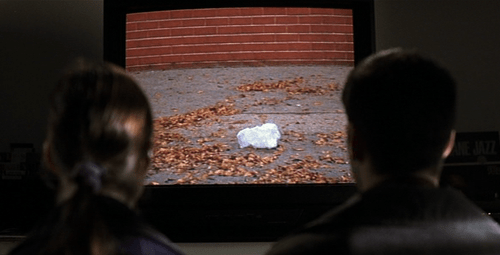
Think of the plastic bag in American Beauty, caught in a vacant-lot updraft, briefly choreographed by invisible heat currents. That’s what I mean by dust-devil: a small, ecstatic vortex generated by the ordinary machinery of the world.
2. Apprenticeship: Entropy and the Build Toward V.
Before the cathedrals, there are the sketches. Slow Learner (1984), collecting early stories from the late 1950s and early 1960s, gives us the workshop floor: “Entropy”, “Under the Rose”, “The Secret Integration”. These are not minor in ambition; they are minor in scale.
What we see here is not immaturity in the sense of incompetence. We see compression. “Entropy” already stages thermodynamics as social metaphor. “Under the Rose” is already doing colonial intelligence intrigue. The paranoia is present. The systems thinking is present. But they are not yet totalised.
They are fragments of a method looking for a chassis.
V. (1963) is that chassis. It is the first cathedral. A global sprawl linking colonial Africa, fin-de-siècle decadence, postwar New York, mechanical women, and a quest narrative that dissolves as it proceeds. It is excessive. It is uneven. It is, frankly, mad. But it establishes the template: history as conspiracy; technology as destiny; identity as scattershot; narrative as centrifugal force.
And then Gravity’s Rainbow (1973) detonates the template.
If V. is a baroque cathedral, Gravity’s Rainbow is a black hole with a stained-glass exterior. The V-2 rocket becomes the organising metaphor for an entire century’s drive toward annihilation. The book is obscene in scale. Hundreds of named characters. Songs every few pages. Pornography, slapstick, theology, quantum physics, corporate genealogy. It is not simply dense; it is gravitational. You do not read it. You orbit it.
This is the first peak. And it establishes an expectation that Pynchon himself will struggle against for the rest of his career.
3. Gravity’s Rainbow: The Great American Novel?
If the phrase “The Great American Novel” means anything at all, and it may not, then it must refer to a work that captures not simply a nation but a system. Not character, not landscape, not even ideology, but the operating logic of the American century.
By that measure, Gravity’s Rainbow is the closest contender we have.
If we’re going to play the game straight for a moment, the usual contenders line up quickly: Moby-Dick, because it yokes metaphysics to industry and makes obsession national; Adventures of Huckleberry Finn, because it stages freedom and hypocrisy in the vernacular bloodstream; The Great Gatsby, compressing aspiration, fraud, and class performance into a green light; The Grapes of Wrath, turning Depression-era displacement into a national reckoning with capital and land; Absalom, Absalom! for its baroque excavation of Southern myth and historical guilt; Invisible Man for its anatomy of race, ideology, and invisibility within American modernity; Beloved for forcing the republic to confront the ghost it tried to bury. These are the moral-epic candidates, the books that wrestle directly with history, identity, and the American promise.
Then there are the system novels and social panoramas: Updike’s Rabbit sequence, chronicling postwar suburban consciousness as a slow spiritual attrition; Roth’s American Pastoral, anatomising the collapse of mid-century optimism under the pressures of Vietnam and domestic unrest; Wolfe’s The Bonfire of the Vanities, skewering Reagan-era finance, media, and race in the theatre of New York excess; DeLillo’s Underworld, mapping the Cold War as waste system and memory machine; McCarthy’s Blood Meridian, rendering expansion as cosmological violence; even Wallace’s Infinite Jest, diagnosing entertainment, addiction, and late-capitalist paralysis. Each captures an America: regional, racial, economic, and psychological. Only a few attempt to capture the operating system.
But Gravity’s Rainbow is not American in the narrow sense. Much of it is set in Europe. Its central technological object is German. Its characters scatter across borders. But its true subject is the transfer of power, from war to corporation, from state to technocracy, from visible authority to distributed control. That transfer is the American story after 1945.
Melville gave us expansion. Fitzgerald gave us aspiration. Faulkner gave us regional haunting. Morrison gave us the moral reckoning of history. But Pynchon gives us infrastructure.
Gravity’s Rainbow is the novel in which America ceases to be a place and becomes a system.
The Rocket is not just a weapon; it is a trajectory. A parabolic arc that predicts its own impact before it lands. That is the logic of postwar American power: pre-emption, projection, inevitability. Slothrop’s scattering is not just comic absurdity; it is the fragmentation of the subject under systems too large to comprehend.
If the Great American Novel must diagnose the national condition, then Gravity’s Rainbow does something more severe: it diagnoses the emergence of a global order in which America is the invisible centre.
But here’s the complication.
The novel is also obscene, manic, destabilising, full of songs about erections and octopi. It refuses dignity. It refuses solemnity. It refuses to stand still long enough to be monumental.
And that may be the point.
The Great American Novel, in its mythic form, is supposed to stabilise national identity. Gravity’s Rainbow does the opposite. It dissolves identity into networks of capital, intelligence, and desire.
So perhaps the better formulation is this:
Gravity’s Rainbow is not the Great American Novel.
It is the novel that explains why the idea of a Great American Novel no longer makes sense.
4. The Long Silence and the Western Line
Between Gravity’s Rainbow and Mason & Dixon (1997) lies a silence punctuated only by Vineland (1990). The silence matters. It becomes myth. Pynchon disappears into privacy; the author becomes rumour. But more importantly, the formal question emerges: how do you follow Gravity’s Rainbow?
The answer, in Vineland, is: you don’t.
Vineland is the first of the Californian books. It is set in Reagan-era America, haunted by the failed radicalism of the 1960s. It is funny, sad, and politically aware. But it is not structurally insane. It does not attempt totality. It is, by Pynchon standards, modest.
And here the charge of dilution begins. Compared to Gravity’s Rainbow, Vineland feels like a comedown. The paranoia is smaller-bore. The historical reach is limited. The systems are local, not planetary.
Yet to dismiss it is to miss a key shift. Vineland marks a pivot from metaphysical paranoia to media paranoia. The enemy is no longer only the Rocket; it is television. Surveillance culture. Bureaucratic creep. The Reagan state. The mode becomes elegiac rather than apocalyptic.
Still, if you are waiting for another cathedral, you wait.
Mason & Dixon is that cathedral.
Written in faux-18th-century prose, it reconstructs the surveying of the Mason–Dixon Line as a meditation on Enlightenment rationality, empire, slavery, and the birth of America’s technocratic dream. It is vast, discursive, digressive. Talking dogs. Mechanical ducks. Jesuit astronomers again. It is history rewritten as tall tale and theological argument.
And here the pattern becomes clearer. The big books are historical. They look backward to look forward. They stage turning points: imperial modernity (V.), the Second World War and its rocket epiphany (Gravity’s Rainbow), the Enlightenment’s cartographic violence (Mason & Dixon), and later, the anarchist/industrial threshold of the late 19th century (Against the Day, 2006).
The Californian books, by contrast, are contemporary. They deal with the immediate. They feel smaller because their temporal horizon is smaller.
But is that merely scale, or a different aesthetic programme? And for some readers, myself included, that contraction did not feel like evolution. It felt like betrayal.
5. Vineland, or: the …And Justice for All Moment
I need to say this plainly, because it’s part of my own reader-biography and it belongs in any honest map of Pynchon’s phases: Vineland was the book I’d waited a decade for, and when it arrived, it hit me the way …And Justice for All hit me the first time I heard it. You’re waiting for the band you know. You’re expecting the muscular, feral, unrepeatable thing. And instead you get this weird, over-produced, thinned-out, wrong-balance artefact. Like someone’s taken the bass out of the world (Cliff Burton dead, the “weight” gone, the engine missing).
And I remember that first listen: I just… got up, carried it to the window, and flung it out. Six Ways Handsworth/New Town/Lozells converging island, streetlights, the whole dramatic teenage-myth gesture. Vineland did that to me in book form. Ten years of expectation and then: what the fuck is this? What is this instead of the dust-devil book I was promised?
6. Against the Day and the Apotheosis of Maximalism
Against the Day (2006) is the last true cathedral. It is arguably the most excessive of all: 1,000+ pages of anarchists, mathematicians, Balkan intrigues, airships, light as a physical and metaphysical entity. It revisits the fin-de-siècle moment that haunts V. and Gravity’s Rainbow and pushes it outward into speculative mathematics and parallel worlds.
It feels like a summation. It gathers Pynchon’s obsessions (entropy, empire, capital, transcendence) and explodes them across continents. If you believed that Pynchon had gone soft in California, Against the Day is a rebuke.
And yet it is also a book of doubling. Multiple timelines. Alternate dimensions. Light refracting into alternatives. It is as though Pynchon knows that this kind of maximalism cannot be sustained indefinitely. The book feels terminal. Not in the sense of decline, but in the sense of culmination.
After Against the Day, there are no more cathedrals.
7. A Note on Maximalism: the Cathedral Method
“Maximalism” isn’t just “long”. It isn’t “big cast”. It isn’t even “lots of research”, though it usually comes with that. Maximalism is a method of cognition: a belief, sometimes explicit, sometimes deranged, that the only way to tell the truth about a historical moment is to overload the narrative system until it starts generating emergent properties. In a maximalist novel, plot stops being a tidy chain and becomes a weather pattern. You get recursion, echo, and counter-melody. You get documents, songs, diagrams, bad jokes, metaphysics, pornography, theology, technical manuals, anything that belongs to the lived texture of a world. The book behaves less like a story and more like an engine for producing reality-effects at scale.
That’s why the maximalist canon isn’t a “genre shelf”. It’s a family resemblance: Gravity’s Rainbow and Mason & Dixon, yes, but also the tradition behind them and alongside them, Joyce’s Ulysses (and the nuclear option of Finnegans Wake), Melville’s Moby-Dick, Gaddis, DeLillo in his big-system mood, Wallace’s Infinite Jest, Vollmann doing Vollmann, Bolaño’s 2666. And you don’t get to talk about narrative density without tipping your hat to Dostoevsky, The Brothers Karamazov as a kind of proto-maximalist moral cosmos where every argument sprouts a person and every person sprouts a theology. My son Bill would bang on about this, about how the Karamazov brothers aren’t just characters, they’re philosophical weather systems, and he was right. That book is a pressure chamber.
Maximalism, in other words, is what happens when the novel refuses the consolations of reduction. It won’t summarise the world into a clean arc. It won’t let you have a single villain, a single hero, a single thesis. It forces you to live inside plurality and noise until the noise starts to sound like structure.
8. The Californian Drift: Inherent Vice and Bleeding Edge
Inherent Vice (2009) and Bleeding Edge (2013) are the books that trigger the “meh” reaction for readers who came for the dust-devils.
Inherent Vice is a stoner detective novel set in 1970 Los Angeles. It is playful. It is affectionate. It riffs on Chandler and Pulp Fiction aesthetics. The paranoia is there, real estate conspiracies, shadowy syndicates, but it is filtered through haze and humour.
Bleeding Edge moves to New York around the dot-com crash and 9/11. It engages with the early internet, virtual reality, financialisation. It is more serious in tone, but still far more linear than the cathedrals.
These books are often described as “accessible Pynchon”. Which is true. But accessibility, here, is not simply a concession to readers. It is a thematic choice.
The Californian novels are about aftermath. They are about the slow sedimentation of failure. The revolutionary energies of the 1960s curdle into nostalgia in Vineland and Inherent Vice. The utopian promise of the early internet curdles into surveillance capitalism in Bleeding Edge. The scale is smaller because the horizon of possibility is smaller.
In the cathedrals, history is still in motion. The Enlightenment is being invented. The Rocket is ascending. Anarchists are dynamiting the old order. In California, history has already congealed. The system has won. What remains is drift.
So perhaps the sense of dilution is not aesthetic weakness but historical diagnosis.
But this isn’t the end of the story. The late Pynchon doesn’t stay in drift. He compresses the system into genre.
9. Shadow Ticket: the Late Hybrid, or “Genre with Teeth”
One thing I missed in the earlier map is Shadow Ticket (2025), because it complicates the neat binary between “cathedral Pynchon” and “California drift”. It’s a shorter book, and it wears the detective suit again. But it isn’t simply another sunny West Coast amble. It’s set in 1932, with a private investigator starting in Milwaukee and getting flung, classically Pynchonian style, into a continent-hopping mess that includes Hungary and the spreading shadows of 1930s Europe.
So, where does it sit in the two-modes hypothesis?
It sits in the seam.
On the one hand, it’s recognisably in the late-genre line: a tighter chassis, a more forward-driving plot impulse, the pleasure of the case, the pleasure of pursuit. You can feel the noir toolkit in your hands. On the other hand, Shadow Ticket isn’t content to stay local or purely contemporary, and it isn’t content to treat genre as mere accessibility. The historical setting matters. 1932 isn’t “vibes”; it’s a hinge, Depression economics, pre-war political acceleration, the sense of systems tightening their grip. That automatically reintroduces one of the cathedral instincts: history as a machine whose gears you can hear turning under the floorboards.
Which means it functions like a hybrid proof: evidence that the late work isn’t just dilution, but compression. A smaller container that still wants to smuggle in the old contraband: politics as occult logistics, power as transnational choreography, paranoia as a rational response to the invisible wiring of the world.
So yes: it partially supports the model (the detective lane continues), but it also weakens the claim that the lane is necessarily watered down. Shadow Ticket suggests a third possibility: not drift versus cathedral, but drift versus cathedral versus densified noir. A late form in which genre becomes a pressure vessel, compressing the historical dread of the cathedrals into a smaller narrative chassis.
10. What the Academics Think They’re Talking About
There is an entire industry devoted to explaining Thomas Pynchon. It hums away in journals, monographs, conference panels, edited volumes with sober titles. Some of it is brilliant. Some of it is career maintenance. Most of it circles the same gravitational questions: What is paranoia? What is system? Is this postmodernism or something worse?
Broadly speaking, the camps fall into three tendencies.
- The Systems Theorists
- The Postmodern Ironists
- The Political Theologians
10.1 The Systems Theorists
This is the camp that takes entropy seriously.
From the beginning, critics recognised that Pynchon wasn’t simply being decorative when he invoked thermodynamics in “Entropy” or built Gravity’s Rainbow around the ballistic arc of the V-2. Scholars like N. Katherine Hayles read Pynchon through information theory and cybernetics, situating him in the shift from thermodynamic entropy (heat death, dissipation) to informational entropy (noise, signal degradation). In this view, Pynchon becomes the novelist of the postwar systems turn, the moment when feedback loops, control mechanisms, and probabilistic thinking reshape reality.
Brian McHale’s work on postmodernist fiction positions Pynchon at the ontological frontier: the move from epistemological questions (“How can we know the world?”) to ontological ones (“Which world is this?”). In that reading, the proliferation of plots and counterplots is not excess; it’s a dramatization of ontological instability. Worlds bifurcate. Timelines double. Reality itself becomes a branching system.
Thomas Schaub, Hanjo Berressem, and others extend this into full systems analysis: Pynchon as novelist of self-organising complexity. Conspiracies are not just political, they are emergent properties. Paranoia becomes an epistemology appropriate to living inside vast, distributed, semi-visible networks of power. Critics like Joseph Tabbi extend this further, reading Pynchon through cognitive science and network theory, as a novelist mapping distributed consciousness in an age of informational overload.
In this camp, the density is methodological. The big books must be big because systems are big. The novel mimics the structure of what it depicts. Gravity’s Rainbow is not long because Pynchon is indulgent; it is long because late-industrial technocracy is.
This is the most intellectually persuasive camp.
But it risks turning Pynchon into a diagram.
10.2 The Postmodern Ironists
Then there are the ironists.
Here Pynchon becomes the high priest of postmodern play. Linda Hutcheon, Patricia Waugh, and others frame his work as historiographic metafiction, texts that foreground their own constructedness while parodying historical narrative. The songs, the slapstick, the cartoons, the tonal lurches: these are signals that the text knows it is text.
In this reading, paranoia is stylised. Density is aesthetic exuberance. The proliferation of characters is carnivalesque rather than diagnostic. Pynchon becomes the virtuoso of surface, brilliant, destabilising, but ultimately anti-foundational.
There is truth here. The novels are undeniably self-aware. Mason & Dixon explicitly stages its own storytelling frame. Against the Day revels in pulp forms. Inherent Vice is openly genre pastiche.
But if you lean too hard into this camp, you end up with a Pynchon who is playing rather than warning. The systems become toys. The dread becomes performance.
And that, frankly, does not survive sustained contact with Gravity’s Rainbow.
10.3 The Political Theologians
The third camp takes the paranoia at face value.
Fredric Jameson reads Pynchon as a cartographer of late capitalism, his sprawl an attempt at “cognitive mapping”, a way to render visible the otherwise invisible structures of global capital. In this framework, the novels are not games but strategies: attempts to make systemic power legible to subjects trapped within it.
Other critics push further into political theology. Pynchon’s obsession with elect and preterite, with secret histories and invisible elites, with eschatology and transcendence, invites theological reading. The Rocket in Gravity’s Rainbow is not just technology; it is destiny, sacrament, apocalypse. The Line in Mason & Dixon is not just cartography; it is a secularised act of world-creation.
This camp sees empire everywhere, British imperialism, American militarism, corporate sovereignty. It reads the novels as chronicles of domination and resistance, haunted by the question of whether genuine freedom is still possible inside advanced systems. Scholars such as Paul Saint-Amour and Eric Santner push this reading toward questions of sovereignty, state violence, and the theological residues embedded in modern political power.
Here, the density is moral. The novels are large because the stakes are large.
This camp, too, risks excess, turning every joke into prophecy, every pun into doctrine.
10.4 Where I Sit
My argument sits somewhere between the systems theorists and the political theologians, but diverges from both in one crucial respect: scale is not incidental in Pynchon. It is diagnostic.
The size of the book tells you what historical moment you are in.
When systems are forming, when empires are expanding, when rockets are rising, when mathematics is reconfiguring space, Pynchon writes cathedrals. The density corresponds to emergence. The narrative overload is a measure of historical acceleration.
When systems have congealed, when capital is ambient, when media saturates, when rebellion has curdled into nostalgia, he contracts. The Californian novels are not failures of ambition; they are representations of systemic stasis. The world is smaller because it feels smaller from inside.
And when he compresses history into genre, into what I’ve called densified noir, the form itself becomes a pressure vessel. Smaller container. Same dread.
Without some engagement with the secondary literature, this argument risks sounding like taste. With it, it becomes diagnostic: an attempt to read Pynchon’s formal shifts as historically indexed rather than personally erratic.
11. Cycles, Not Decline
If we plot Pynchon’s oeuvre across time, a cyclical pattern emerges:
- Apprenticeship (1959–1963): Short forms, system sketches, density in embryo.
- First Maximalist Phase (1963–1973): V. and Gravity’s Rainbow.
- Transitional/Contemporary Phase (1990): Vineland.
- Second Maximalist Phase (1997–2006): Mason & Dixon and Against the Day.
- Late Contemporary Phase (2009–2013): Inherent Vice, Bleeding Edge.
- Hybrid Phase (2025+): Shadow Ticket and the emergence of densified noir.
Rather than a single arc from greatness to dilution, we see alternation. Historical totalisation followed by contemporary contraction. Cathedral followed by Californian bungalow.
The question is whether the smaller books are derivative of the larger, or whether they are parasitic in a more interesting way, feeding off the energy of the cathedrals while refusing to replicate their architecture.
12. Warlock, Carrera, and the Western Obsession
Pynchon’s admiration for Oakley Hall’s Warlock, a Western about law, order, and the thin line between justice and violence, is not incidental. Nor is his early friendship with Richard Fariña (not Carrera, though the misnaming is revealing), whose Been Down So Long It Looks Like Up to Me captures the manic energy of 1960s counterculture.
These relationships situate Pynchon within a lineage of American mythmaking. The Western, the frontier, the countercultural road novel. What Pynchon does in the cathedrals is explode the myth from within. What he does in the Californian books is show its hangover.
Warlock is about the founding violence of order. Mason & Dixon literalises that in the surveying of a line. Fariña’s novel captures the ecstatic drift of rebellion; Vineland and Inherent Vice capture its afterlife as memory.
The Californian novels, then, are not lesser Pynchon. They are Pynchon in minor key.
13. Does the Hypothesis Stand?
If by “real Pynchon” we mean narrative density approaching the thermodynamic limit, then yes: the four big books are the peaks. They are the works in which Pynchon attempts total historical cognition. They are intellectually feral. They feel like standing inside a data storm before data storms existed.
The later, lighter books do not attempt that. They are more linear. More genre-inflected. More localised.
But to call them derivative misses the structural intent. The cathedrals are about the birth of systems. The Californian books are about life inside them. The former require sprawl because the systems are emergent. The latter contract because the systems are ambient.
The Californian novels are written from inside the system; the cathedral novels are written at the moment of its formation.
The moments Pynchon writes at maximal scale coincide with historical inflexion points, imperial consolidation, technological rupture, mathematical revolution, moments when the system itself is unstable enough to become visible.
The distinction is heuristic rather than absolute; Pynchon’s modes bleed into one another, but the oscillation in scale remains legible.
In that sense, the oeuvre is not a decline but a cycle: eruption, sedimentation, eruption, sedimentation.
The dust-devils still spin. They are simply smaller now, closer to the ground.
Some critics argue that the later maximalism of Against the Day tips into self-indulgence rather than diagnosis, that excess becomes manner rather than method. But that objection mistakes saturation for slackness; the overload is the point.
14. Coda: The Problem of Expectation
Part of the disappointment some readers feel is self-inflicted. Gravity’s Rainbow rewires the brain. After that, you want every Pynchon novel to feel like intellectual freefall.
But a writer cannot permanently inhabit the mode of detonation. There is something almost merciful in the late books. They are humane. They allow for domesticity. They allow for children, for small businesses, for nostalgia. They recognise that not every historical moment is a hinge.
And yet, if you step back, the ambition is still there. The systems are still humming beneath the jokes. The paranoia has not gone; it has become infrastructural.
The hypothesis, then, partially stands. There are big, fat, feral books. They are unmatched in density. They define the peaks of late 20th-century American maximalism.
But the so-called watered-down works are not failures. They are meditations on what happens after the explosion, after the rocket ascends, after the line is drawn, after the light refracts into a thousand possibilities.
You wake up in California. The revolution is over. The TV is on. The fridge is buzzing. The internet is humming. The system is everywhere.
And the dust-devils are still spinning in the yard.
The scale has changed. The weather has not.
And in the late work, that hum sometimes condenses into what I can only call densified noir, the detective chassis packed tight with historical dread.
15. References
- Berressem, Hanjo. Pynchon’s Poetics: Interfacing Theory and Text. University of Illinois Press, 1993.
- Cowart, David. Thomas Pynchon and the Dark Passages of History. University of Georgia Press, 2011.
- Hayles, N. Katherine. Chaos Bound: Orderly Disorder in Contemporary Literature and Science. Cornell University Press, 1990.
- Hutcheon, Linda. A Poetics of Postmodernism: History, Theory, Fiction. Routledge, 1988.
- Jameson, Fredric. Postmodernism, or, The Cultural Logic of Late Capitalism. Duke University Press, 1991.
- McHale, Brian. Postmodernist Fiction. Routledge, 1987.
- Schaub, Thomas. Pynchon: The Voice of Ambiguity. University of Illinois Press, 1981.
- Seed, David (ed.). The Cambridge Companion to Thomas Pynchon. Cambridge University Press, 2012.
- Weisenburger, Steven. A Gravity’s Rainbow Companion. University of Georgia Press, 1988.
- Waugh, Patricia. Metafiction: The Theory and Practice of Self-Conscious Fiction. Routledge, 1984.