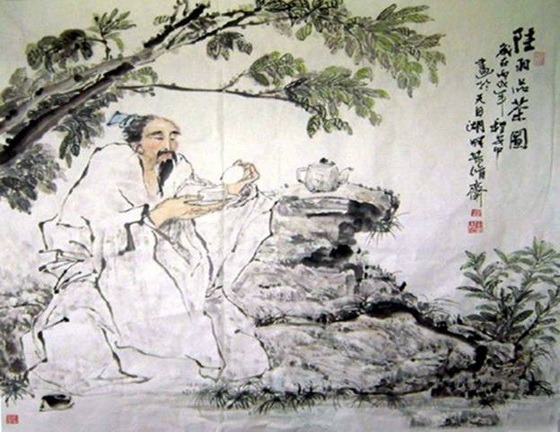
A Zen master overfills a visitor’s teacup to show that a mind already full has no space to receive. The problem is not knowing too much, but being unable to listen. Emptying the cup is not a single insight but an ongoing practice: noticing when we’ve stopped listening and allowing a small pause to create space. Have a cup of tea. Have another one.
There’s a line from a Gong song that I’ve always liked:
Have a cup of tea, have another one.
It’s playful, slightly absurd, and oddly reassuring. It doesn’t sound like advice so much as permission… to linger, to not conclude. Keep going. Stay a little longer. There’s no rush.
It’s not an accident that Gong’s Flying Teapot plays with this image. Daevid Allen borrowed it from Bertrand Russell’s famous thought experiment… a teapot in orbit, impossible to disprove, yet taking up mental space simply by being asserted.
The point wasn’t the teapot. It was the way certainty can occupy the mind without earning its place.
Different traditions. Same gesture.
Notice what’s filling the cup.
The Zen Story of the Cup of Tea is a classic teaching about presence, openness, and receptivity. Before reflection, here is the story itself…
A Cup of Tea
Nan-in, a Zen master, once received a university professor who came to inquire about Zen.
The professor talked. At length.
He was learned, articulate, and confident. He explained his views, his studies, his conclusions. Nan-in listened patiently, saying very little.
Eventually, the master suggested they have tea.
Nan-in poured the professor’s cup. When it was full, he kept pouring. Tea spilled over the rim, onto the table, and down onto the professor’s robes.
The professor watched for a moment, then finally cried out:
“Enough! The cup is full. No more will go in!”
Nan-in stopped and said:
“Like this cup, you are full of your own opinions and speculations. How can I show you Zen unless you first empty your cup?”
That’s the entire story. Zen doesn’t elaborate.
What the Cup Is Pointing At
The professor’s problem isn’t that he knows too much. It’s that his knowing has filled all the available space.
We recognise this pattern easily.
We listen while preparing our reply.
We arrive already certain of what’s going on.
We carry conclusions forward long after they’ve stopped being useful.
The cup isn’t full because it contains truth. It’s full because it’s already occupied.
Zen doesn’t ask us to discard what we know. It asks us to notice when we’re no longer able to receive.
Have Another One
The thing about cups is that they don’t stay empty.
We refill them constantly, with opinions, assumptions, old stories, and quiet defensiveness. So emptying the cup isn’t a single moment of insight. It’s something closer to maintenance.
Have a cup of tea.
Empty it.
Have another one.
Not as accumulation, but as renewal.
Like the man hanging from the vine who pauses to taste the strawberry, or the monk who puts the woman down and walks on, the teaching lives in a small, ordinary act.
Pouring tea.
Stopping.
Leaving space.
A Small Practice
This isn’t about striving for openness or trying to silence the mind. It’s much simpler.
It’s the moment you notice you’re no longer listening… and for a breath, you don’t.
The moment you realise you already know what you’re going to say.
The moment you feel the need to be right.
And then, just for a breath, you don’t.
A little space appears.
I like this story because it isn’t about becoming empty for its own sake. It’s about making room. What we already know can be useful, but it also takes up space. And sometimes, receiving more requires letting some of it go.
Have a cup of tea. Have another one.
Not as accumulation… but as renewal.
Not as knowing… but as space to receive.
References & Notes
- “A Cup of Tea” is a widely circulated Zen story attributed to Nan-in, a Japanese Zen master of the Meiji era, and appears in collections such as Zen Flesh, Zen Bones and is sometimes linked to Shaseki-shū in modern presentations/collections.
- “Have a cup of tea, have another one” echoes a lyric from Gong, Flying Teapot, from the album Flying Teapot (1973).