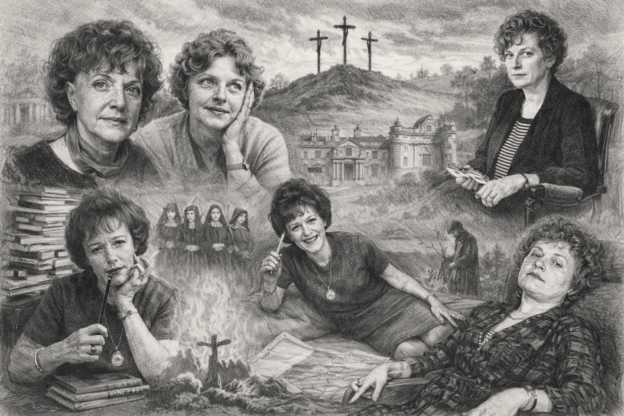
Muriel Spark’s fiction rejects the idea that conversion offers comfort. Instead, it imposes structure, constraint, and limits on human authorship. Through The Driver’s Seat and The Public Image, and in contrast to postmodernism and writers like du Maurier, Spark shows that attempts at total control collapse into termination. Set against lived experience of suicide and ideation, the essay argues that meaning requires shared reality and sustained participation, not imposed closure.
Contents
- Contents
- 1. Introduction
- 2. Structure Without Comfort
- 2.1 The Comfort Assumption
- 2.2 Conversion as Structure
- 2.3 Spark Among the Converts
- 2.4 Structure vs Collapse (Spark and the Postmodernists)
- 2.5 Lise Under Other Authors
- 2.6 Narrative as Authority
- 2.7 The Public Image: Control of Appearance
- 2.8 The Driver’s Seat: Control of Outcome
- 2.9 Suicide and the Closure of Meaning
- 2.10 Du Maurier vs Spark: Internal vs Structural Instability
- 2.11 Why This Is Not Comforting
- 3. Author, Image, and System
- 4. Proximity, Ideation, and Constraint
- 5. Control, Self-Control, and Limits
- 6. Conclusion
1. Introduction
There is an assumption that conversion, particularly to Catholicism, brings clarity, stability, and a form of emotional resolution. Muriel Spark’s work challenges that assumption at a structural level. In her fiction, conversion does not soften reality. It defines it. The result is a world that is ordered, constrained, and resistant to individual authorship.
This essay examines how that structure operates across Spark’s work, particularly in The Public Image and The Driver’s Seat, and situates it in relation to other Catholic writers, postmodern thought, and contemporary ideas of hyperreality. It then moves from literary analysis to lived experience, arguing that the temptation towards absolute control, particularly in the context of suicide, reflects a deeper misunderstanding of how meaning is generated.
The emphasis of this essay is not neutral. The questions of comfort, control, and closure are not only literary or theological concerns, but points of direct intersection with lived experience. The argument that follows is shaped by that proximity.
Spark shows that reality is structured and meaning exists, but not under our control; the attempt to fully author it collapses into termination, and the only viable form of agency is the self-control that sustains continuation within limits.
2. Structure Without Comfort
This section sets out the framework through which Spark’s work operates, moving from literary context to the structural limits it imposes on meaning and control.
2.1 The Comfort Assumption
There is a persistent assumption that religious conversion, particularly to a tradition as historically and institutionally grounded as Catholicism, brings with it a form of relief. The expectation is that belief resolves uncertainty, that doctrine stabilises experience, and that faith softens the edges of reality. Conversion, in this view, is a movement towards comfort, coherence, and emotional ease.
Catholic tradition has always insisted on the reality of suffering, yet popular expectation still treats conversion as emotional resolution. Spark dismantles the latter without denying the former.
Muriel Spark’s work does not support that assumption. If anything, it dismantles it. In her fiction, conversion does not reduce complexity or remove ambiguity. It sharpens both. It replaces the possibility of interpretive freedom with the presence of structure. That structure does not console. It defines.
The distinction matters because it reframes what conversion is understood to do. It is not a psychological intervention. It is an ontological commitment. It does not make life easier. It makes it exact.
2.2 Conversion as Structure
To understand Spark’s position, it is necessary to separate two ideas that are often conflated. One is the emotional experience of belief. The other is the structural claim that belief makes about reality. Spark is concerned with the latter.
Her conversion to Catholicism in 1954 followed a period of instability in her personal and professional life, but she consistently resisted the suggestion that conversion functioned as a form of resolution. It did not stabilise her circumstances. It did not remove difficulty. What it did was impose a framework within which those difficulties were understood.
This framework is not optional. It does not adapt itself to individual preference. It asserts that reality is structured, that meaning exists independently of perception, and that human agency operates within limits that are not self-defined. The effect of this is not comfort but constraint. The individual is no longer the final authority on what things mean.
In Spark’s fiction, this manifests not as theological exposition but as narrative design. Events are not open-ended. Outcomes are not contingent in the way that modern realism often implies. Characters act, but their actions take place within a system that is already formed. The question is not what will happen, but how what is already determined will be realised.
2.3 Spark Among the Converts
Spark’s position becomes clearer when placed alongside other twentieth-century Catholic converts, particularly G.K. Chesterton, Evelyn Waugh, and Graham Greene. Each of these writers engages with the same underlying structure, but the tone and emphasis differ significantly.
| Author | Emphasis | Effect on Reality |
|---|---|---|
| Chesterton | Coherence and intellectual joy | Reality becomes intelligible |
| Waugh | Grace within decline | Reality remains redeemable |
| Greene | Sin and moral pressure | Reality becomes ethically tense |
| Spark | Structure and constraint | Reality becomes exact |
Chesterton treats Catholicism as a resolution to philosophical confusion. The world, once properly understood, reveals itself as coherent and even joyful. Waugh introduces a more tragic dimension, but retains the possibility of grace operating within decline. Greene intensifies the moral dimension, focusing on guilt, failure, and the difficulty of maintaining integrity under pressure.
Spark removes the residual consolation present in all three. There is no emphasis on joy, and no narrative reliance on redemption. Even moral struggle, in the Greene sense, is largely absent. What remains is structure. The world is ordered, meaning exists, and human beings are not in control of either.
2.4 Structure vs Collapse (Spark and the Postmodernists)
At the level of form, Spark is often grouped with postmodern writers such as Samuel Beckett or Alain Robbe-Grillet. The comparison is not without basis. Her prose is sparse, her characters are often psychologically opaque, and her narratives disrupt conventional expectations of development and resolution.
The similarity, however, is superficial. The underlying metaphysics diverge sharply.
| Postmodernism | Spark |
|---|---|
| Meaning collapses | Meaning persists |
| No ultimate author | Implied authorship remains |
| Reality destabilises | Reality is structured |
| Stasis or repetition | Movement toward fixed outcomes |
In Beckett, the absence of structure is the point. Characters exist in a state of suspension, unable to progress or resolve their condition. In Robbe-Grillet, the focus on surface eliminates the possibility of depth, leaving only description without interpretation. In both cases, the effect is a form of ontological uncertainty.
Spark does not produce uncertainty. She produces constraint. The world holds together. Events have direction. Outcomes are fixed, even when their meaning is not immediately clear. The absence is not of structure, but of access. Characters do not lack reality. They lack control over it.
2.5 Lise Under Other Authors
This distinction becomes clearer when applied to a single character. Lise, the protagonist of The Driver’s Seat, can be read as a test case. Her actions are extreme, but the logic behind them is precise. She seeks to construct an event that is definitive, controlled, and immune to reinterpretation.
If Lise were placed within a different literary framework, her trajectory would change accordingly.
| Author | Likely Outcome |
|---|---|
| Beckett | Endless deferral, no decisive act |
| Robbe-Grillet | Reduction to gesture and surface |
| Waugh | Interruption or redemptive intervention |
| Greene | Completion with moral conflict and guilt |
| Spark | Completion without consolation |
Spark allows the act to complete. This is the critical difference. There is no interruption, no intervention, and no subsequent moral resolution. The event occurs as intended. The consequence is not redemption, but finality.
2.6 Narrative as Authority
This outcome is not incidental. It follows directly from how Spark constructs narrative authority. Her narrators operate with a level of knowledge that is both complete and detached. They reveal outcomes in advance, compress time, and present events without emotional mediation.
This has two effects. First, it removes conventional suspense. The reader is not asked to wonder what will happen. Second, it establishes a hierarchy of control. The narrative itself possesses total authority. Characters act within it, but they do not determine it.
This can be understood as a structural analogue to theological authorship. The narrative stands outside time, contains all events, and is not subject to revision by those within it. Characters retain agency, but that agency is bounded. They can choose, but they cannot alter the structure within which their choices take place.
2.7 The Public Image: Control of Appearance
In The Public Image, this bounded agency operates within a recognisable social framework. Annabel Christopher is an actress whose identity is entirely constructed through public perception. She manages her image with precision, calibrating her responses to maintain a consistent narrative.
Her control is real, but limited. It applies to appearance, not to underlying reality. When her husband dies, the event is not experienced as a personal loss, but as a problem of representation. The question is how it will be seen, not what it is.
Spark captures this with characteristic dryness: Annabel’s concern is not with grief but with the image that must be preserved. Even Frederick’s suicide is immediately translated into a public relations crisis: the notes he leaves are weapons aimed directly at her carefully constructed “public image.”
This places Annabel in a position that anticipates later discussions of mediated identity. She exists as a function of her image, and her success depends on maintaining its coherence. What she cannot do is alter the fact of events themselves. Control of perception does not extend to control of outcome.
2.8 The Driver’s Seat: Control of Outcome
Lise represents the extension of this logic beyond the social domain. Where Annabel operates within systems of representation, Lise removes those systems entirely. She is not concerned with how events are perceived. She is concerned with ensuring that a specific event occurs.
Spark makes this explicit from the outset. “She will be found tomorrow morning dead.” The narrative does not conceal the outcome. It enforces it. Her objective is to construct an ending that is fixed, deliberate, and unambiguous. She identifies a participant, establishes conditions, and directs the sequence of actions. The result is a form of control that exceeds anything available within ordinary social interaction.
This is control at the level of outcome. It is also absolute. There is no further revision, no reinterpretation, and no continuation. The event defines itself completely. There is no hesitation in this construction. Only execution.
2.9 Suicide and the Closure of Meaning
Within a Catholic framework, this movement towards absolute closure has a specific significance. Suicide is not treated simply as a moral failure, but as an attempt to terminate the openness of existence. It is an act that seeks to fix meaning by ending the conditions under which meaning can develop.
Lise’s act is structurally aligned with this, even if it is not technically self-inflicted. She engineers her own death, selecting both the agent and the circumstances. The distinction between suicide and murder becomes secondary to the underlying intention.
What is being asserted is total authorship. The individual determines not only the fact of death, but the meaning of the life that precedes it. There is no allowance for reinterpretation, no space for redemption, and no continuation beyond the event itself.
2.10 Du Maurier vs Spark: Internal vs Structural Instability
This approach can be contrasted with that of Daphne du Maurier, whose work often explores instability at the level of the individual psyche. In novels such as Rebecca or My Cousin Rachel, uncertainty arises from perception, memory, and desire. Reality is filtered through subjectivity, and its meaning remains open to question.
Spark removes this internal instability and replaces it with external precision.
| Du Maurier | Spark |
|---|---|
| Psychological depth | Psychological flattening |
| Ambiguity of motive | Clarity of action |
| Uncertain reality | Structured reality |
| Internal conflict | External constraint |
Where du Maurier allows for doubt, Spark enforces structure. The instability is not in the world, but in the individual’s capacity to understand it. This produces a different kind of tension, one that does not resolve into clarity, but remains fixed.
2.11 Why This Is Not Comforting
What emerges from this is not ambiguity, but precision. The world, in Spark’s fiction, is neither chaotic nor meaningless. It is ordered, directed, and complete. What is absent is the ability of individuals to align that structure with their own preferences.
This is why it is not comforting. Comfort depends on flexibility, on the possibility that meaning can adapt to experience. Spark removes that possibility. Meaning exists, but it is not negotiable. Control is available, but only within limits that are not self-defined.
The result is a view of reality that is exact, but not accommodating. It does not collapse into uncertainty, but it does not offer reassurance. It defines the system and leaves the individual to operate within it.
This emphasis on constraint does not exhaust Spark’s work. Her fiction is frequently playful, ironic, and even mischievous in tone. The severity identified here operates at the level of structure rather than surface. The wit remains, but it does not alter the underlying conditions. If anything, it sharpens them, allowing a form of lightness to exist within a system that is not itself light.
3. Author, Image, and System
This section extends that framework, bringing in Spark’s own account, and situating her work within broader questions of representation, authorship, and constrained systems.
3.1 What Spark Said, and What Was Heard
Spark was unusually explicit about her conversion, and equally precise about what it did and did not mean. She did not present it as a source of emotional comfort or psychological resolution. There is little in her own account that suggests relief. Instead, she described it as a movement towards alignment with reality as she understood it. It was not a retreat from difficulty, but a recognition of structure.
This distinction is often overlooked. Conversion is frequently read as a form of personal stabilisation, particularly when it follows a period of instability. Spark’s life prior to 1954 included professional uncertainty, financial difficulty, and episodes of psychological strain. It is tempting to interpret her conversion as a response to those conditions. She resisted that interpretation. The conversion did not resolve those pressures. It reframed them.
Her comments on her own work reinforce this position. She did not consider herself a “Catholic novelist” in the sense of producing fiction about religious themes. Nor did she embed doctrine in any overt way. What Catholicism provided was not subject matter but form. As Spark later remarked, it allowed her “to see life as a whole rather than as a series of disconnected happenings.” It determined how reality operated within the narrative, not what the narrative addressed. The effect is subtle but decisive. The structure of the world is fixed. The characters move within it.
This has led to a persistent misreading. Literary criticism tends to focus on her stylistic qualities, particularly her use of irony, compression, and narrative control. Religious readings, where they occur, focus on biography and belief. The two are rarely integrated. As a result, her work is often treated either as technically innovative or as personally informed, but not as structurally coherent in a philosophical sense.
What is missed is that the style is the philosophy. The detachment, the control, and the refusal of psychological depth are not aesthetic choices in isolation. They are expressions of a worldview in which reality is ordered independently of individual perception. The narrative does not explain itself because it does not need to. It presents a complete structure.
3.2 The Public Image and Hyperreality
This structural position becomes clearer when considered alongside later theoretical frameworks, particularly Jean Baudrillard’s account of hyperreality. It is not only a literary position. It anticipates a broader condition. Baudrillard describes a condition in which representation no longer refers to an underlying reality, but instead circulates within a closed system of signs. The distinction between the real and the simulated collapses, leaving only the image.
Annabel Christopher, in The Public Image, appears at first to occupy such a space. Her identity is constructed entirely through public perception. She manages her image with care, responding to events in terms of their impact on her reputation rather than their intrinsic meaning. Her husband’s death is not experienced as a loss, but as exposure. The problem is not what has happened, but how it will be seen.
There is a clear affinity here with Baudrillard’s analysis. Annabel operates within a system in which representation dominates, and her success depends on maintaining coherence within that system. She does not appeal to a private self or an underlying truth. The image is sufficient.
The divergence, however, is decisive. In Baudrillard, the disappearance of the real is the defining condition. There is no external reference point. In Spark, the real persists. Events have consequences that are not reducible to their representation. Annabel can manage perception, but she cannot alter what has occurred. The structure of reality remains intact, even when mediated.
This difference can be expressed more precisely.
| Baudrillard | Spark |
|---|---|
| Representation replaces reality | Representation overlays reality |
| No external reference point | External structure persists |
| Meaning circulates within signs | Meaning exists beyond signs |
Annabel’s position is therefore unstable in a different way. She achieves control within the domain of appearance, but that control does not extend to the underlying system. The gap between the two remains unresolved. It is maintained.
3.3 Spark in a Hard-Wired Wetware System
This gap can be understood more generally as a feature of constrained systems. Human beings operate within structures that are not of their own making. These structures include biological limits, social conditions, and, in Spark’s framework, a narrative order that precedes individual action. Agency exists, but it is bounded.
Spark’s characters are defined by their position within such a system. They act, sometimes decisively, but their actions do not alter the structure itself. The outcome is not generated by the character. It is realised through them. This produces a particular kind of tension. Control is present, but it is partial. The system holds.
Lise represents a boundary case within this model. She recognises the constraint and attempts to override it. Her actions are directed towards eliminating ambiguity and asserting total control. She does not seek to manage perception, as Annabel does. She seeks to determine the outcome.
From a systems perspective, this is an attempt to move from bounded agency to complete authorship. The result is not an expansion of control, but its collapse into a single point. By fixing the outcome absolutely, she removes the possibility of continuation. The system is not altered. Her participation in it is terminated.
This can be expressed at a high level.
| Layer | Function | Lise’s Action |
|---|---|---|
| Narrative | Orders events | Forces a specific ending |
| Moral | Constrains interpretation | Rejects external meaning |
| Biological | Sustains continuation | Ends continuation entirely |
The outcome is consistent with the underlying structure. Total control is achieved, but only when no further action is possible. The system is not rewritten. It is exited.
This is not a theoretical observation. It follows directly from the constraints that Spark’s work makes visible. The possibility of absolute authorship exists, but it is indistinguishable from termination.
4. Proximity, Ideation, and Constraint
This section grounds the argument in lived experience, examining how proximity to suicide and the mechanics of ideation alter the perception of reality and the role of constraint.
4.1 Suicide and Proximity
This is not abstract. My dad, my best friend, and someone I love very deeply all died by suicide. That proximity alters the structure of the encounter with the idea. It removes distance. It makes suicide imaginable in a way that it is not for most people. It becomes familiar, and familiarity has consequences.
What emerges is a false pattern. When something occurs repeatedly in a close personal context, it begins to feel as though it belongs there. It acquires internal legitimacy. It is no longer an external event but something that appears consistent with the world as experienced. That appearance is misleading. The repetition is contingent, not structural, but it does not present itself that way.
The effect is subtle. Suicide becomes thinkable without the same level of resistance. It is not immediately rejected. It sits within the range of possible actions, not as an abstract concept, but as something that has already been realised by people who matter. That shift is difficult to detect while it is happening, but once established it is persistent.
4.2 Ideation and the Loss of Consequence
When suicidal ideation occurs, it does not simply introduce a new thought. It changes how reality is processed. The most significant change is the reduction of consequences. This is not a matter of ignorance. The individual may still understand, at an intellectual level, what the effects of suicide would be. The issue is that this understanding no longer carries weight.
The relational dimension is diminished. The presence of other people and their impact on them recedes. It is neither actively denied nor fully present. The system that ordinarily connects action to consequence becomes attenuated. The future is compressed. The focus narrows to the immediate condition and the possibility of ending that condition.
A useful way to describe this is in terms of absence rather than distortion. The consequences do not appear false. They fail to appear at all. It is as if a stone is thrown into water, but the surface is not perceived. The ripples exist, but they are not registered. Without that registration, the action appears self-contained.
4.3 Constraint as Intervention
In that state, internal reasoning is not sufficient. The mechanisms that would normally regulate behaviour are compromised. It follows that any effective intervention must operate externally to those mechanisms. It must introduce a constraint that is independent of the individual’s fluctuating state.
For me, that constraint is provided by Catholicism. Not as a source of comfort, but as a boundary. It establishes that certain actions are unavailable, regardless of circumstances. This is not experienced as reassurance. It is experienced as a limitation.
The function of that limitation is to introduce friction. Where ideation produces a direct path from thought to action, constraint disrupts that path. It requires the individual to engage with something outside the immediate logic of the situation. That interruption does not resolve the underlying condition. It does not remove the thought. What it does is create space in which the thought is no longer sufficient on its own.
This does not always work. There are circumstances in which the force of ideation overrides constraint. But in many cases, the presence of an external boundary is enough to prevent the transition from consideration to action. It restores, in a minimal way, the separation between what is thought and what is done.
4.4 The Promise of Closure
What suicidal ideation offers is not only escape from difficulty. It offers closure. It presents the possibility of ending ambiguity, of fixing a situation that otherwise remains unresolved. This is what gives it its force. It is not simply a rejection of the present. It is a proposal for a definitive outcome.
That proposal has a clear structure. It removes uncertainty. It eliminates the need for further interpretation. It establishes a single, unchangeable event that determines everything that precedes it. In this sense, it mirrors the logic of Lise’s actions. The aim is not only to end, but to define.
This is particularly compelling in situations where meaning feels unstable. Where relationships are uncertain, or where the future cannot be clearly modelled, the idea of a fixed endpoint carries a certain appeal. It resolves what cannot otherwise be resolved.
4.5 Why That Fails
The promise of closure does not hold because it is based on a partial model of reality. It assumes that meaning can be fixed by terminating the process that generates it. This assumption ignores the relational dimension of that process.
Meaning does not arise solely from the individual. It is produced through interaction, over time, within a system that includes other people. To remove oneself from that system is not to resolve meaning, but to abandon it. The achieved closure is local. It does not extend beyond the individual perspective that initiated it.
From the outside, the event does not function as a resolution. It introduces new uncertainty, new questions, and new forms of disruption. The system continues, but in a changed state. The consequences that were not perceived at the point of action become visible to others.
This is where the earlier model of the unseen ripple becomes relevant. The absence of perception at the point of ideation does not correspond to an absence of effect. The effects occur, regardless of whether they are recognised. The failure is not in the intention to resolve, but in the inability to account for the system within which that resolution is attempted.
4.6 Shared Reality and Co-Authorship
What is removed in this process is the shared reality. Under ordinary conditions, meaning is not self-generated. It is co-authored. It emerges through engagement, through being taken seriously, and through the continuation of interaction over time. This is not an abstract principle. It is a functional condition for stability.
When that condition is weakened, reality becomes less certain. The absence of engagement produces a form of drift. Without co-authorship, there is no mechanism to reinforce or correct interpretation. The individual is left to construct meaning alone, within a system that is not designed for solitary operation.
The importance of this becomes clear in contrast to the imposed definition. It is possible to create an event that forces recognition, which cannot be ignored or reinterpreted. Such events produce clarity of a kind. They generate what might be described as a bow wave of reality. Everything is oriented around a single point.
The problem is that this clarity is not sustainable. It does not support continuation. It resolves by ending, rather than by integrating. Shared reality, by contrast, depends on ongoing participation. It cannot be fixed in a single act. It must be maintained.
4.7 The Temptation of Defining Acts
In conditions of uncertainty, the attraction of defining acts is understandable. They offer a way to replace ambiguity with certainty, to substitute a single decisive event for a sequence of unresolved ones. They provide a form of control that appears absolute.
This is the same logic that operates in Lise’s construction of her own death. It is not enough that the event occurs. It must occur in a way that determines its own meaning. The ambiguity of life is replaced with the finality of a single outcome.
The limitation of this approach is structural. It confuses definition with understanding. It assumes that meaning can be imposed, rather than developed. In doing so, it collapses the conditions under which meaning is possible.
The distinction, then, is not between action and inaction, but between two different modes of engagement with reality. One seeks to impose resolution through termination. The other accepts constraint and operates within it, allowing meaning to emerge over time.
It is this distinction that leads to the final question of control.
5. Control, Self-Control, and Limits
This section resolves the argument, distinguishing between forms of control and setting out the limits within which meaningful action remains possible.
5.1 Control vs Self-Control
The distinction that emerges from the preceding sections is not between control and its absence, but between two different forms of control. One is directed outward, towards shaping events and determining outcomes. The other is directed inward, towards the regulation of action within constraints that are not self-defined.
The first seeks authorship. It aims to determine not only what happens, but what it means. It moves towards closure, towards the elimination of ambiguity, and towards the production of a fixed point from which no further interpretation is possible. In its most complete form, it attempts to align reality entirely with intention.
The second does not seek to remove ambiguity. It accepts that ambiguity is a condition of operating within a system that is larger than the individual. It does not attempt to control the structure itself. Instead, it focuses on maintaining the capacity to act within that structure without collapsing it. This is not a lesser form of control. It is a different one.
The difference can be stated precisely.
| Control | Self-Control |
|---|---|
| Seeks to determine outcome | Operates within given outcomes |
| Moves toward closure | Maintains continuation |
| Eliminates ambiguity | Tolerates ambiguity |
| Imposes meaning | Engages with meaning |
In Spark’s work, the first form is available, but only at a cost. It can be realised, but only in a way that terminates the conditions for further action. Lise achieves control in this sense. She determines the event and ensures its completion. What she cannot do is continue beyond it.
Self-control, by contrast, does not produce definitive outcomes. It does not resolve the system. It sustains participation within it. It preserves the conditions under which meaning can be developed, rather than fixed. It is therefore less visible, but more functional.
This distinction reframes the problem. The question is not how to achieve control over reality, but how to maintain the ability to operate within it without reducing it to a single point.
5.2 Final Position
What remains, once the possibility of total authorship is examined, is constraint. Not as a limitation to be overcome, but as a defining feature of the system itself. Reality is structured. Meaning exists. The individual does not determine either.
This is not a position that offers reassurance. It does not reduce difficulty or provide a resolution. It removes the possibility of imposing such a resolution. What it offers instead is clarity about the terms under which action takes place.
Within those terms, control is partial. It applies to action, not to outcome. It governs what is done, not what is made to be. Self-control, in this sense, is not a diminished form of agency. It is the only form that remains viable once the limits of authorship are acknowledged.
It could be argued that Spark’s vision is excessively austere, reducing the richness of human experience to structure and limit. Yet her work does not deny complexity or doubt. It insists that both operate within a reality that is not self-authored. The severity is not a reduction, but a refusal of illusion.
Spark’s work does not argue against control. It shows where it leads when taken to its logical conclusion. The attempt to fully determine reality collapses into the termination of participation in it. The system has not changed. The individual is removed.
The alternative is less definitive and less satisfying in the short term. It involves operating within a structure that cannot be altered at will, accepting ambiguity, and engaging with meaning as something that develops over time and in relation to others. It does not produce a final answer.
It does, however, allow continuation.
What this leaves is not comfort, but precision. The world is not made easier. It is made exact.
This severity does not exclude wit. The capacity for irony, play, and even absurdity remains, both in Spark’s work and in the experience from which this argument emerges. The presence of constraint does not eliminate these qualities. It situates them. What is ruled out is not humour, but the illusion that humour alters the structure within which it occurs.
6. Conclusion
What Spark removes is not meaning, but the illusion that it can be settled in advance. The desire to define things completely, to produce a final and unambiguous account of events, is understandable but misplaced. It confuses the need for clarity with the possibility of closure.
In that sense, the attraction of defining acts is not difficult to explain. They offer a way out of uncertainty, a way of forcing the world to yield a single, fixed answer. But the answer they produce does not hold. It resolves by ending the conditions under which meaning can exist at all.
The alternative is less satisfying and less visible. It does not produce a decisive moment or a final account. It requires continuation, and with it the acceptance that meaning is not owned, but developed, and not alone.
That is the position Spark leaves open. Not a resolution, but a condition. Not comfort, but the removal of the expectation of it, and in its place, the exacting mercy of limits that keep us within a story we did not write.