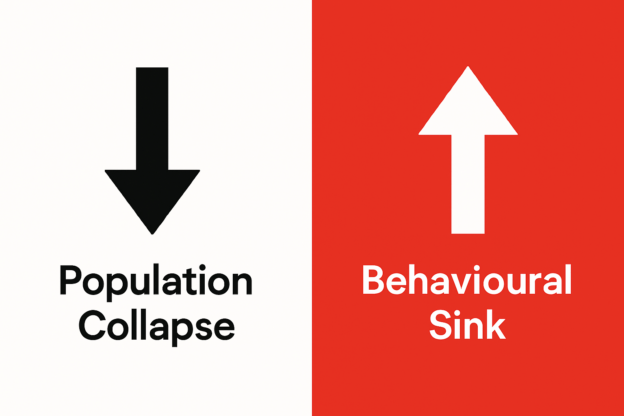
Modern societies face two anxieties that appear contradictory: fears of population collapse and fears of behavioural-sink-like social breakdown. This article shows that both can be true simultaneously because they operate on different dimensions: biological decline and functional overcrowding. By integrating demographic and psychosocial dynamics, it explains how civilisation can be both underpopulated and overwhelmed at the same time.
Prologue: Two Fears in One Century
In recent years, public debate has been shaped in no small part by Elon Musk’s warnings about two seemingly contradictory threats: population collapse and behavioural sink. On one hand, Musk argues that civilisation is sleepwalking into demographic decline: too few children, ageing societies, diminishing human potential. On the other hand, he points to the social dysfunction of overcrowded cities and digital life, invoking the spectre of a behavioural sink reminiscent of Calhoun’s early ethology experiments.
These fears appear incompatible. How can humanity be at risk of having too few people while simultaneously suffering the consequences of having too many: physically, psychologically, and digitally? Are we witnessing genuine structural problems, or is this simply the pattern of an anxious age, worrying for the sake of worrying?
The truth behind these tensions is neither trivial nor contradictory. The paradox emerges because both fears are rooted in different dimensions of human sociality. Population collapse concerns the biological reproduction of societies, while behavioural sink concerns the organisation and experience of social life under high functional density. Modern civilisation has inadvertently engineered conditions where both dynamics can coexist: shrinking populations embedded within environments that feel increasingly claustrophobic, competitive, and psychologically saturated.
Understanding how these two anxieties reflect deeper societal changes is not merely an exercise in resolving intellectual contradictions; it is essential to grasping the lived realities of 21st-century life.
Abstract
Across contemporary discourse, two seemingly contradictory social anxieties dominate: fears of a global population collapse driven by declining fertility, and concerns that advanced societies are succumbing to a behavioural sink, a pathological overcrowding dynamic first observed in ethological experiments. This article interrogates both concepts, clarifies their conceptual lineage, and resolves the apparent paradox. In doing so, it argues that modern societies experience simultaneous underpopulation and psychosocial saturation, not as opposites but as mutually reinforcing outcomes of technological modernity, urban concentration, and shifting socio-economic structures.
Contents
- Prologue: Two Fears in One Century
- Abstract
- Contents
- 1. Introduction
- 2. The Mechanics of Population Collapse
- 3. The Behavioural Sink Revisited
- 4. The Apparent Paradox: Too Many People or Too Few?
- 5. How These Dynamics Reinforce Each Other
- 6. The Dual Crisis of Modernity
- 7. Resolving the Paradox: A Unified Theory of Social Density
- 8. Conclusion
- References
1. Introduction
The 21st century presents a demographic paradox. On the one hand, economists, demographers, and technologists warn of a fertility freefall: accelerating below-replacement birth rates across the developed and, increasingly, the developing world. On the other hand, commentators invoke the spectre of John B. Calhoun’s “behavioural sink”, a phenomenon in which overcrowding precipitates severe social dysfunction in animal populations, implying that modern societies face breakdown due to excessive population density and social proximity.
These narratives appear mutually exclusive: How can a civilisation be both collapsing from too few people and imploding under too many?
The answer lies in recognising that these phenomena do not describe literal headcounts, but structural and psychological dynamics. Population collapse concerns the macro-scale replacement of generations, whereas behavioural sink concerns the micro-scale pathologies of social organisation under conditions of forced proximity, anonymity, and competition. Modern societies manage to experience both dynamics simultaneously due to specific features of post-industrial life: accelerated urbanisation, digitised sociality, economic centralisation, and the disintegration of traditional family structures.
In the following sections, we examine each dynamic in turn, beginning with the demographic forces reshaping the human future.
2. The Mechanics of Population Collapse
Before diving into the complex demographic forces shaping the 21st century, it helps to start with a simple picture. For most of human history, societies grew naturally: families had children, children became workers, workers became parents, and the cycle repeated. Growth was almost taken for granted.
But today, something unprecedented is happening. Even in times of peace and prosperity, many nations are shrinking. The decline is not sudden, dramatic, or catastrophic: it is quiet, unfolding through everyday decisions not to start families, or to have fewer children than previous generations.
This raises fundamental questions: What changed? Why did societies that once feared overpopulation suddenly begin fearing its opposite? And what hidden mechanisms are pushing so many countries toward demographic decline?
The answers reveal a slow, structural shift in how modern life is organised, leading us into the deeper analysis that follows.
2.1. Fertility Decline as a Global Trend
Most countries now fall below the replacement fertility rate of 2.1 children per woman. This includes:
- East Asia (Japan, South Korea, China)
- Europe broadly
- North America
- Increasingly, Latin America
- Urban zones of the Global South
The decline is driven by a convergence of factors:
- Urbanisation and high cost of living
- Education increases, especially among women
- Delayed marriage
- Labour market insecurity
- Housing scarcity
- Changing cultural values, emphasising autonomy
Unlike historical population declines due to disease or famine, the modern decline is voluntary, or more precisely, it is structurally incentivised by economic and social systems that render child-rearing burdensome.
2.2. Consequences of Population Collapse
The implications are profound:
- Shrinking labour forces
- Unfunded pension liabilities
- Collapsing consumer markets
- Decline in innovation and entrepreneurship
- Elevated geopolitical risk as young-population nations gain relative power
- Urban hollowing and rural extinction
In effect, population collapse creates a social vacuum: fewer interpersonal interactions, fewer family ties, and weakening community continuity.
3. The Behavioural Sink Revisited
If the idea of shrinking populations seems intuitive, our next subject appears to clash with it. At the same time many societies are having fewer children, people often report feeling more crowded, more stressed, and more socially compressed than ever. Cities overflow, commutes lengthen, and online spaces feel chaotic and overwhelming.
This emotional reality echoes a famous set of experiments from the mid-20th century, the “behavioural sink”, in which overcrowded animal habitats led to intense social dysfunction. Though humans are far more complex than the animals in those studies, the metaphor has persisted because many see troubling parallels in modern life.
But what exactly was the behavioural sink? And how can it apply to a world where populations are, paradoxically, shrinking? To understand this, we must revisit the concept with fresh eyes.
3.1. Understanding Calhoun’s Experiments
Calhoun’s classic “Universe 25” experiments on mice revealed that severe social pathologies, violence, sexual dysfunction, infanticide, withdrawal, and eventual extinction, arose from extreme population density and limited territorial autonomy.
The term “behavioural sink” described the collapse of normal social patterns under these conditions.
Critics correctly note that humans are not mice, but the experiments’ relevance lies in their social dynamics, not their biological specifics.
3.2. Human Crowding is Social, Not Spatial
Modern behavioural sink analogues emerge not from physical overcrowding but from functional overcrowding:
- Too many people competing for the same opportunities
- High anonymity within large populations
- Low individual agency in bureaucratic or hyper-regulated environments
- Parasitic attention economies (social media)
- Erosion of stable social roles
- Housing density without community cohesion
Thus, the behavioural sink in humans manifests not as literal crowding but as overloaded social systems, where individuals feel both surrounded and isolated.
4. The Apparent Paradox: Too Many People or Too Few?
At this point, the picture seems contradictory. How can a society fear both not enough people and too many people at the same time? On one side, economists warn of ageing populations and collapsing birth rates. On the other, cultural commentators lament overcrowded cities, intense competition, and social breakdown.
It feels as if we are living in two completely different worlds. One is emptying out; the other is bursting at the seams.
This contradiction is not a flaw in the argument, it’s a clue. It tells us that something more subtle is happening beneath the surface, something that can only be understood by examining how population numbers and lived human experience interact. Resolving this tension becomes the key to understanding the wider social dynamics of the 21st century.
The paradox dissolves when we recognise that population collapse and behavioural sink operate on different axes:
| Dynamic | Scale | Trigger | Outcome |
|---|---|---|---|
| Population Collapse | Macro (state, civilisation) | Demographic incentives and socio-economic structures | Fewer births, ageing society |
| Behavioural Sink | Micro/meso (urban environments, social networks) | Perceived crowding, anonymity, hyper-competition | Social dysfunction, psychological decline |
In other words:
Modern societies are demographically emptying while psychosocially saturating.
We are fewer in number but more densely layered in competition, visibility, noise, and expectation.
5. How These Dynamics Reinforce Each Other
Once we recognise that population decline and crowding dynamics are not opposites, the next question emerges naturally: how do they relate? Are they independent issues that merely coexist, or do they push and pull on each other in meaningful ways?
Modern life is shaped by multiple overlapping pressures: economic, technological, social, and psychological. What appears, at first, as two separate problems often turns out to be a single, interconnected system. A change in one sphere reverberates through the others.
Understanding how low birth rates and behavioural-sink-like pressures reinforce one another requires looking beyond simple cause-and-effect. It demands recognising the feedback loops that shape modern societies. The following section unpacks those mechanisms.
5.1. Urban Hyper-Density Discourages Childbearing
The behavioural sink mechanisms, anonymity, stress, noise, housing scarcity, directly reduce fertility. Urban zones consistently have the lowest birth rates globally. Individuals in high-stress, high-density environments:
- Postpone family formation
- Prioritise career stability
- Experience “social fatigue”
- Suffer from resource competition
5.2. Population Decline Amplifies Social Dysfunction
Ageing societies exhibit:
- Higher loneliness
- Reduced intergenerational interaction
- Weaker social norms
- Greater psychological distress
As community density decreases in meaningful relationships, behavioural sink-like pathologies actually increase due to lack of social scaffolding.
5.3. Technological Density Replaces Physical Density
Digital spaces compress social interaction beyond human evolutionary tolerance. The behavioural sink now operates through:
- perpetual online visibility
- comparison with global peers
- algorithmically magnified status competition
While physical populations shrink, digital populations explode, creating a permanent sense of overcrowding.
6. The Dual Crisis of Modernity
As the strands come together, a bigger picture emerges: a picture of a civilisation caught between two crises that mirror and magnify each other. One crisis is visible in the emptying classrooms, ageing populations, and shrinking towns. The other is felt in the daily experience of stress, fragmentation, and social overload.
These forces together form something more profound than either could achieve alone. They reshape relationships, economies, political systems, and cultural expectations. They alter how individuals see themselves and their future.
We are not witnessing isolated trends but a widespread transformation in how societies function. This dual crisis is the defining backdrop for many of the challenges facing the modern world. To understand its roots and implications, we must examine it as a combined phenomenon.
The interaction between low fertility and behavioural sink mechanisms creates a self-reinforcing dual crisis:
6.1. Social Hollowing
Communities lose functional cohesion as family formation collapses.
6.2. Psychological Saturation
Individuals feel overwhelmed by informational, economic, and bureaucratic density.
6.3. Institutional Inertia
Legacies of high-population eras persist (e.g., school systems, pension models), mismatched with shrinking generations.
6.4. Economic Misalignment
Hyper-urban economies designed for dense workforces collide with demographic contraction.
This duality is the signature demographic-psychological condition of late modernity.
7. Resolving the Paradox: A Unified Theory of Social Density
Having explored the demographic and psychological currents shaping modern life, we now arrive at the central challenge: making sense of it all in a coherent framework. How can societies feel simultaneously empty and overcrowded? How do individuals become more isolated even as they live in closer physical or digital proximity?
A unified explanation requires stepping back from individual symptoms and examining the underlying structures that shape human sociality. It means distinguishing between biological populations and functional populations, between the number of people and the intensity of their interactions.
Only by integrating these perspectives can we resolve the paradox and propose a conceptual model that explains the dual pressures of modernity. The next section offers that synthesis.
To resolve the tension between the two narratives, we introduce the concept of differential social density:
It is possible for a society to experience low biological density (few births, ageing population) while experiencing high functional density (intense competition for status, resources, and attention).
Low biological density → fewer families, fewer children
High functional density → crowded urban centres, economic pressure, bureaucratic complexity, digital overload
These forces produce a “V-shaped collision”:
- The biological system trends toward emptiness
- The social system trends toward chaos
Both stem from misalignment with evolved human social structures.
8. Conclusion
The coexistence of population collapse and behavioural-sink dynamics ultimately challenges our assumptions about what thriving human societies look like. It forces us to confront the possibility that modernity has decoupled the quantitative aspects of human life, how many of us there are, from the qualitative experience of being human: how we live, connect, and find meaning. If civilisation is to avoid the twin pitfalls of demographic implosion and psychosocial breakdown, it must rebuild environments that support both human flourishing and human continuity. The future depends not on optimising society for growth or for efficiency alone, but on restoring a balance between the biological, social, and psychological dimensions of human existence.
The fear of population collapse and the fear of a behavioural sink reflect distinct but interlocking modern pressures. Rather than contradictory, they are symptoms of the same underlying transformation: the compression of human sociality by urbanisation, technology, and post-industrial economic structures.
Modern individuals live in worlds that are:
- Underpopulated biologically
- Overcrowded psychologically
- Under-connected communally
- Over-stimulated informationally
Understanding this duality is essential for designing effective public policy, urban planning, social technologies, and economic incentives that realign modern life with human needs.
The future of civilisation depends on resolving this tension: creating environments conducive to both human flourishing and sustainable reproduction. In reconciling these twin pressures, we may finally learn what kind of world human beings are meant not just to inhabit, but to thrive in.
References
Calhoun, J. B. (1962). Population density and social pathology. Scientific American, 206(2), 139–148.
Calhoun, J. B. (1973). Death Squared: The Explosive Growth and Demise of a Mouse Population. Proceedings of the Royal Society of Medicine, 66(1), 80–88.
Coleman, D. (2006). Immigration and ethnic change in low-fertility countries: A third demographic transition. Population and Development Review, 32(3), 401–446.
Davis, K. (1937). Reproductive Institutions and the Pressure for Population. The American Journal of Sociology, 43(1), 19–27.
Eberstadt, N. (2010). Demographic Winter: The Global Decline in Fertility. Foreign Affairs, 89(6), 54–64.
Frey, W. H. (2018). Diversity Explosion: How New Racial Demographics are Remaking America. Brookings Institution Press.
Harari, Y. N. (2014). Sapiens: A Brief History of Humankind. London: Harvill Secker. (Useful for historical context on population expansion and social structuring.)
Klinenberg, E. (2012). Going Solo: The Extraordinary Rise and Surprising Appeal of Living Alone. Penguin Books.
Lee, R. (2003). The Demographic Transition: Three Centuries of Fundamental Change. Journal of Economic Perspectives, 17(4), 167–190.
Lesthaeghe, R. (2010). The unfolding story of the second demographic transition. Population and Development Review, 36(2), 211–251.
McDonald, P. (2000). Gender Equity in Theories of Fertility Transition. Population and Development Review, 26(3), 427–439.
Musk, E. (2022–2025). Public statements on population collapse and demographic decline. Interviews and commentary via Twitter/X, Tesla shareholder meetings, and public talks.
Putnam, R. D. (2000). Bowling Alone: The Collapse and Revival of American Community. Simon & Schuster.
Sassen, S. (2001). The Global City: New York, London, Tokyo. Princeton University Press.
Turkle, S. (2011). Alone Together: Why We Expect More from Technology and Less from Each Other. Basic Books.
United Nations Department of Economic and Social Affairs (UN DESA) (2022). World Population Prospects. United Nations.
World Bank (2023). Population, Fertility, and Urbanisation Statistics. World Development Indicators.