Ontological Desynchronisation offers a compelling synthesis of demographic, behavioural, and algorithmic dynamics to explain contemporary societal fragility. Building on reproductive desynchronisation and behavioural sink theory, it introduces ontological capture as a missing mechanism linking algorithmic governance to population collapse and civic erosion. The article is strongest in showing how temporal compression undermines judgement, coordination, and intergenerational continuity. While some remedies remain aspirational, the framework is original, integrative, and strategically valuable, reframing collapse not as decline in numbers alone but as a failure of shared time, attention, and becoming.
Executive Summary (TL;DR)
Contemporary population and civic crises are not only about declining birth rates, economic stress, or technology misuse. They are failures of synchronisation across time. This article shows how three processes converge: reproductive desynchronisation (misaligned life and fertility timing), behavioural sink dynamics (stress-driven social breakdown), and ontological capture (algorithmic compression of attention, judgement, and shared time). Together, they erode the conditions for pairing, institution-building, and intergenerational continuity. Collapse is thus reframed as a loss of shared temporality rather than numbers alone. Resilience lies not in universal re-synchronisation or blind adaptation, but in selectively preserving shared temporal frameworks where their loss becomes irreversible. This perspective does not reject adaptation to the new normal; it argues for adaptive fluidity where possible, combined with deliberate protection of the few shared temporal structures without which collective coordination, reproduction, and governance cannot persist.
Contents
- Executive Summary (TL;DR)
- Contents
- Abstract
- 1. Introduction: A Crisis of Timing, Attention, and Being
- 2. Reproductive Desynchronisation and the Missing Mechanism in Population Collapse
- 3. The Behavioural Sink: Social Stress, Density, and Collapse
- 4. Ontological Capture and Algorithmic Desynchronisation: A Critical Engagement
- 5. Ontological Capture: Algorithmic Governance and the Erosion of Shared Time
- 6. A Unified Framework: Desynchronisation Across Scales
- 7. Ontological Desynchronisation and Population Collapse
- 8. From Collapse to Resilience: Re-Synchronising Systems
- 9. Conclusion
- 10. References
Abstract
Contemporary societies face multiple forms of desynchronisation: physiological, social, and cognitive; that destabilise both population and civic life. While demographic research highlights reproductive desynchronisation and the behavioural sink as mechanisms of population collapse, burgeoning work on algorithmic governance reveals an under-acknowledged driver of collective disengagement: ontological capture. Algorithmic infrastructures reshape attention, temporality, and judgment, eroding not only social coordination but the very conditions necessary for civic being. This article develops a unified framework of desynchronisation that integrates biological, behavioural, and algorithmic dynamics, offering a novel lens for understanding collapse and resilience in complex social systems. Understanding desynchronisation as a multi-scale phenomenon opens new pathways for resilience—not through universal re-synchronisation, but through selective preservation of shared temporal frameworks where loss becomes irreversible.
Keywords: desynchronisation, population collapse, behavioural sink, algorithmic governance, ontological capture, resilience, civic temporality
1. Introduction: A Crisis of Timing, Attention, and Being
Population collapse research often focuses on fertility rates, socio-economic stressors, and ecological constraints.
Two mechanisms remain under-theorised. The first is reproductive desynchronisation: the temporal misalignment of fertility windows and socio-sexual opportunity structures that reduces coupling, kin formation, and generational continuity. The second is the behavioural sink: the collapse of social behaviour under sustained density and stress, first observed in animal populations but increasingly evident in human urban and digital environments.
Both mechanisms share a core: synchronisation failure — the inability of individuals and groups to align their behaviours across time and space. This paper argues that a third layer — ontological desynchronisation induced by algorithmic governance — interacts with and amplifies these dynamics, disrupting collective timing, attention, and civic coordination.
2. Reproductive Desynchronisation and the Missing Mechanism in Population Collapse
Reproductive desynchronisation refers to the breakdown in temporal overlap of fertility windows and socio-sexual opportunity structures in a population. Unlike purely economic or cultural explanations for declining birth rates, desynchronisation emphasises collective timing — when individuals are biologically and socially positioned to reproduce simultaneously with others.
The effect mirrors phenomena seen in synchronised systems like cicada emergences or coordinated bird migrations: when timing breaks down, interactions diminish, and system integrity collapses. This mechanism is absent from prevailing models of demographic decline, yet it offers explanatory power for population collapse beyond conventional socio-economic metrics.
Reproductive synchrony is not just biological but social — contingent on shared rhythms of courtship, pairing, and reproduction. Asynchrony therefore undermines one of the most fundamental collective processes: intergenerational continuity.
3. The Behavioural Sink: Social Stress, Density, and Collapse
First identified in overcrowded animal populations, the behavioural sink describes how social stress and high density produce significant behavioural changes. Under these conditions, populations exhibit withdrawn behaviour, increased aggression and fragmentation, and the breakdown of normative social interaction.
In humans, behavioural sink dynamics can be found in overcrowded urban environments, competitive labour markets, and digitised social spaces — all arenas where stress compresses behaviour toward reactivity rather than cooperation.
The human behavioural sink is not purely a function of physical density but of social attentional collapse — where individuals become less able to coordinate, empathise, and act collectively. It lowers the threshold for social failure.
4. Ontological Capture and Algorithmic Desynchronisation: A Critical Engagement
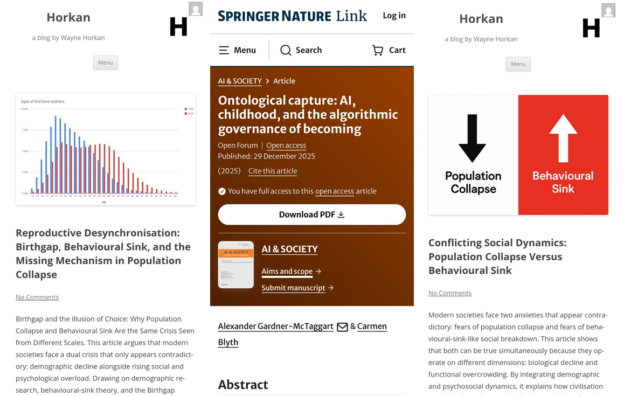
A recent intervention by Gardner-McTaggart and Blyth, Ontological capture: AI, childhood, and the algorithmic governance of becoming (AI & Society, 2025), offers one of the most philosophically rigorous accounts to date of how algorithmic systems reshape not only behaviour but the conditions of becoming itself. Their argument is not that AI merely mediates social life, but that predictive infrastructures reconstitute attention, temporality, and judgement in ways that fundamentally alter civic formation—particularly in childhood and education.
The paper traces how algorithmic governance compresses time into machinic rhythms of instant feedback, optimisation, and pre-emption. Drawing on Anders, Baudrillard, and Debord, the authors argue that this produces what they term the algorithmic citizen: a subject habituated to obedience by design rather than coercion, where disobedience is foreclosed before it can be conceived. Education, under these conditions, becomes a site of ontological capture rather than human formation, with writing, learning, and civic participation increasingly reduced to transactional performances for machines rather than dialogical encounters with others.
In response, the authors propose stewardship leadership and a set of pedagogical practices—silence, non-instrumental play, arts-based work, ecological embeddedness, and embodied storytelling—as forms of ontological repair. Their core claim is stark: AI in education is not a technical issue to be optimised, but a societal and ontological problem concerning what kinds of subjects, relations, and futures are being produced.
The ontological capture argument rests on several core claims:
4.1 Key claims of the ontological capture argument
- Algorithmic systems do not merely influence behaviour; they reshape the ontological conditions of attention, judgement, and becoming.
- Governance has shifted from disciplinary control to anticipatory pre-emption, producing obedience by design.
- Predictive systems compress temporal depth, undermining deliberation, ethical uncertainty, and civic imagination.
- Education risks becoming simulation rather than formation, with writing and learning transformed into machine-oriented performance.
- Resistance requires stewardship, care, and the reclamation of time, presence, and relational depth.
4.2 What this analysis gets right (and what we agree with)
The ontological capture framework is compelling, and this paper aligns with it on several critical points.
First, the authors are right to locate AI governance at the level of temporality and ontology, rather than treating it as a neutral tool layered onto existing social structures. The compression of time into predictive feedback loops is not incidental; it directly erodes the conditions under which judgement, commitment, and collective coordination emerge.
Second, the concept of obedience by design accurately captures a contemporary shift in governance logic. Where earlier systems disciplined after deviation, algorithmic systems increasingly pre-empt deviation altogether. This matters because it reshapes not only action but the horizon of possibility—what can even be imagined as an alternative.
Third, the analysis of writing as thinking, and of education as a relational, temporal practice rather than an output function, is persuasive. When the reader is a machine rather than another human, the ethical contract underpinning learning collapses into performance.
Finally, the paper correctly identifies that these dynamics are not confined to education. They are symptomatic of broader transformations in law, work, governance, and civic life under predictive systems.
4.3 Where the argument is incomplete or where we diverge
While persuasive, the ontological capture framework also has limitations that matter strategically.
First, the analysis tends toward totalisation. Ontological capture is presented as near-ubiquitous, risking an impression of comprehensive enclosure. In practice, algorithmic capture is uneven, stratified, and contested. Children, teachers, and institutions do not merely submit; they adapt, subvert, misuse, and repurpose systems in ways that matter for resilience.
Second, the proposed responses—while ethically rich—remain largely pedagogical and individual. Stewardship, silence, and play are vital, but they do not, on their own, address the structural and systemic conditions under which algorithmic governance operates: procurement regimes, institutional incentives, regulatory gaps, and population-scale dynamics.
Third, the framework underplays how algorithmic temporal compression interacts with biological and demographic processes. Ontological capture explains a collapse of attention and judgement, but it does not fully account for how this collapse feeds into reproductive behaviour, partnership formation, or long-term population dynamics.
These gaps do not invalidate the analysis; they point to the need for integration across scales.
4.4 Strategic implications if ontological capture is correct
If the ontological capture thesis is broadly accurate, several strategic consequences follow that cannot be ignored:
- Population dynamics are indirectly affected: temporal fragmentation and attentional collapse undermine the conditions for stable pair-bonding, family formation, and intergenerational continuity.
- Civic resilience is weakened: societies optimised for responsiveness rather than deliberation struggle to coordinate under stress or plan across generations.
- Risk governance itself becomes brittle: predictive systems that erode judgement ultimately undermine the human capacity required to intervene when models fail.
- Desynchronisation becomes systemic: biological, social, and cognitive rhythms drift out of alignment, increasing the likelihood of collapse rather than adaptation.
If the ontological capture thesis is broadly accurate, several strategic consequences follow. Population dynamics are indirectly affected as temporal fragmentation undermines stable pair-bonding, family formation, and intergenerational continuity. Civic resilience weakens as societies optimised for responsiveness struggle to deliberate, coordinate, and plan under stress. Risk governance becomes brittle as predictive systems erode the human judgement required to intervene when models fail. Together, these dynamics render desynchronisation systemic, increasing the likelihood of collapse rather than adaptation.
These are not merely educational concerns; they are civilisational ones.
4.5 How this paper incorporates and extends ontological capture
This paper incorporates the ontological capture argument by situating it within a broader framework of multi-scale desynchronisation.
Where ontological capture identifies a collapse of civic and cognitive temporality, this work connects that collapse to:
- Reproductive desynchronisation, where misaligned life rhythms reduce opportunities for pairing and reproduction.
- Behavioural sink dynamics, where stress and density degrade social coordination.
- Population-level outcomes, where these processes compound rather than operate independently.
Ontological capture thus becomes not a standalone diagnosis, but a missing mechanism linking algorithmic governance to demographic and societal instability. Rather than framing resistance solely as ethical refusal or pedagogical repair, this paper reframes the challenge as one of re-synchronisation: restoring shared temporal frameworks across biological, social, and civic domains.
In this sense, ontological capture is neither rejected nor romanticised. It is incorporated as a critical explanatory layer—necessary but insufficient on its own. The task is not to escape algorithmic systems, but to govern them in ways that preserve temporal depth, relational capacity, and collective coordination at scale.
This reframing extends ontological capture beyond a critique of subject formation, positioning it as a system-level mechanism within population dynamics and resilience theory.
5. Ontological Capture: Algorithmic Governance and the Erosion of Shared Time
Having situated ontological capture through recent scholarship, we now return to the broader question of how algorithmic governance reorganises shared time across social systems. The concern here is not education alone, but the way predictive infrastructures recalibrate civic temporality itself—reshaping how societies coordinate attention, judgement, and long-term action.
Algorithmic governance — from recommendation engines to predictive feedback — does more than mediate experience; it reorganises the temporality of daily life, compressing attention and foreclosing shared rhythms. The result is not only behavioural distortion but temporal fragmentation:
- Rhythm → real-time optimisation
- Duration → instant feedback loops
- Shared horizon → personalised prediction
Where reproductive desynchronisation disrupts biological timing and behavioural sinks disrupt social coordination, ontological capture disrupts civic temporality — the shared sense of time necessary for collective action, deliberation, and long-term planning.
6. A Unified Framework: Desynchronisation Across Scales
The three mechanisms inhabit different domains but converge on a common process: the collapse of shared temporal frameworks.
| Mechanism | Domain | Loss |
|---|---|---|
| Reproductive Desynchronisation | Biological / Social | Intergenerational continuity |
| Behavioural Sink | Social / Behavioural | Collective interaction norms |
| Ontological Capture | Cognitive / Civic | Shared attention & judgement |
Together, these mechanisms show how failures of synchronisation at biological, social, and cognitive scales converge on a shared loss of collective temporality. They produce a multi-layered desynchronisation that undermines both demographic stability and civic resilience.
7. Ontological Desynchronisation and Population Collapse
Population dynamics are not reducible to birth rates and mortality. They depend on patterns of interaction, social coordination, and collective meaning.
These dynamics are not merely abstract. Contemporary dating platforms, algorithmically optimised for engagement rather than pairing stability, fragment attention and compress relational horizons, reducing opportunities for durable partnership formation. Similarly, attention economies built around continuous partial engagement degrade the sustained interaction required for bonding, caregiving, and intergenerational commitment. While each system is locally adaptive, their combined effect is a reduction in the temporal conditions under which families and institutions can form and persist.
Similar dynamics appear in contemporary institutional and governance contexts. Algorithmic management systems in workplaces and public administration prioritise continuous responsiveness, metric compliance, and short feedback cycles, reducing the temporal space required for judgement, mentoring, and institutional memory. While such systems improve short-term efficiency, they erode the conditions under which expertise, responsibility, and long-horizon decision-making can accumulate. Over time, this produces brittle institutions that function under stable conditions but fail under stress.
Ontological desynchronisation contributes by:
- Short-circuiting shared attention windows necessary for social bonding and partnership formation.
- Encouraging temporal fragmentation, making long-term commitments — including family formation — less stable.
- Normalising responsiveness over reflection, reducing capacities for sustained relational engagement.
Ontological desynchronisation contributes by short-circuiting shared attention windows necessary for social bonding and partnership formation, encouraging temporal fragmentation that destabilises long-term commitments, and normalising responsiveness over reflection, thereby reducing capacities for sustained relational engagement.
These effects have demographic consequences. When civic and social temporality is compressed into personalised, instantaneous feedback loops, the conditions under which people meet, commit, and raise children change fundamentally.
8. From Collapse to Resilience: Re-Synchronising Systems
Addressing desynchronisation requires intervention at multiple levels, not to restore synchrony universally, but to prevent desynchronisation from crossing irreversibility thresholds in critical social systems.
8.1 Biological & Social Synchrony
Interventions at this level include policies that support shared life rhythms—such as work–life alignment, communal activity, and fertility support systems—as well as urban design that fosters sustained in-person interaction.
- Policies that support shared life rhythms (work–life alignment, communal activities, fertility support systems)
- Urban design that fosters in-person interaction
8.2 Behavioural Norms and Stress Management
Reducing social density stress through equitable resource distribution and promoting public spaces that encourage collective engagement can lower behavioural sink pressures and restore social coordination.
- Reducing social density stress via equitable resource distribution
- Promoting public spaces that foster collective engagement
8.3 Ontological Repair
Drawing on critical work in education and civic formation, we propose:
- Reclaiming duration over immediacy
- Cultivating shared attention practices (analog spaces, arts, ecological engagement)
- Reframing technology not as governance but as a partner within shared temporal frames
These practices resist algorithmic compression and restore temporal depth necessary for collective life.
8.4 Re-synchronisation, Adaptation, and Threshold Management
It is important to clarify what is meant by re-synchronisation in the context of contemporary societies. A return to fully shared temporal rhythms across entire populations is unlikely under current economic, technological, and political conditions. Large-scale re-synchronisation historically occurs only following severe systemic shock, not through incremental reform.
Equally, however, adaptation to the so-called “new normal” is not neutral. Much of what is framed as adaptation today consists of deeper alignment with algorithmic optimisation: increased responsiveness, shortened horizons, individualised timing, and predictive governance. From a systems perspective, this represents maladaptive specialisation: improving short-term efficiency at the cost of long-term resilience.
The viable path, therefore, is neither full restoration nor uncritical adaptation, but selective and bounded re-synchronisation. This entails preserving shared temporal frameworks in domains where desynchronisation becomes terminal, such as reproduction, civic deliberation, and institutional judgement, while tolerating or even exploiting desynchronisation in less critical domains. Re-synchronisation, in this sense, is not a nostalgic project but a form of threshold management: preventing losses of synchrony from crossing points of irreversibility.
9. Conclusion
Modern complexity demands syntheses across biological, behavioural, and cognitive domains. Population collapse is not solely a matter of fertility statistics; it is a failure of synchronization — in bodies, societies, and minds.
Ontological capture reveals a deeper mechanism: the erosion of shared temporality itself. When time is atomised, collective becoming falters, and systems tip toward disintegration.
This reframing also clarifies the limits of adaptation. While human systems are highly adaptable, not all adaptations support persistence. Adaptation that further compresses time, fragments attention, and individualises coordination may increase short-term survivability while undermining reproduction, governance, and intergenerational continuity. The distinction between resilience-aligned adaptation and extinction-aligned adaptation is therefore critical. The question is no longer whether societies can adapt, but which forms of adaptation they can survive.
This is not an argument against adaptation to technological or social change. It is an argument for adaptive fluidity with constraints: allowing systems, institutions, and individuals to flow with new conditions where possible, while actively stabilising the shared temporal foundations—of care, commitment, judgement, and intergenerational continuity—on which collective life depends.
Understanding desynchronisation as a multi-scale phenomenon opens new pathways for resilience — grounded not in optimisation or prediction, but in reviving shared rhythms, relational depth, and democratic temporality.
10. References
- Gardner-McTaggart, A., & Blyth, C. (2025). Ontological capture: AI, childhood, and the algorithmic governance of becoming. AI & Society. https://doi.org/10.1007/s00146-025-02807-8
- Horkan, W. (2025). Reproductive desynchronisation, birthgap, behavioural sink and the missing mechanism in population collapse. https://horkan.com/2025/12/20/reproductive-desynchronisation-birthgap-behavioural-sink-and-the-missing-mechanism-in-population-collapse
- Horkan, W. (2025). Conflicting social dynamics: population collapse versus behavioural sink. https://horkan.com/2025/12/03/conflicting-social-dynamics-population-collapse-versus-behavioural-sink