A personal reflection on decades of role-playing games, Warhammer, and kitbashing, exploring a lifelong love of Exodite Eldar, space elves, dragons, and the creative joy of building armies by hand, set against the wider cultural moment where Warhammer 40,000 has finally become something people are proud to admit they love.
I have always loved elves.
I have always loved dragons.
And I have always loved the particular alchemy that happens when ancient myth collides with absurdly advanced technology.
That combination, space elves with lost sciences and living dragons, is why I kitbashed an Exodite army, and why I still love them so much.
The Exodites sit at a strange, beautiful intersection of traditions. They are Eldar (or Aeldari, if we’re being modern about it), but they are also something older, wilder, and more mythic. They are the Eldar that left before the Fall, rejecting the decadence that would eventually birth Slaanesh. They saw where things were going and opted out.
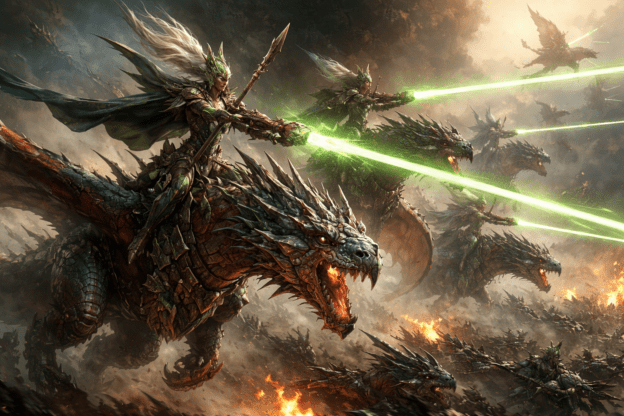
They fled to the edges of the galaxy, to harsh, sparsely populated worlds deliberately chosen for their hostile megafauna, worlds where Exodites bonded with native dragon-beasts rather than trying to dominate them. Worlds with dragons on them, because yes, that is objectively cool, and it allows you to kitbash dinosaurs, dragons, and cavalry into something glorious.
Elves ❤️
Dragons ❤️
Honestly, what more do you need?
Pssst: This article was inspired by meeting the Head of Information Security from Games Workshop at one of Lisa Ventura’s wonderful Cyber Lunch Hour meetings (which I highly recommend, many thanks for having me, BTW).
Moorcock, Eldar, and Dragons
My affection for Exodites isn’t just a Warhammer thing, it runs deeper into the fantasy and science-fantasy traditions that shaped me.
Michael Moorcock looms large here. His elves are never just Tolkienian forest dwellers; they’re alien, tragic, ancient, and morally complicated. Races like the Vadhagh, the Eldren, and Melnibonéans, feel like spiritual ancestors of the Eldar… beings of immense power and history, carrying memory and guilt like a weapon as the universe grinds on around them.
That lineage matters. Exodites feel like Moorcock elves who took one look at galactic decadence and said nope, grabbed their world-spirits, bonded with dragons, and rode out to the margins to build something quieter, harder, and truer.
Growing Up with Dice, Dragons, and Lead Miniatures
I started role-playing games around the age of about 12, back in 1982. It was Tunnels & Trolls, Dungeons & Dragons, then Advanced D&D, Traveller, MERP (and RoleMaster), Call of Cthulhu, Paranoia; joy! Just good old stuff. Dice, notebooks, bad lighting, and very late nights.
Around figures and figurines, it was always Warhammer. Back in the day it was more Warhammer aka Warhammer Fantasy than Warhammer 40,000 at first. Games Workshop figures were metal then… single blister packs. Heavy little things. You didn’t customise kits because there weren’t really kits. You filed, pinned, glued, and hoped.
I’ve been using Games Workshop since the very beginning, and I’ve been using their figures since they were single metal kits. Even before the blister packs… little draws full of metal figures sparkling like exotic jewels.
Family Armies and Coming Back to Exodites
When I had my three boys, Andy, Joe, and Bill, Warhammer became something we shared.
We all had different armies. Andy had Chaos Space Marines and Daemons, a proper mixed bag of wonderfully heretical nonsense. Joe had Grey Knights. Bill had Necrons. And I had Exodites.
Exodites are a sub-faction of the Eldar, and they’re never really fully supported in neat, boxed-set ways. That’s part of the appeal. If you want Exodites, you build them. You kitbash. You invent. You steal bits from everywhere and make something that feels right.
Kitbashing and Making It Your Own
Kitbashing is where the hobby really becomes art.
One of the things I kitbashed was a Grey Knight character who summons the dead, Grand Master Vorth Mordrak, except it wasn’t necromancy, because that would be heresy. It was more a psychic echo: a powerful psychic presence acting as an anchor for astral remnants of fallen warriors, manifesting as ghostly figures on the battlefield. Transparent, spectral, unmistakably not meant to be there… and all the cooler for it.
Over time, I got fairly serious about the craft. This wasn’t just brushes anymore. I had proper kit: an airbrush, a spray gun, compressors, all that mad stuff. Layering, blending, effects. It stopped being “painting toy soldiers” and became a genuine practice.
Good times.
Everyone Suddenly Admitting They Love 40K
One of the more amusing things in recent years has been watching everyone and their dog come out of the woodwork to admit they love Warhammer 40,000. Actors, musicians, tech people… suddenly it’s fine to say it out loud. Henry Cavill being openly, unapologetically into 40K felt like a cultural permission slip. The thing many of us loved quietly in garages, spare rooms, and hobby shops turned out to be something a lot of very visible, very serious people loved too.
Why Exodites Still Matter
Exodites represent resistance through restraint. They are technologically advanced beyond comprehension, yet choose to live closer to the land. They bond with dragons instead of ruling over machines. They remember what was lost—and refuse to repeat it.
In a universe obsessed with escalation, excess, and annihilation, Exodites choose something else.
They choose tradition.
They choose survival.
They choose dragons.
And honestly, that’s why I’ll always love them.
Good times.